Can you vibe code your own Sigma alternative? Why AI plus a data warehouse is not enough

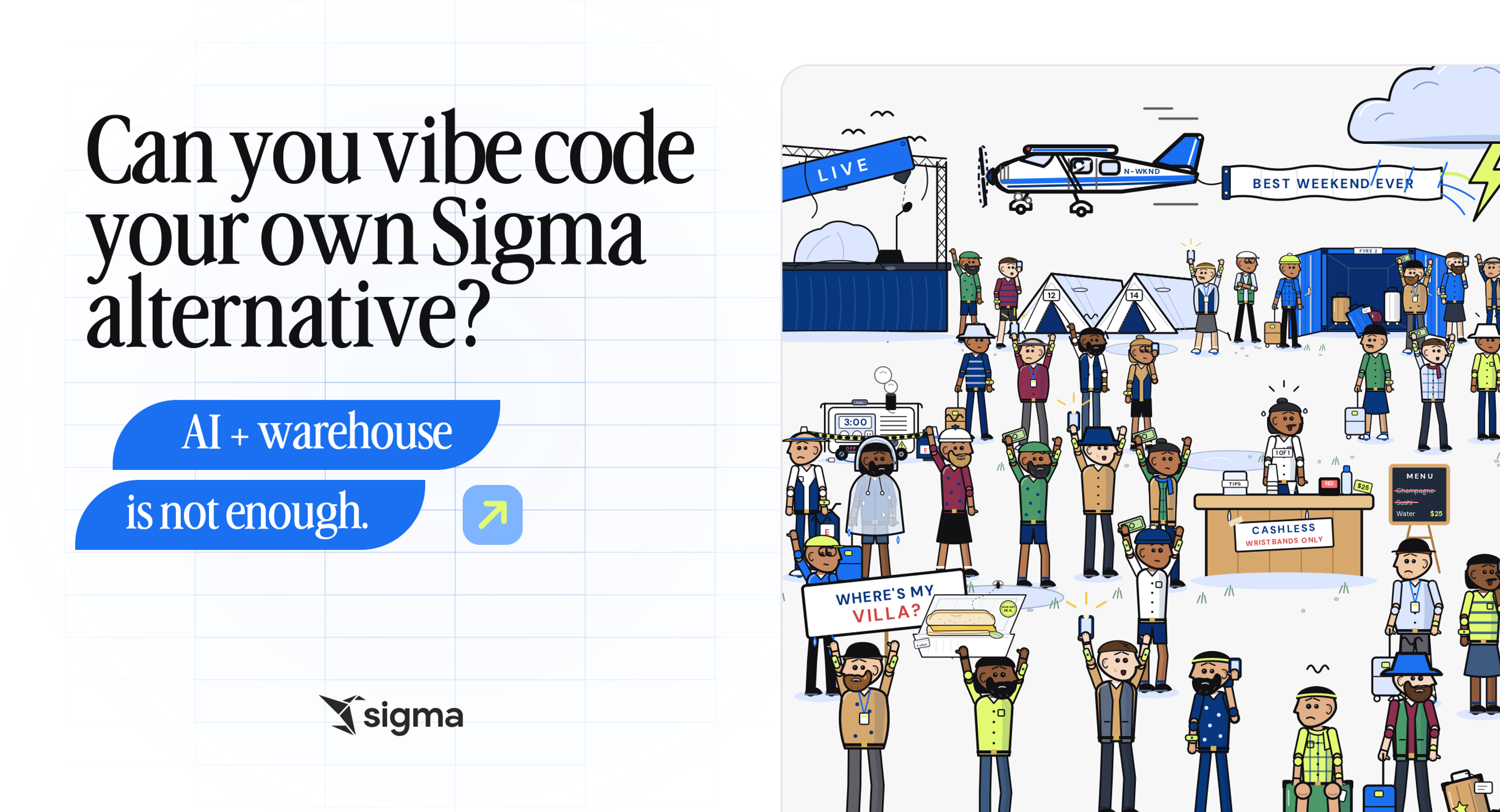
Tyler Denk, who runs beehiiv, posted something last week that made me laugh, mostly because I recognized it. People keep telling him they will vibe code their own beehiiv over a weekend, so he published the backlog they would need to finish first, from inbox deliverability to a support team, and closed by noting that at least they would save the monthly fee.
I get the Sigma version of that conversation every week, usually from a smart data leader who has already pointed an AI model at the warehouse and liked what came back: "I have a model and a warehouse. Why do I need a platform?" It is a fair question, and the honest answer has nothing to do with the initial build being bad, because it usually is not. That first version, which is basically a dashboard, works fine on day one. The trouble starts once other people depend on it.
Can you vibe code an analytics app on your data warehouse?
I will concede the part most vendors avoid. Building software has become cheap, close to free in a lot of cases, and a model can write the query and wire up a decent-looking app in a couple of hours—or minutes. For a person asking one question of a well-designed data schema they already understand, that may be all they need (I have done it myself, and I enjoyed it).
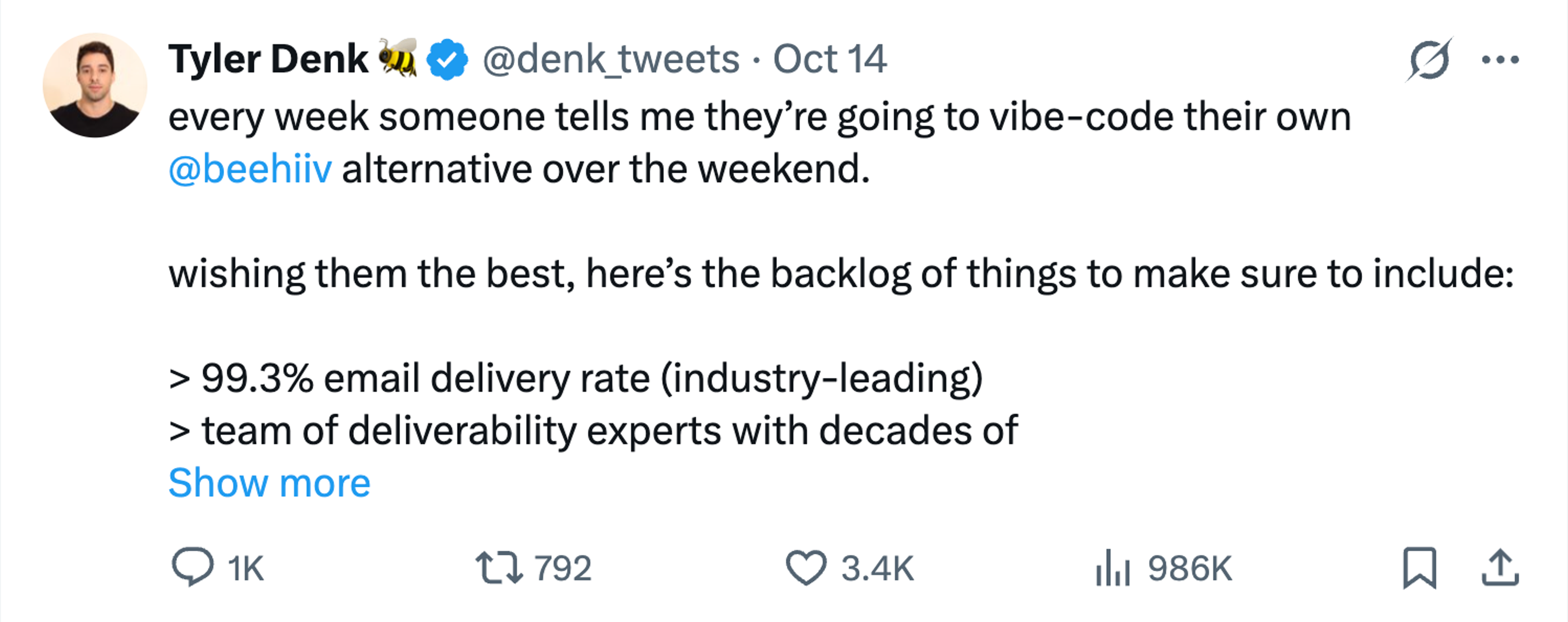
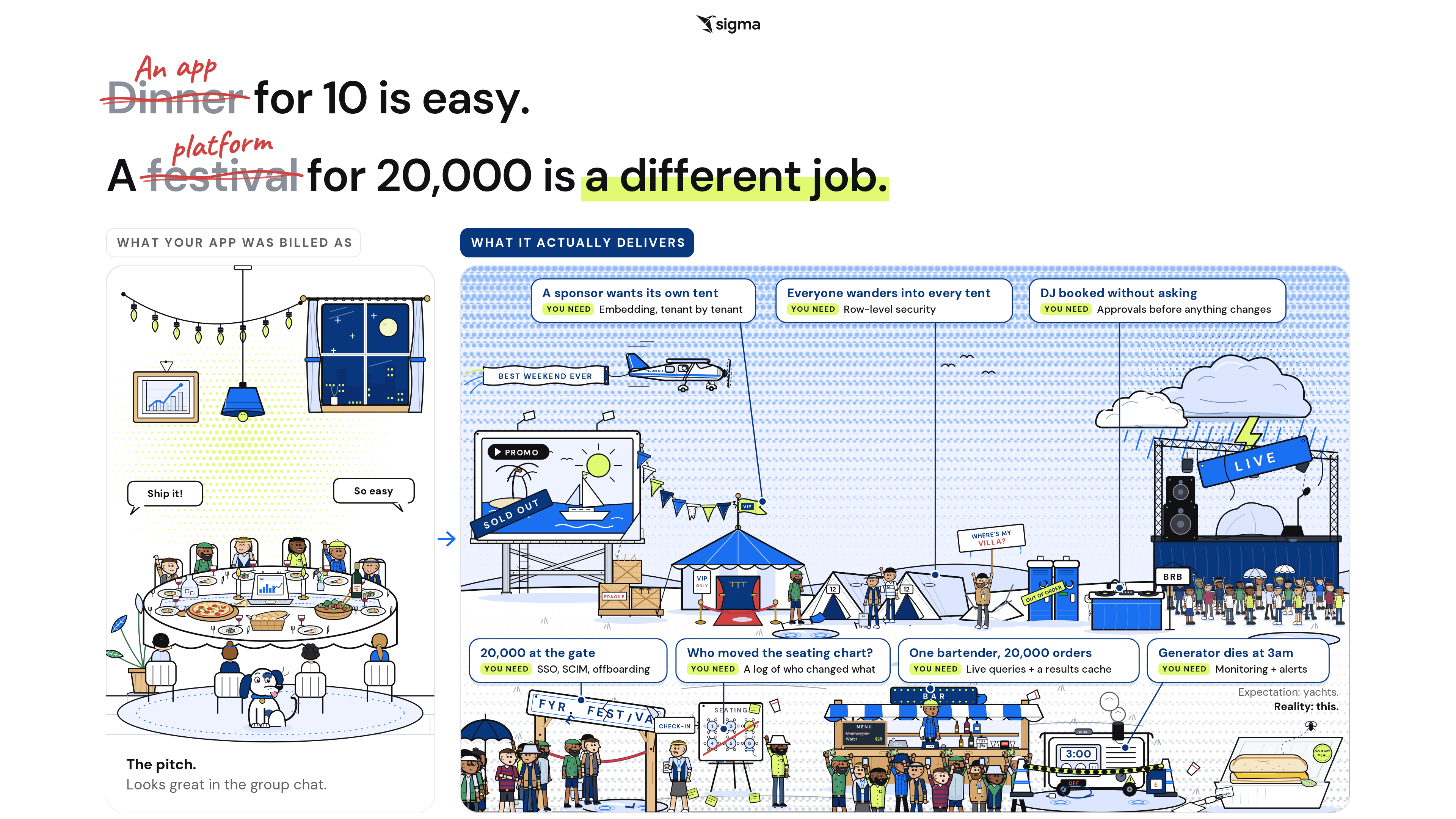
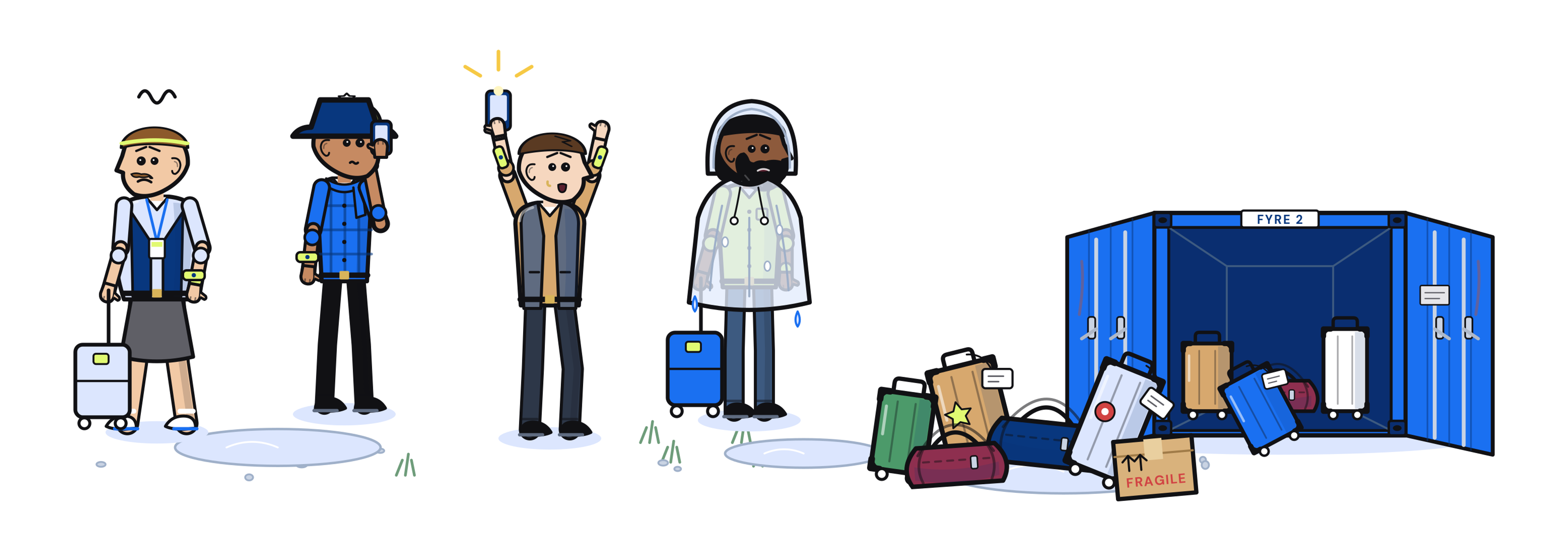
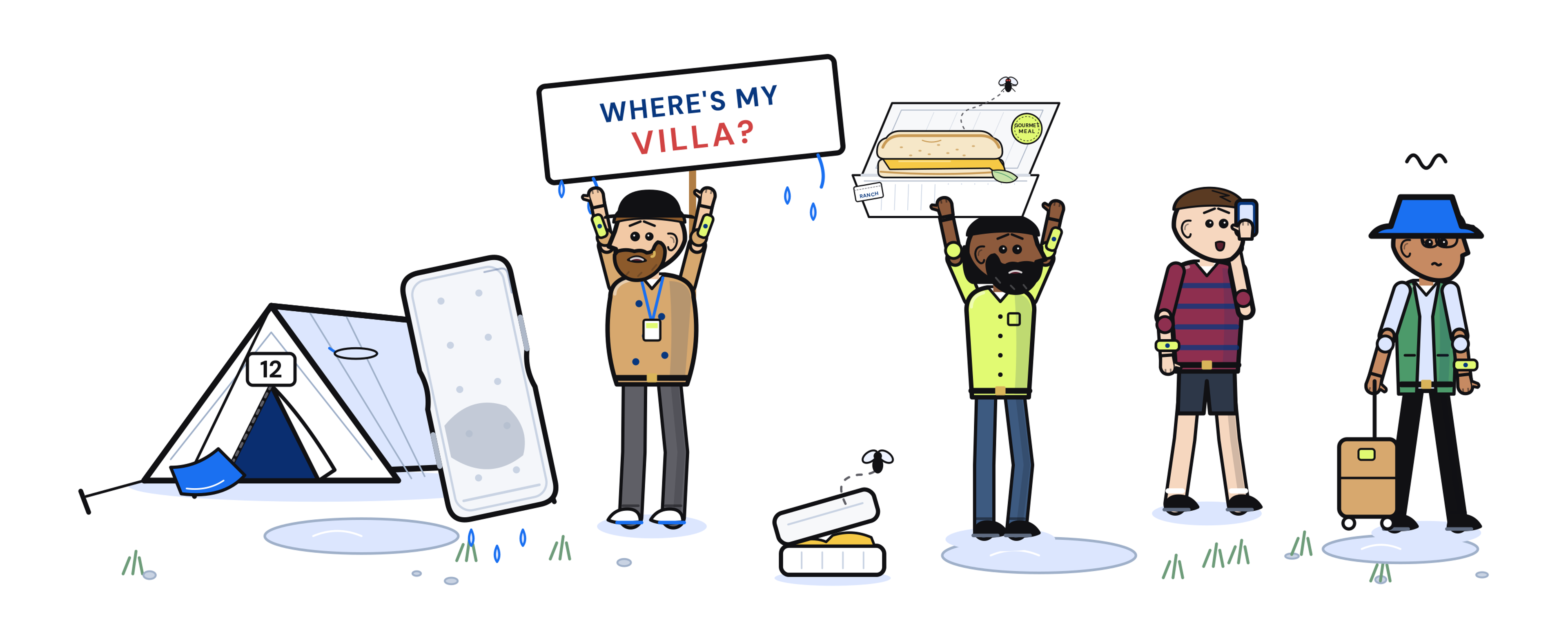
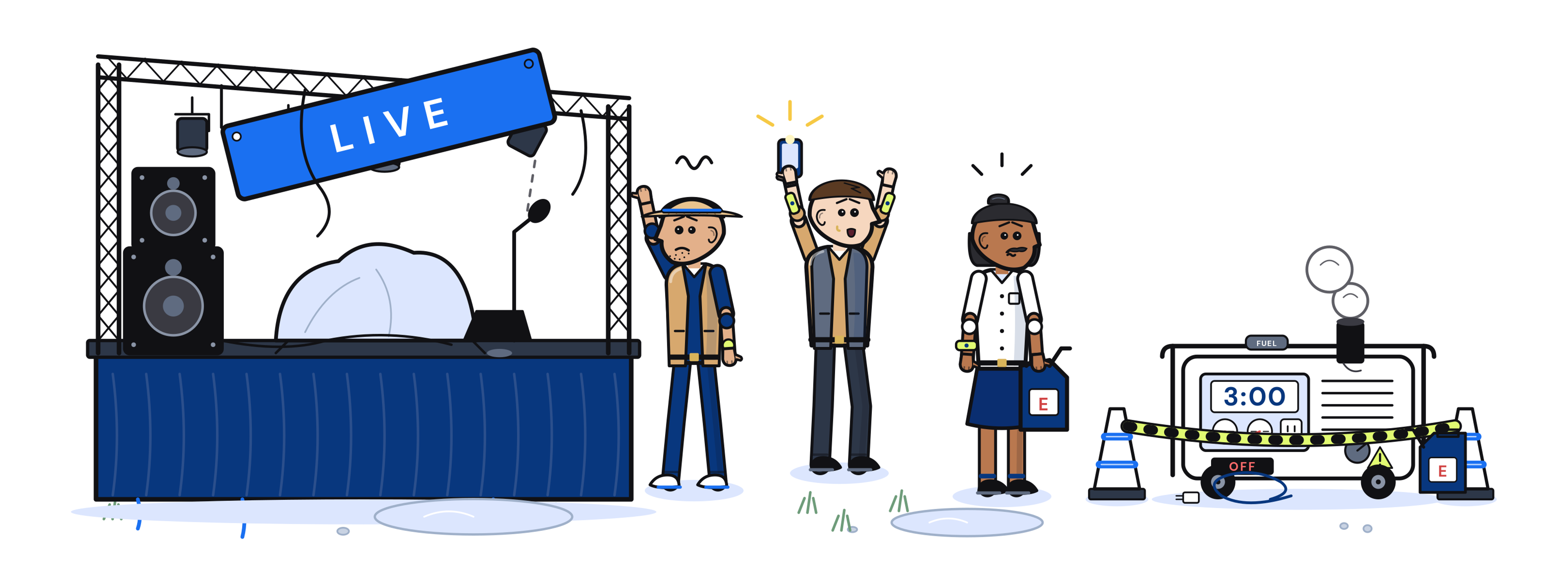
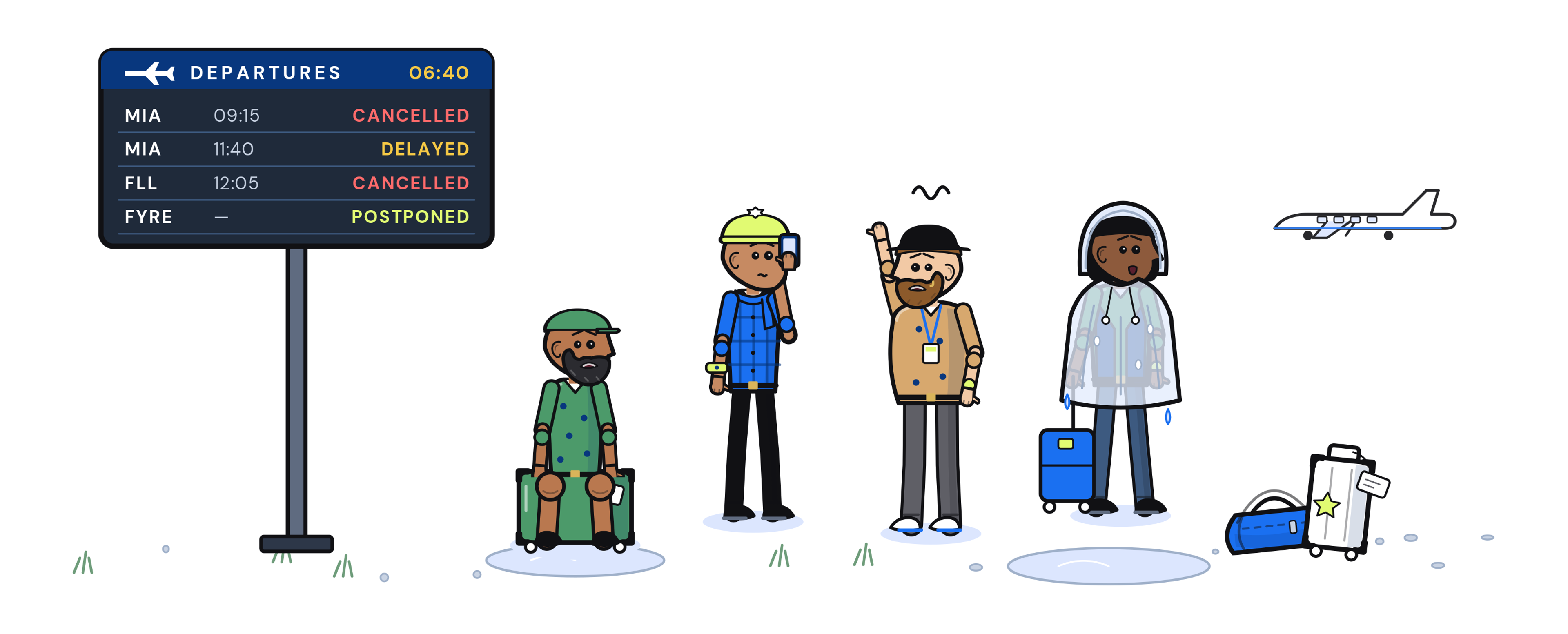
But the initial build hides what’s needed to support the work on an ongoing basis. Remember the Fyre Festival? In 2017, its promoters sold a luxury music weekend in the Bahamas with a glossy video of models on a beach, and thousands of people bought tickets. The video was the easy part. Nobody had planned for the water, the power, the security, or the beds, so guests landed in disaster-relief tents and got a cheese sandwich in a foam box. The festival was called off before the first act played.
Your app is the video. Somebody forwards the link, and the dinner you built for 10 turns into a festival for 20,000. Suddenly Finance wants to change a number in the forecast and has nowhere to type it, a regional manager is looking at numbers from regions that aren’t theirs, and the app slows to a crawl every Monday morning when everyone logs in at once. And who do they call? You. And now you have a lot more work to do.
By spring, an auditor wants to know who edited the plan in February. (That, by the way, is a routine question because any company that has to do a public filing must show who can change financial data and what they changed. In the US, the Sarbanes-Oxley Act makes that a legal requirement).
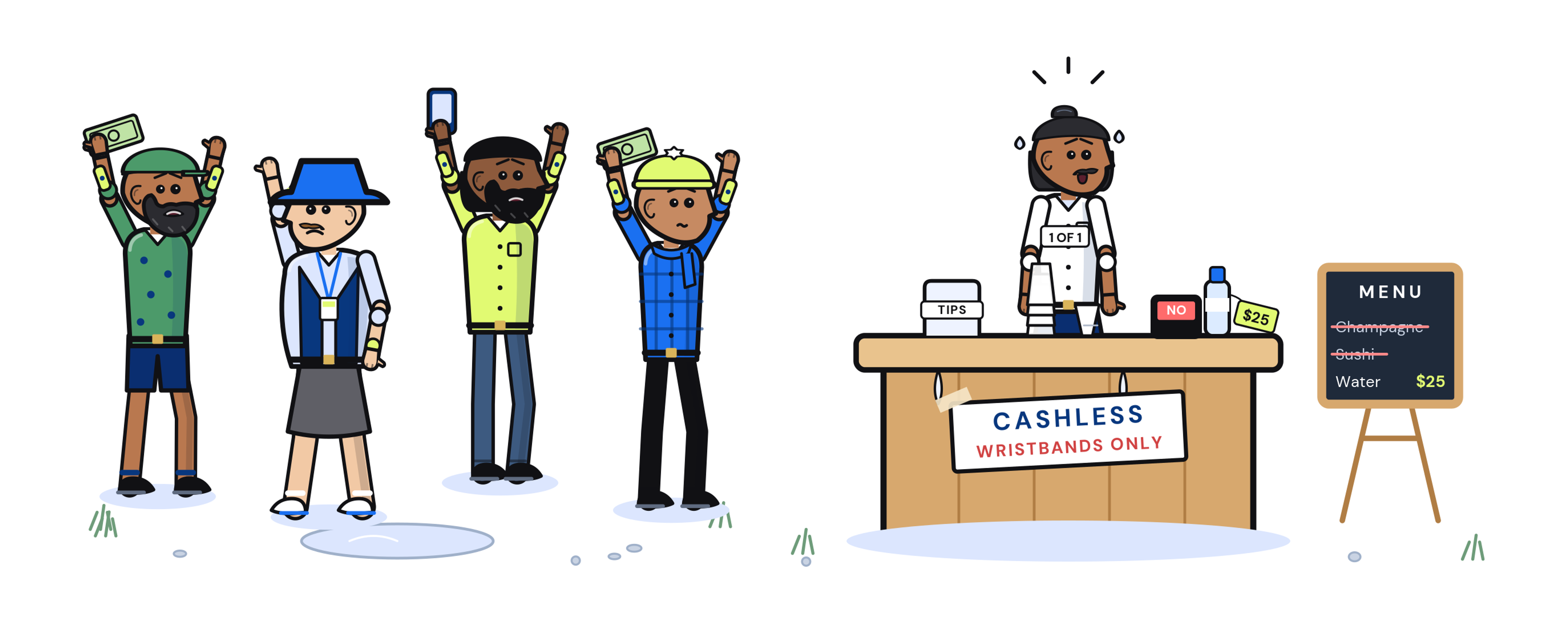
An app that lets anyone overwrite a forecast without leaving a record has what auditors call a control gap. A control gap is when a number can change, and nobody can prove who changed it or why. Here, it would happen because the app saves the new number but never logs the edit, so when an auditor asks about a $2 million jump in Q3, nobody has an answer. At a public company, that becomes a SOX finding. At a private one, it’s finance digging through Slack for two weeks to rebuild what happened.
So yes, a model pointed at your warehouse can vibe-code the app. But every job it takes to keep that app trustworthy for 20,000 people is still yours to do.
Why AI agents make cost control and governance urgent
Back when building was expensive, your company ran a few dozen apps, and your data team knew each one by name (Salesforce, NetSuite, and so on). Now anyone with a model can build, and they will, which is fine until your teams are running hundreds of homegrown apps and agents that nobody ever inventoried.
Then you open the cloud bill. What you realize is you let an agent point straight at your warehouse, and that same agent writes whatever SQL it needs to get an answer. These queries often do a full scan of a table it could have filtered, because nothing built in a few hours is optimized for query costs before they run. Guess what, though: three more people are asking the same question with different agents they built. And you pay for it three times, once in tokens and again in warehouse credits. All to get the same answer back each time. None of that is the model’s fault. It’s what happens when nothing sits between the agent and your warehouse.
With that challenge, at least the cost shows up on a bill someone reads every month. Even more challenging, answers get less accurate over time because the instructions an agent relies on describe a data model that changes every day. To keep up with that drift, you need a team constantly rewriting those instructions and testing the agent's answers against numbers they know are right.
Even Anthropic's own data team ran into this. They reported that without curated instructions (written guidance on what each table means and how each metric is calculated), their model's accuracy on their analytics evals did not exceed 21%, and that adding those instructions pushed it consistently above 95%. But within a month, accuracy had drifted to about 65% as their data models changed, until they treated the instructions as an engineering problem and kept them in the same repository as the data models they describe. The model wasn’t the issue; 21% accuracy and 95% accuracy came from the same model. The issue was that the context kept changing around the model, and keeping that context current is work that never ends.
The agents are only part of the bill. Every vibe-coded dashboard also needs somewhere to run, and someone has to pay for hosting and keep the software up to date. Without guardrails, each app keeps its own copy of the business logic, so two teams build the same revenue view, get different numbers, and spend the next meeting reconciling them.
Each new app also needs a security review before it touches customer data, and apps you vibe code tend to skip the review because they start as a quick experiment nobody thinks to send to security. That is how customer data ends up somewhere it should not be. Nobody budgets for any of this when they write the prompt, and the company pays for all of it later.
Add it up, and the tokens are the smallest line on the invoice, because the real cost of vibe coding your own platform is keeping hundreds of apps and agents correct and secure long after the people who built them have moved on to a new job.
The security and governance controls your vibe-coded apps, agents, and analytics need
When you have a platform that can support every app and agent your people build, these jobs get done once instead of getting rebuilt for each new effort. Every vibe-coded app, dashboard, or agent your team builds should include the following guardrails and capabilities by default:
- Data is live on the warehouse. Queries run on billions of rows where the data already lives, so nothing gets copied into an extract that quietly goes stale. The number an agent gives you is the number finance closes on, and you can drill into it (which, in my experience, is the moment people start to believe it).
- Permissions follow the user. An agent runs with the permissions of whoever calls it, so if I build one and share it with a colleague, it shows them only what they are allowed to see. That is what lets a team share an agent across the company without anyone auditing table access first.
- Data writeback includes a record. When someone changes the inventory count, the change lands in the warehouse along with who made it and what the value was before. That record is how you answer the auditor's questions, and how you undo a bad edit without guessing what the number used to be.
- There’s an owner for everything. Every app and agent has a named owner, a version history, and a rollback, so the day the builder leaves is an ordinary Tuesday. Without that, IT cannot centrally manage anything people create, and an AI frontend that felt empowering turns into an administrative problem over time.
- You pay for answers once. A shared results cache means a popular question gets cheaper as more people ask it. Asking a model the same question 10 times costs money 10 times, which is why the answers people need every morning belong in something built once and reused.
You can try to build each of those capabilities yourself, and you may succeed. You may succeed with building data writeback to the cloud warehouse, even where dozens of highly resourced SaaS tools have failed. But once you have a product you’re happy with, you still have to scale it out and run it in perpetuity. When employees are seeing compensation data, or the East team makes a forecast that breaks the West team’s data, or the auditor asks for an audit trail, you’re the person they call. The vibe-coded data platform may work for a team of 10, but it can’t scale to an enterprise of thousands.
How Sigma works with the AI model you already use
AI pointed at your warehouse can build a dashboard for 10 people in an afternoon, but once it turns into your own Fyre Festival, someone has to keep the AI bill in check and the agents' answers right for as long as people rely on them.
So you need a system. A secure, governed system that lets anyone on your team build with AI in an IT-approved way. Admins need the ability to monitor the agents and apps. Your team should be able to keep using the AI model or AI assistant they prefer. And you should take advantage of the resources your cloud data platform already provides, like warehouse agents (ex: Databricks Genie and Snowflake Cortex) already trained on your data.
This is why the Sigma approach to data and AI is agnostic. Use whichever AI models and warehouse agents work for you. Use whichever semantic layer you like. Connect to any cloud data platform, or multiple platforms. Build with AI assistants in Sigma or build outside of Sigma—in Claude, Codex, or Cursor—and bring it into Sigma.
You get to work with AI and data however you like. But when you bring it into Sigma, we provide the secure and governed system around that work. You don’t have to worry about maintaining a vibe-coded app forever, or tracking down everyone’s agents, or passing the auditor review. You can just build. Sigma’s got the rest covered.
So, should you vibe code Sigma?
If you’re looking for a simple answer to well-modeled data, or a basic dashboard that a small team can use, then by all means: chat or vibe-code your way to the result. In fact, it’s what our team does too: we use an agent pointed at our warehouse for straightforward data questions, and we often start our dashboard builds with a prototype in Claude.
But once we need to go deeper into the data, or upgrade the dashboard into a scalable and reliable app, that’s when we bring the work into Sigma.
It’s no trouble to vibe code an app, set up an agent, or get a confident data answer from an AI assistant. The trouble comes with everything that has to keep running once 20,000 people show up. That’s how a dinner for 10 turns into your own personal Fyre Festival.
Sigma runs your AI agents, your vibe-coded apps, and your sensitive analytics for the 20,000 people. Underneath every app, agent, dashboard, and report, Sigma supplies the live data, the permissions that follow the person, the record of every change, an owner for everything, and answers you pay for once, so the AI keeps doing the building and nobody ends up sleeping in a disaster-relief tent. And if you would still rather run all of it yourself, I understand. At least you will have saved the license cost.
See Sigma on your own data warehouse
Show us the dashboard your team vibe-coded last month, and we’ll show you how to bring it into Sigma, so it becomes a reliable system your team can depend on.
Request a demo before your next dashboard turns into a Fyre Festival.