Turn healthcare data into coordinated action
Explore clinical, claims, and operational data in your warehouse. Build apps that help teams investigate issues and coordinate follow-up.
Investigate on governed data
PHI stays in your warehouse, under the access policies already set there.
Coordinate the follow-up
Assign reviews, work denials, and log outreach as records with an owner and a status.
AI that shows its work
Summaries link to the rows behind them, and a person approves before anything is saved.
Trusted by healthcare teams












Issues to resolution
Finding the issue is the easy part
Teams can see the trend. The follow-up, who owns it, what was decided, and whether it closed, happens in email and spreadsheets.
| Today | With Sigma |
|---|---|
| PHI extracted to spreadsheets to work a list | PHI stays in the warehouse under its access policies |
| Review assignments tracked in email | Reviews saved to the warehouse with an owner and a due date |
| Provider mappings and reference data corrected in spreadsheets | Corrections saved to the warehouse with the editor’s name |
| Denial follow-up split across billing exports and notes | Denials worked from one queue on live billing data |
| Providers and clients get static screens and slide decks | Each provider and client drills into only their own data |
| No record of what was decided or by whom | Every decision recorded with who made it and when |
From the trend to the follow-up
Analytics finds the issue, an app captures the team’s response, an agent assembles the context, and writeback records the decision and its owner.
Constraints owned
Investigate capacity constraints
Find where beds, staffing, and throughput fall short, unit by unit, on live data. Managers assign the response, like a staffing change, with an owner and due date in the warehouse.
- Occupancy, boarding, and staffing gaps by unit
- Staffing changes assigned with an owner and due date
- Agents draft the huddle summary for approval
Denials resolved
Coordinate denial follow-up
Track denials and balances across facilities on live billing data. Revenue cycle teams assign claims, log notes, and record decisions, so follow-up doesn’t stall in a spreadsheet.
- Denials by payer, reason, and facility
- Assignments and notes saved to the warehouse
- Provider and staff mappings kept in one place
Ask what’s behind the CO-16 denials.
Denials Analyst
I summarize new denials and prepare follow-up. I never contact payers or change claims.
Synthetic data · work assignments only
Denials Queue
New denials
37
+8vs last week
At risk
$117.5K
3 payer reasons
Unassigned
22
CO-16
New denials this week
| Payer | Reason | Claims | At risk | Status |
|---|---|---|---|---|
| Ashcombe Health Plan | CO-16 missing info | 22 | $61,400 | Open |
| Wexcombe Care | CO-197 no auth | 9 | $38,200 | Assigned |
| Ashcombe Health Plan | CO-50 not necessary | 6 | $17,900 | Assigned |
Denial assignments
| Payer | Claims | Owner | Due | |
|---|---|---|---|---|
| 1 | Ashcombe Health Plan | 6 | Clinical review | Oct 30 |
| 2 | Wexcombe Care | 9 | Auth team | Oct 29 |
| + | ||||
At risk by reason
Gaps closed
Manage outreach queues
Work HEDIS and Stars care gaps from a shared queue. Care teams record outreach outcomes against the member list, and managers see what’s closed.
- Care gaps by measure and member
- Outreach outcomes saved as records
- Agents prepare the day’s queue for review
Cohorts explored
Support research cohort exploration
Researchers explore curated data in a spreadsheet interface and save cohort definitions and notes, without exporting CSVs or waiting on a data engineer.
- Cohorts built by pivoting, not by ticket
- Definitions and notes saved for the team
- Access governed by warehouse roles
Clients self-serve
Deliver reporting inside your product
Health tech teams embed interactive, white-labeled reporting in their own applications, with each customer’s data isolated by Sigma Tenants.
- White-labeled embedded apps
- One tenant per customer
- No separate data pipeline to run
Codes validated
Validate suspect conditions at scale
Health plans review HCC suspect conditions across millions of members, manage exceptions, and record each status, without exporting member records.
- Suspect conditions by plan and member
- Exception workflows with an owner
- Status changes recorded with an audit trail
Agents with a reviewable role
Agents prepare the work so people can decide
Agents summarize the evidence, find exceptions, and prepare work for a person to approve. Records save to your warehouse, never to clinical source systems.
- 1Summarize the evidenceAn agent summarizes this week’s new denials and links each point to the claims behind it.
- 2Separate what’s knownIt marks what it observed apart from what still needs review, such as a payer’s portal change.
- 3Prepare for approvalIt drafts the follow-up assignments. A manager approves them, and nothing goes to the payer or the billing system.
Healthcare teams running on Sigma

 300 Million 300m rows of curated patient data made easily accessible. 15X 15x increase in active users of data self-service toolkit. 25% targets 25% reduction in time to generate and deliver datasets for research use.Moffitt Cancer Center takes One More Step towards its Mission of Improving Cancer Care with Data Democratization through Sigma

 Improving patient outcomes in underserved communities: Why Leap Metrics calls Sigma “life saving.”

 Transforming Cancer Care with Advanced Data Analytics at Florida Cancer Specialists & Research Institute
Explore healthcare apps built in Sigma
Working examples from the App Library. Open one to see how it works.
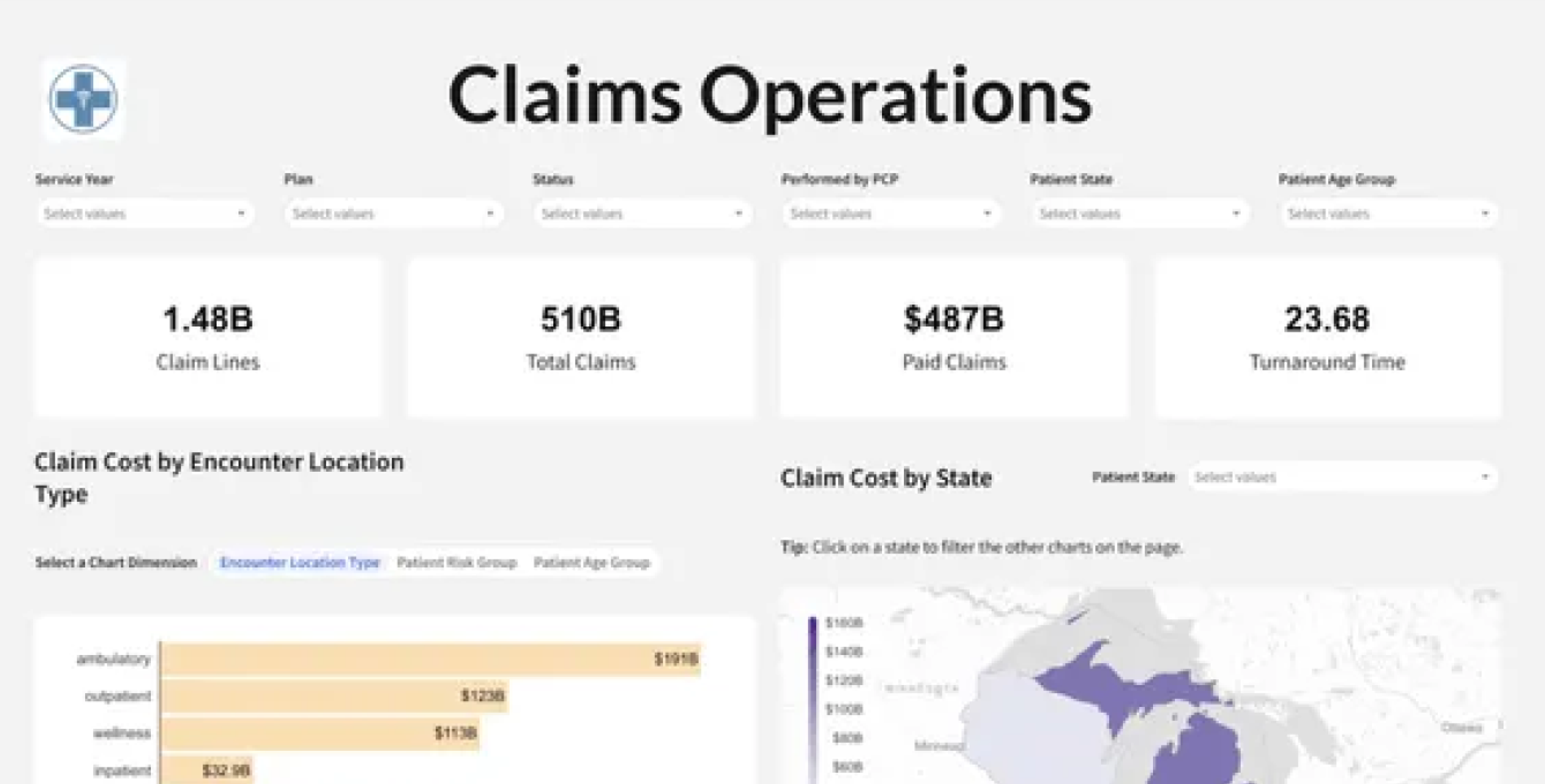
Healthcare Claims Analysis
Analyze billions of claims rows to improve patient experience. Identify patients without primary care providers and suggest matches.
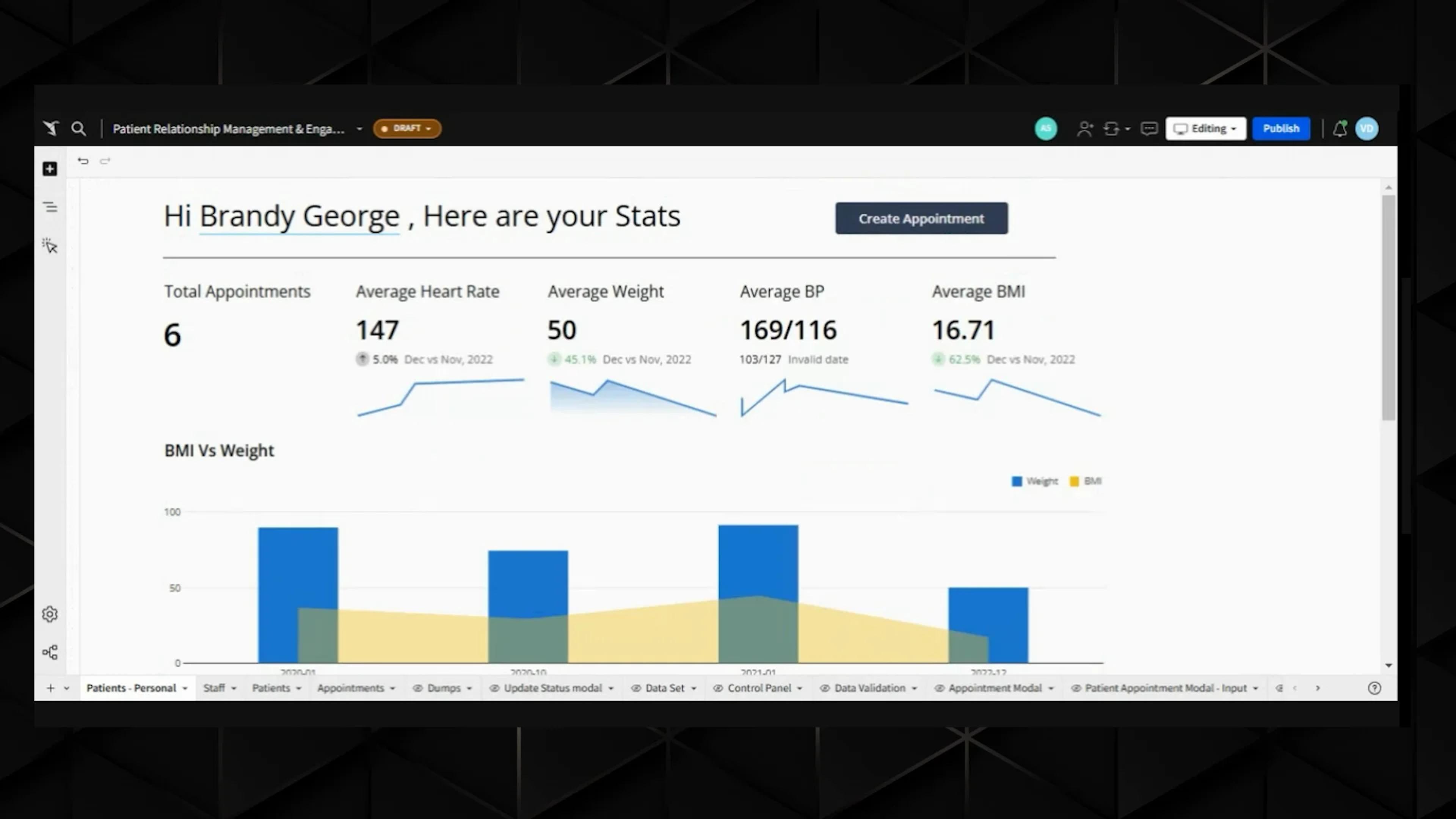
See the appPatient Relationship Management
Patient relationship and engagement app for clinics. Streamline scheduling, improve interactions, and surface clinical insights.
See the appClinical Research Solution
Patient cohort analysis for life sciences, built with phData on Sigma + Snowflake. Accelerate drug development and clinical trial workflows.
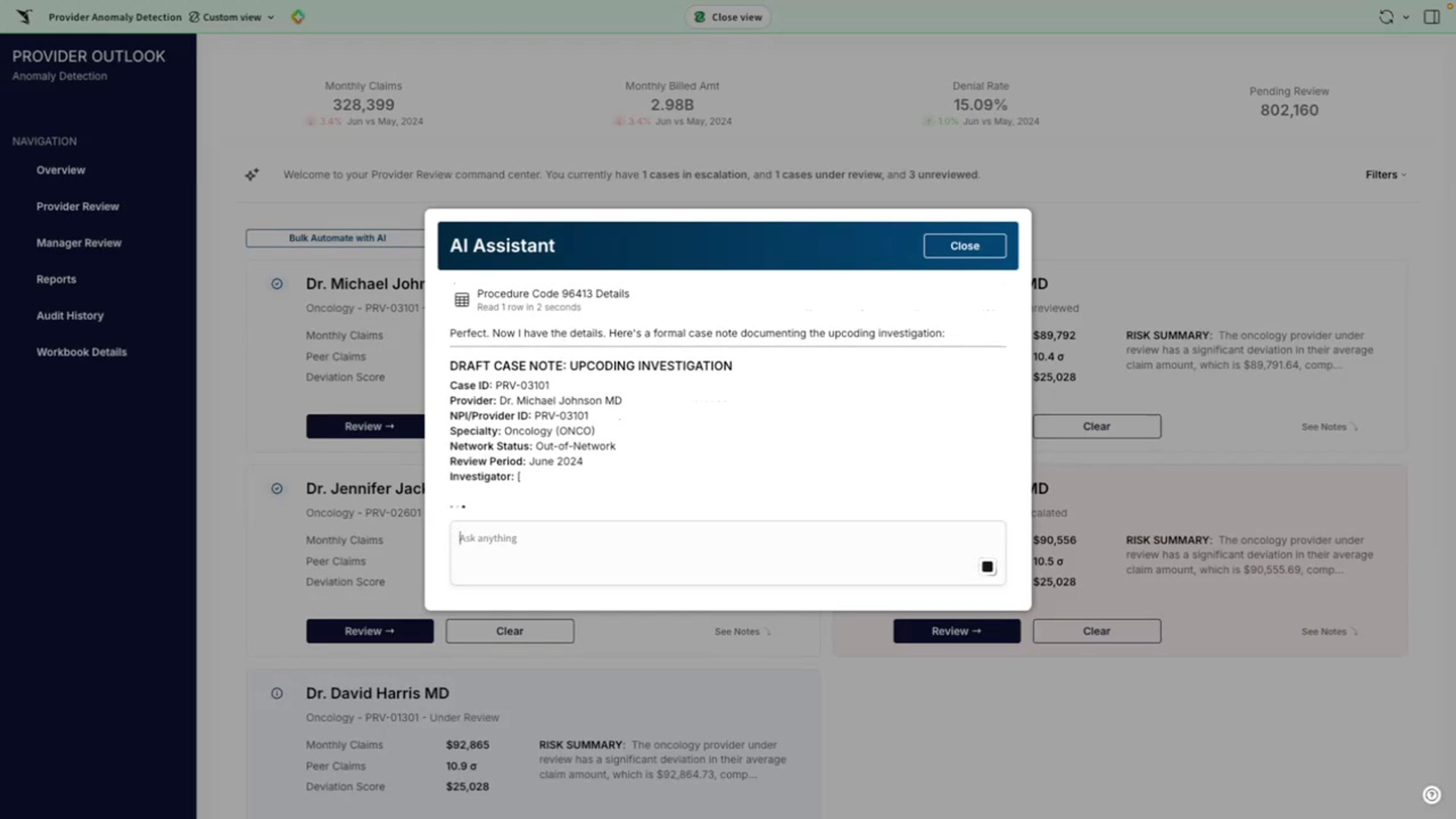
See the appProvider Anomaly Detection
Surface providers with outlier claims using Sigma agents, then investigate, document, and escalate cases with write-back to a governed warehouse.
See the app

Built for PHI
Meet strict compliance requirements without moving patient records out of your warehouse.
Writeback kept separate
Review tasks and outreach outcomes save to their own tables, never to clinical source records.
Per-user OAuth
Connect with OAuth so queries run with each person’s own warehouse role.
Row- and column-level security
Reads and writes both inherit your table policies.
Audit trail
Audit logs record user activity, AI conversations, and input table edits, so you can see who changed what.
Your data stays put
Sigma queries your warehouse in place and never copies the data out.
Certified
SOC 1, SOC 2, SOC 3, HIPAA, GDPR, CCPA, and ISO 27001.
Healthcare FAQs
How do we analyze patient data without compromising HIPAA compliance?
Sigma queries PHI in place in your cloud data warehouse, under its access policies, so there are no extracts to secure.
How do we coordinate claim denial follow-up?
Revenue cycle teams work denials from one queue on live billing data, drill to the claim line, and record assignments, notes, and decisions as they go.
How do we close HEDIS and Stars care gaps?
Care teams work gaps from a shared queue and record outreach outcomes against the member list, so managers see what’s closed and what’s next.
Can teams work with millions of rows without exporting them?
Yes. Sigma runs calculations as SQL in your warehouse, so clinical, finance, and research teams pivot and filter millions of rows in a spreadsheet interface. PHI stays under the warehouse’s access policies the whole time.
How do we deliver data to our own customers?
Embed white-labeled Sigma apps in your product, with each customer’s data, users, and content isolated by Sigma Tenants.
Does saving a record in Sigma update our EHR?
No. Input tables write to tables your team designates in the warehouse, such as a review queue or an outreach log. Sigma doesn’t write to clinical source systems or submit claims.
Bring the trend your quality team is chasing
We’ll show the investigation, the summary, and the review assigned and tracked, on synthetic data first.