Introducing the Sigma Context Engine: Teaching AI how your business works


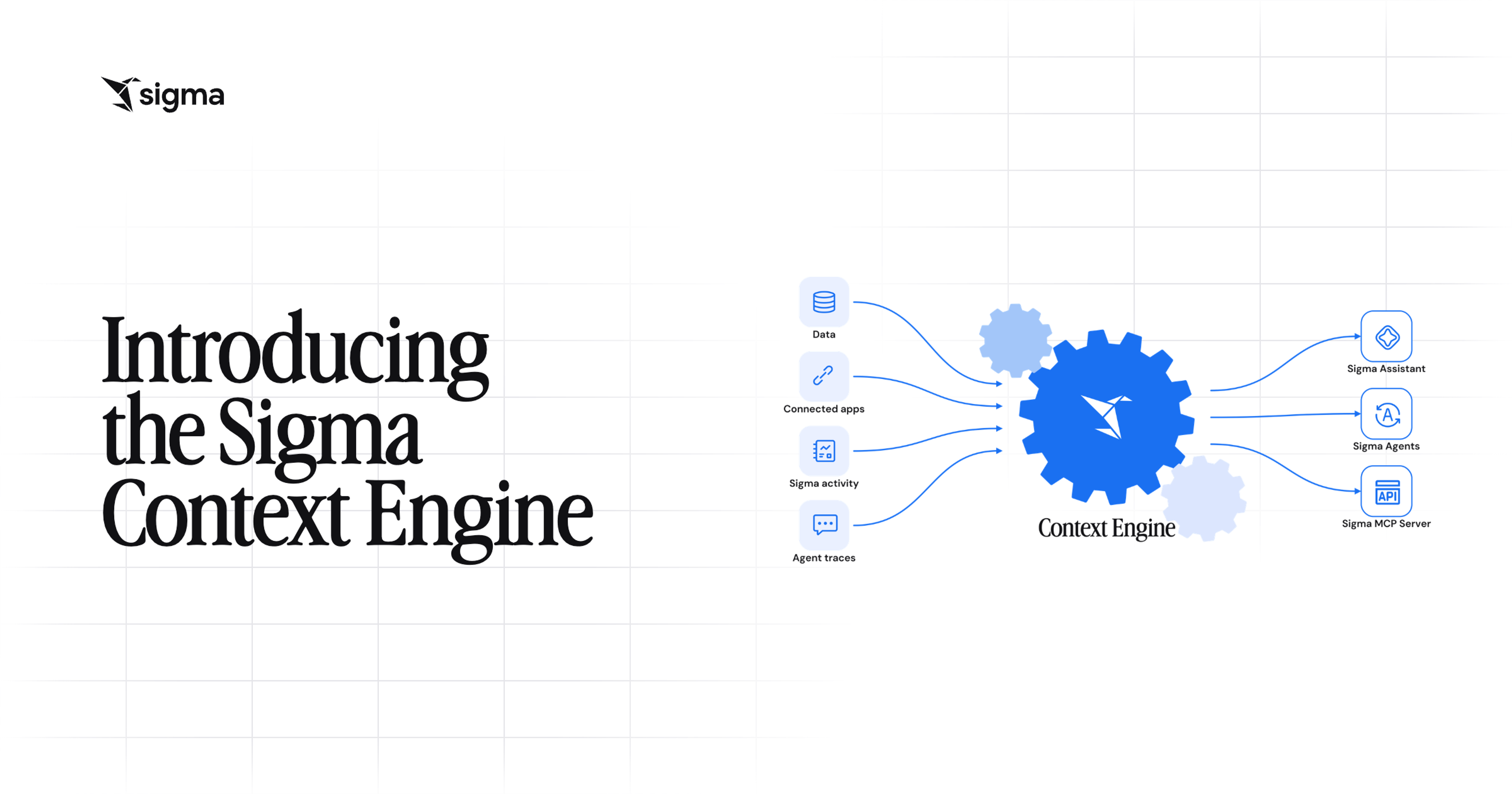
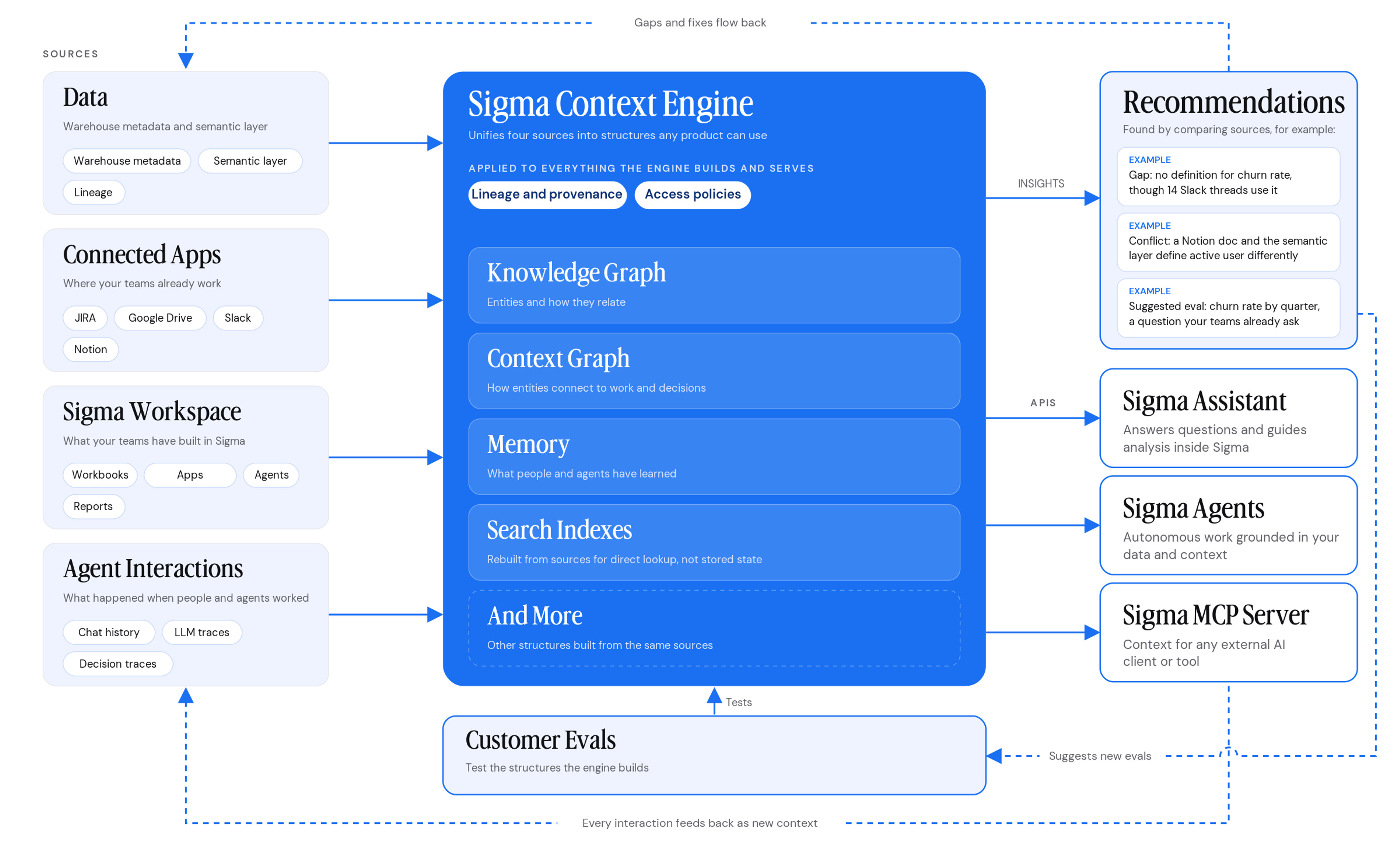
Whether AI is answering a question, building an app, or running an agent, it can only be effective if it understands how your business works. Today we're introducing the Sigma Context Engine, a new layer that learns how your organization works from everything it does in Sigma. It uses that knowledge to make every Sigma AI experience more accurate and reliable, from Sigma Assistant and Sigma Agents to AI tools connected to the Sigma MCP Server.
The Sigma Context Engine is in testing, and we plan to open a private beta next month. Read on for why context has become the defining challenge of enterprise AI, how the engine works, what it found in our own org, and the principles we built it on.
Context has always steered AI, and agents expanded its job
Context has mattered since the first large language models. Early models were generic, multi-task systems, and you got one to do a specific job well by showing it what you wanted in the prompt: a few examples and a few instructions. It was called in-context learning, and it turned a general model into a useful one.
As models grew far more capable, we started building them into agentic systems that plan, query data, call tools, and hand work to other agents. Context matters as much as ever, and its job is bigger. An agent now retrieves context at every step to decide what to do next: which data to trust, what a term means, what each user or team cares about, and how the pieces fit together.
Ask an agent what drove the drop in enterprise renewals last quarter. Before it can answer, it has to decide what counts as enterprise, which table holds renewals, whether last quarter means the fiscal or calendar quarter, how the tables join, which drivers are worth checking, and which documents to review, like the renewal playbook or notes from account reviews. Every decision depends on context, and every wrong guess carries forward.
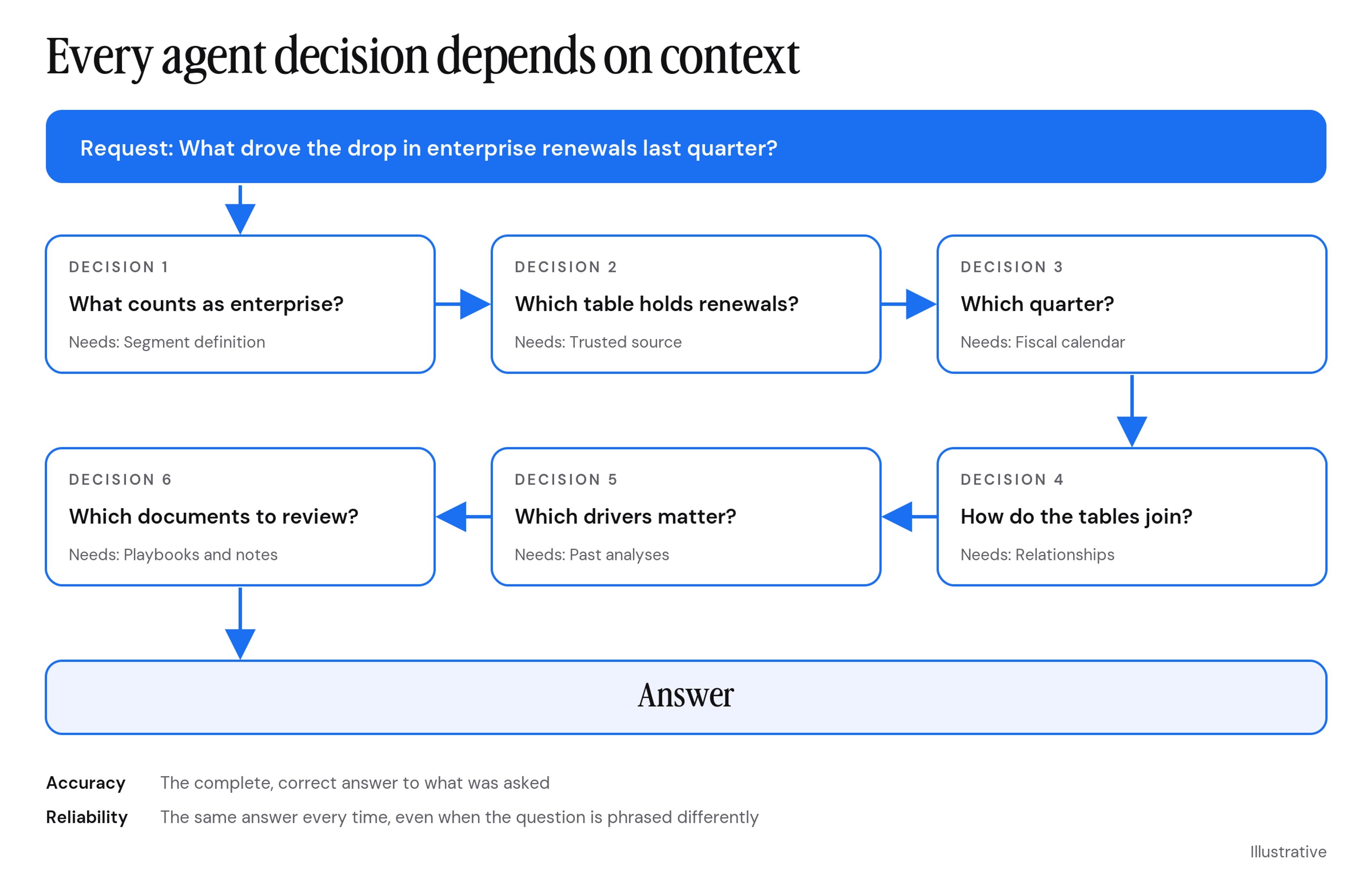
Get context right, and it improves the four things that matter most in any AI system: accuracy, reliability, cost, and latency. Agents that start with the right context take fewer steps, so they answer sooner and spend less doing it. Accuracy and reliability matter most to the people using AI. Accuracy means a complete, correct answer to what was asked, and reliability means the same answer every time, even when someone asks in slightly different words. When either one slips, users notice and lose trust.
The good news is that context can be managed, measured, and improved, and Sigma is building the tools to do it, right at the heart of where your users do their work.
Real enterprises are messy, and so is their context
Context lives in many places: warehouse metadata, the semantic layer your data team maintains, the workbooks and apps people build, documents, tickets, and chat threads. Those sources often disagree. A data team defines revenue carefully in the semantic layer, while a business user builds their own version in a workbook because they need revenue for a new product line the semantic layer doesn't cover yet. Over time, the way people actually do analytics drifts from what's written down.
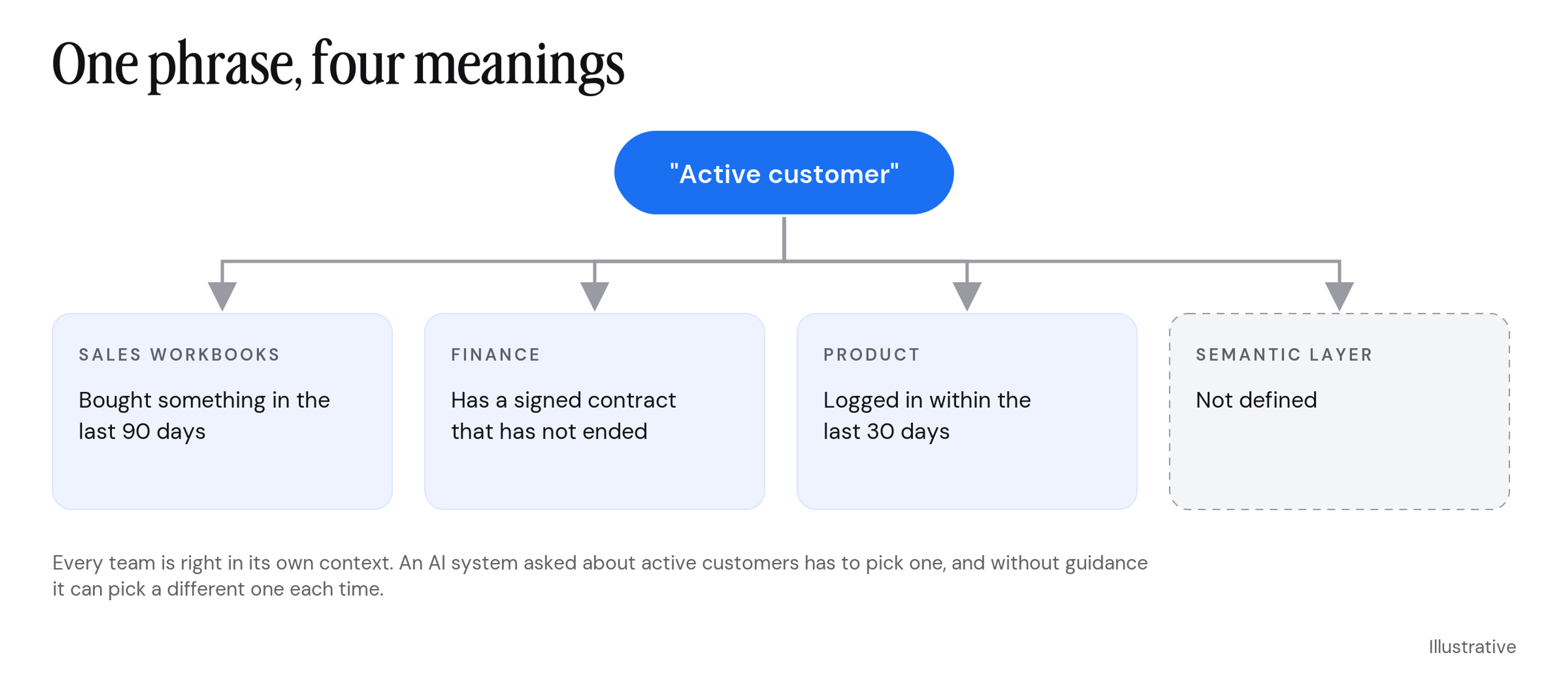
Teams also speak different languages. Sales, finance, and product can each use the same phrase and mean something different, and each team is right in its own context. For an AI system, that mess is at best a lot of information to reason through. At worst, it's stale and conflicting information that produces a confident, wrong answer.
The Sigma Context Engine learns from your organization
With the right context in place, every person and agent works from the same understanding of the business. A sales leader asks about enterprise renewals and gets the same complete answer the finance team would, with links to where every number came from. A builder describes the workbook, app, or agent they need in plain language, and it starts with the right metrics and definitions.
Our approach starts where the work happens. Sigma is where people build workbooks, apps, and data models, explore data, and talk to AI every day. That activity is the clearest record of what matters to an organization: the workflows teams run, the apps and agents they build to run them, how decisions get made and approved, and the data and definitions all of it depends on.
The Sigma Context Engine processes that activity across your whole org, reconciles it with the external sources you choose to connect, and provides two benefits:
- It powers context APIs. Sigma Assistant, Sigma Agents, and the Sigma MCP Server draw on the same context, so answers are more accurate and reliable wherever someone asks. Agents that start with the right context also take fewer steps, which makes them faster and less costly to run.
- It recommends changes to admins. The engine proposes updates to your context, like a missing metric or a conflicting definition, and flags patterns in how your organization uses analytics that deserve a review. Each recommendation comes with evidence, and nothing changes until an admin approves it.
6 principles that keep your context secure and trusted
An engine that learns from everything your organization does in Sigma raises a fair question: what does it see, and who gets to use what it learns? We built the Sigma Context Engine around six principles:
- Admin control. Recommendations are proposals. Admins review the evidence and decide what changes. They can also define and run their own Evals to continuously track performance and identify gaps where human intervention may be needed.
- Self-learning. The Context Engine keeps learning as your organization works. New workbooks, changing definitions, and every recommendation an admin approves or declines teach it more, so the context it serves evolves with your business.
- Isolation. Every Sigma organization gets its own Sigma Knowledge Graph and Context Engine, built only from the sources it has enabled in Sigma.
- Data privacy. The Context Engine doesn't store your data. It stores only the metadata needed to retrieve data when an AI experience needs it.
- Permissions. Every piece of context carries access controls, so a user's AI activity never draws on context built from sources that user can't access.
- Provenance. Whenever a Sigma AI experience uses context from the engine, it cites its sources and links to them.
The 1st step is the Sigma Knowledge Graph
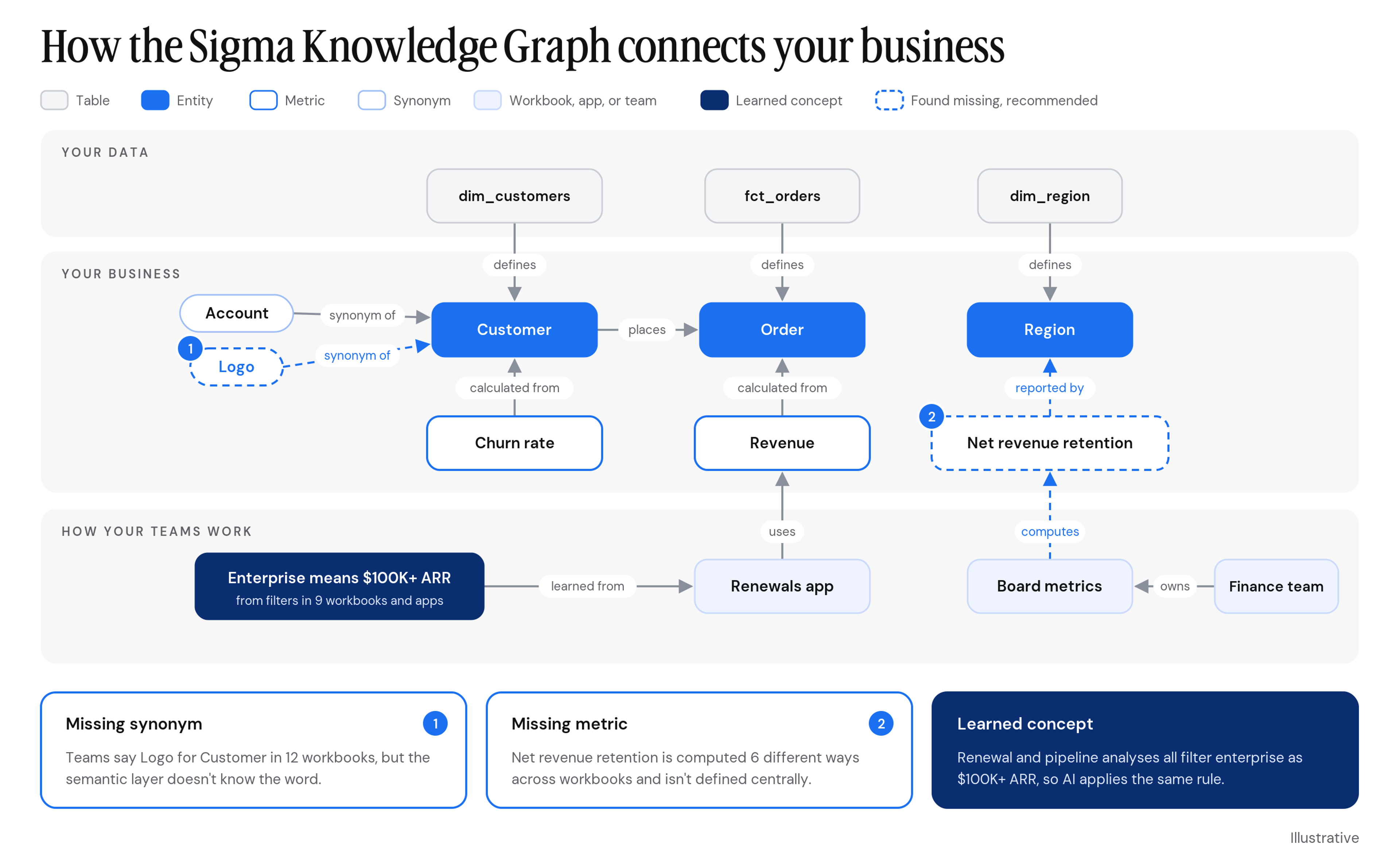
The first component we built on those principles is the Sigma Knowledge Graph. It maps the entities, metrics, synonyms, and relationships that define your business and connects them to the tables, data models, workbooks, apps, and users behind them. More importantly, the graph also learns concepts from how your organization builds and uses Sigma. These concepts capture important learnings, and are connected, in the graph, to your entities, workbooks, etc. so that any Sigma AI experience can retrieve them when needed.
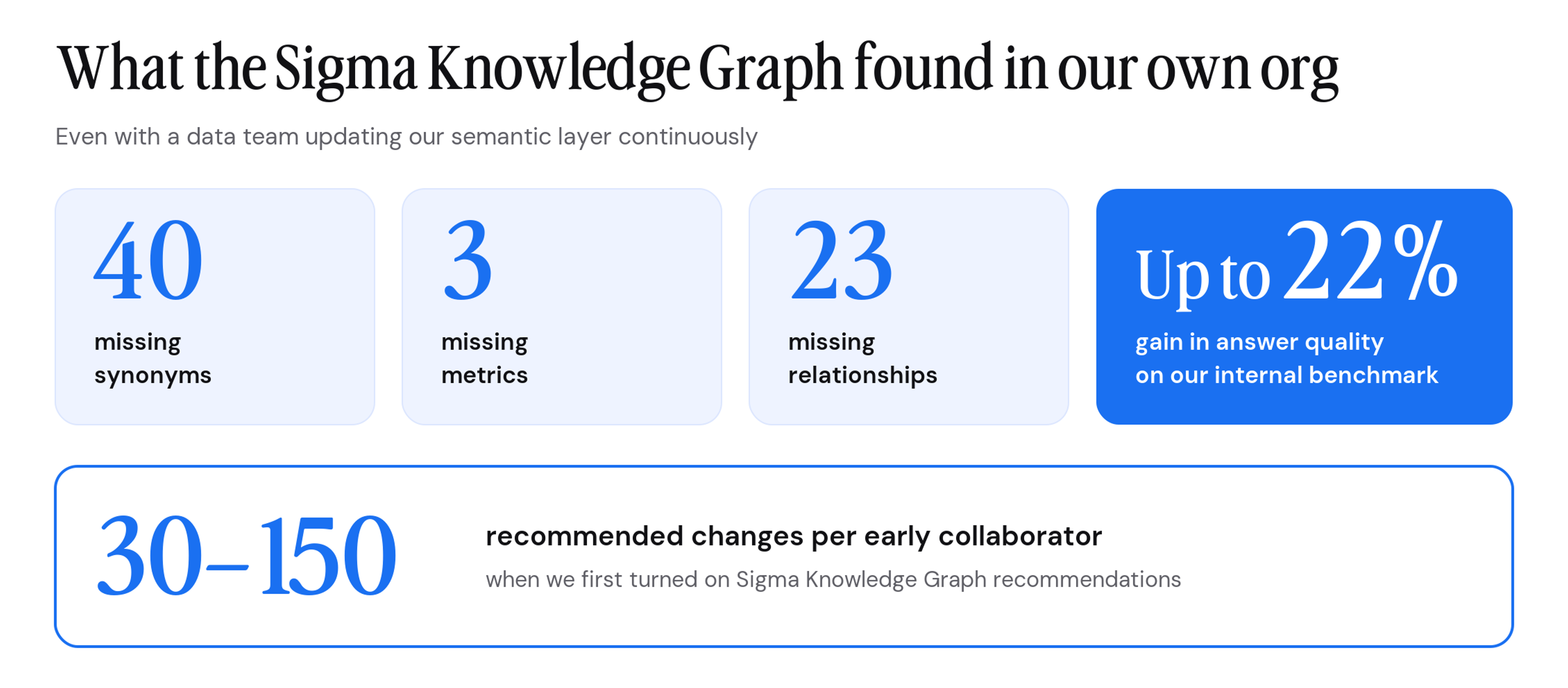
We tested the Knowledge Graph on our own Sigma org first. Sigma has an exceptional data team with a deep understanding of our business and use cases, and they update our semantic layer continuously. Even so, the results showed up on both sides of the Context Engine:
- Recommendations for admins. The Knowledge Graph found 40 missing synonyms, three missing metrics, and 23 missing relationships that our data team could review and add. Our early collaborators observed the same pattern. When we first turned on Knowledge Graph recommendations for them, each one received between 30 and 150 recommended changes. These recommendations include proposals for new metrics and relationships and conflicts that need to be reviewed and reconciled.
- Context APIs for AI. When we gave the graph to our reasoning agent as an additional context source, answer quality on our internal benchmark improved in every experimental setting we tested, such as different model and harness choices. Depending on the setting, the gain ranged from 13 to 22 percentage points. These significant gains are a result of the graph adding what the semantic layer can’t capture on its own: how our teams actually work, including the dashboards we build, the visualizations we rely on, and the queries that power them. With that context, answers became more relevant to our business, and the agent stopped filling gaps with simplifying assumptions when the question was ambiguous.
What’s next with the Sigma Context Engine
We're working with early collaborators now to fine-tune the Sigma Context Engine, and we plan to open a private beta next month. The beta starts with the Sigma Knowledge Graph, context APIs for Sigma AI experiences, and recommendations for admins, and we plan to build out more of the engine from there.
If you’re interested in joining the private beta program, reach out to your Sigma representative.
To learn more about how Sigma uses AI to deliver fast, accurate, and cost-effective results for your business, check out these resources:
- Blog: How we rebuilt Sigma’s AI agent to be cheaper and faster for customers
- Blog: Introducing AI Budgets: Set limits on AI spend in Sigma
- Ebook: Sigma’s architecture: The runtime for AI
- Livestream: The future of building: Everyone builds. IT approved.
- Livestream: Build anything in Sigma with AI