Sigma Recognized in the 2026 Gartner® Magic Quadrant™ for Analytics and Business Intelligence Platforms

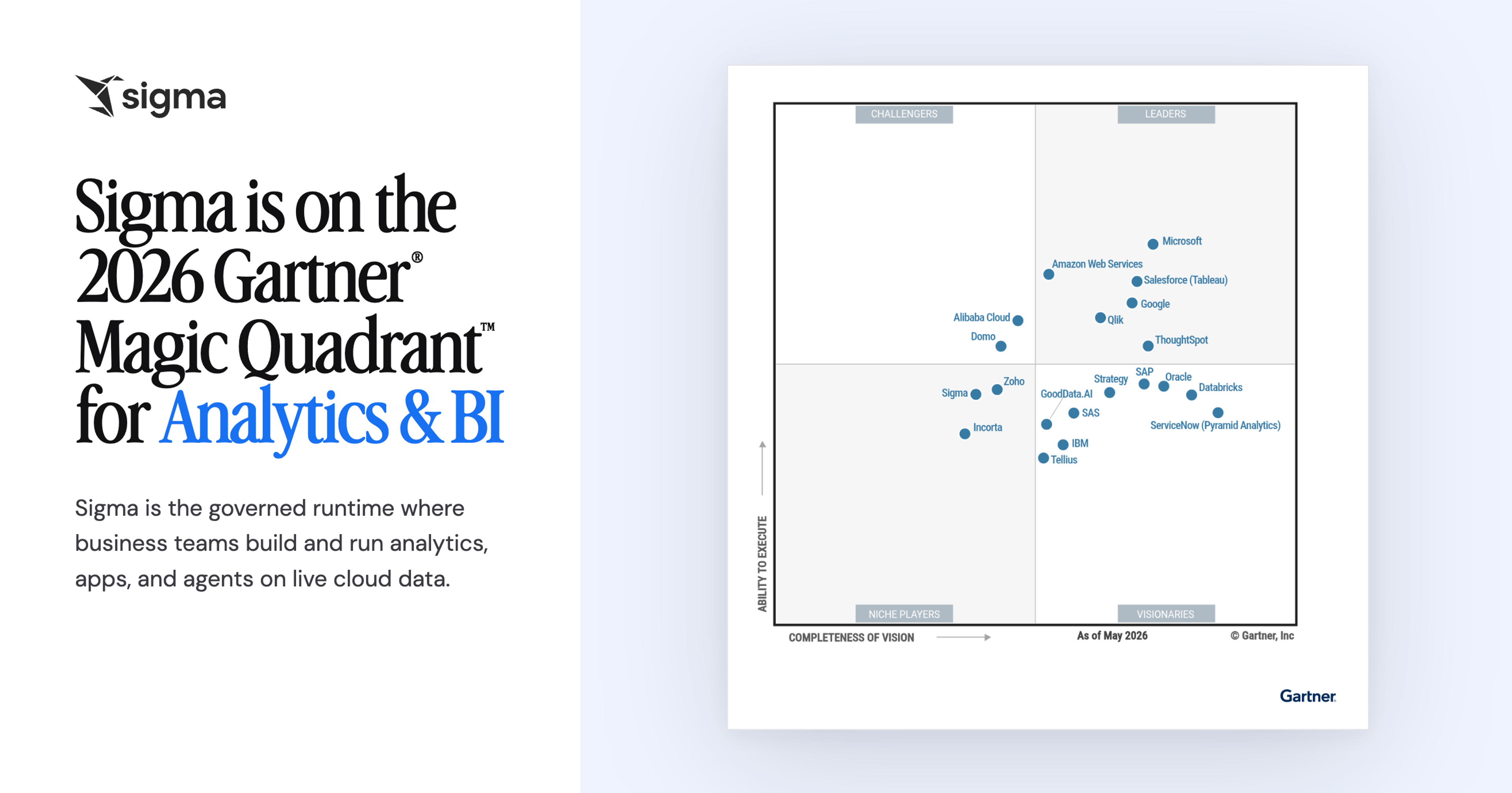
For the second consecutive year, Sigma has been recognized in the 2026 Gartner® Magic Quadrant™ for Analytics and Business Intelligence Platforms. Access the report here.
Sigma is more than business intelligence and agentic analytics. We see it as the runtime layer for business, where companies run their analytics, apps, and agents directly on data in the warehouse. Business and technical teams build on it without copying data out or stepping around the governance IT already set.
Sigma is built for this moment, as the analytics market hits a hard inflection point. The category that grew up on dashboards and static reports is now being asked to do more than describe what already happened. People expect to ask a question in plain language and act on the answer without leaving the place they started.
It's a shift Sigma is ready for. Sigma puts a familiar, spreadsheet-style surface on top of live cloud data, so the place where a business user explores a number is also where the team writes back to it and builds the app or agent that acts on it. This closes the gap between insight and action, on data the business already trusts.
Why is analytics moving beyond dashboards?
For most of its history, business intelligence has been good at telling teams what has already happened. That was enough when the job was reporting, but it falls short now that the same teams are expected to act inside the systems where decisions get made, rather than read a chart and walk away.
Sigma was designed for that gap. Instead of pulling data into a separate tool and leaving the action somewhere else, Sigma keeps the analysis and the work that follows in one governed place on top of the warehouse. A business user can explore live data, build a pixel-perfect report or an app on it, then write a change back to the source without breaking the connection.
What is an AI runtime, and why does it matter?
The most important change in analytics right now is an architectural one. The warehouse holds the data, and AI now generates the artifact built on top of it, whether that artifact is a dashboard, an app, or an agent.
Between the two sits the runtime: the governed layer that carries permissions, audit, and version history, and turns a generated idea into something safe enough to run in production.
That is the layer Sigma provides. Every app and agent built in Sigma inherits the security and row-level access already defined in the warehouse, so a business team can build at the speed AI now allows, while IT keeps the controls it depends on. It's self-service for the business and governance for IT teams. There's no tradeoff between the two.
How do AI Apps, agents, and analytics work together in Sigma?
Over the past year, the range of what a team can build on Sigma has widened. Sigma Assistant turns plain language prompts into real work on the data, whether that's a quick answer or a built-out report.
Sigma Agents take the next step, watching for a condition in the business and acting on it rather than waiting to be asked.
AI Apps let a team package that work into a custom, governed workflow, and the Sigma MCP server lets outside assistants like Claude and ChatGPT operate on the same objects under the same rules.
The line between these surfaces is already blurring. An app that takes an input, runs a few steps, and writes the result back to the warehouse is, for all practical purposes, behaving like an agent. The label a team puts on it matters far less than the fact that it's software the business built to do real work inside the governance IT already approved.
The work in Sigma is built on inputs, actions, and a governed data model, with SQL and Python underneath when a team needs them. The work can move from analysis to action without ever losing its connection to live cloud data.
What do customers say about Sigma on Gartner Peer Insights™?
On Gartner Peer Insights, Sigma now holds 233 all-time reviews, a 4.8 out of 5-star rating, and a 94% willingness to recommend as of 28 June 2026.¹
The usage behind those reviews has grown just as fast: customers have built more than 2 million workbooks and apps on Sigma, and the platform now runs as production infrastructure at more than 2,000 companies, including multiple Fortune 10 enterprises and leading AI innovators.
The picture those customers describe lines up with what we hear directly. They want analytics the data team can trust and the business can actually use, governed closely enough that enterprise IT can stand behind every workbook and agent running on live cloud data. And more and more, they want AI that does more than surface an insight; they want help acting on it.
What comes next for Sigma?
We think the next era of analytics belongs to the governed runtime: the place where teams build and run AI-powered apps and agents directly on live cloud data, and where Sigma is putting its effort.
The investment runs across the whole runtime, from Sigma Assistant and Sigma Agents down to inputs, embedded analytics, and the governance that holds it together, all aimed at making that layer smarter and easier for anyone to pick up.
Customers are already showing what becomes possible once analytics stops being a place you read about the business and becomes a place you run it.
If you want to see how that works, you can:
- Request a Sigma demo
- Access the Gartner Magic Quadrant report
- See what customers are saying on Gartner Peer Insights
To our customers, partners, and team: thank you for helping us keep pushing analytics forward.
Gartner Disclaimer
Gartner, Magic Quadrant for Analytics and Business Intelligence Platforms, Anirudh Ganeshan, Edgar Macari, Christopher Long, 11 June 2026.
Gartner, Magic Quadrant and Peer Insights are trademarks of Gartner, Inc. and/or its affiliates. Gartner Peer Insights content consists of the opinions of individual end users based on their own experiences and should not be construed as statements of fact, nor do they represent the views of Gartner or its affiliates. Gartner does not endorse any vendor, product or service depicted in this content nor makes any warranties, expressed or implied, with respect to this content, about its accuracy or completeness, including any warranties of merchantability or fitness for a particular purpose.