AI Spreadsheets: What Changes When AI Sits Inside the Grid

AI in spreadsheets takes one of two forms. It either runs inside a grid wired to the system where the data lives, or on top of a file someone pulled from that system. That difference shapes how current the data is, how well governance holds, and how much you can trust the answer.
This guide breaks down those two forms, what each makes possible, where AI in spreadsheets breaks down, and what a reliable AI spreadsheet requires.
Key takeaways
- AI is only as current as the data it can reach. An AI add-in analyzing an exported file describes what was in that export, and the answers can be days or weeks out of date.
- For spreadsheets, AI built into the calculation surface behaves differently from AI bolted on as an add-in. File-level sharing on scattered exports can diverge from source-system permissions. AI then analyzes data outside the controls that protect the original data.
- A trustworthy AI spreadsheet needs a live connection to the source system, permissions inherited from that system, and one auditable version with traceable calculations.
How is AI implemented in spreadsheets?
AI shows up in spreadsheets in two common forms inside companies: built into the calculation program itself, or bolted on through an add-in. Standalone, AI-native spreadsheet products also exist, but most teams encounter the built-in and add-in forms. How deep the AI reaches into your data depends on which form you have.
AI built into the spreadsheet
The built-in form puts AI directly on the calculation surface. In-grid assistants may help users create formulas, PivotTables, charts, and larger sections of a spreadsheet from a natural-language prompt. These capabilities may vary by subscription and deployment. More importantly, they work from whatever the workbook contains or can reach. Unless the workbook connects to a live source, the answer only describes what's in the workbook.
AI added on through an add-in
The add-in form bolts AI onto a spreadsheet you already use, which may limit the AI to the rows sitting in the file it opens. Products such as ChatGPT for Excel and Google Sheets, Claude in Excel, and ChatGPT Work bring AI into an existing spreadsheet through add-in interfaces. Without configured external connections, an add-in bases its analysis on the workbook it can access. If that workbook is an export, the analysis covers only the exported data.
What AI inside the spreadsheet grid makes possible
In-grid AI supports a variety of work, including writing and explaining formulas, generating summaries and forecasts, and taking multi-step actions on the data itself. Each function is only as good as the data the AI can access.
Natural language formulas and queries
AI assistants embedded in a spreadsheet can draft and explain a formula from a plain-language request, translating something like "show me the percent change year over year" into working syntax. That explanation covers the formula's logic. Where the numbers came from and whether they're still current are separate questions.
Researchers have documented numeric hallucinations when language models must produce numeric values, so treat a generated formula as a draft. Verify the math before it feeds a decision downstream.
AI-generated summaries and forecasts
Beyond drafting formulas, in-grid AI may summarize ranges, surface outliers and trends, and support forecasts from raw data. Some warehouse-connected spreadsheet features can run forecasting and anomaly detection without relying on a pasted export. Accuracy still lags human work. Microsoft's Agent Mode scored an accuracy of 57.2% on SpreadsheetBench, a measure of an AI model's ability to edit spreadsheets, compared to human accuracy of 71.3%.
Autonomous actions on live data
Summaries and forecasts describe the data. Agent-style spreadsheet tools go a step further and act on it, handling multi-step work like iterative requests and scenario analyses with adjustable assumptions. Configured agents can build forecasts, draft commentary on unusual results, identify anomalies in transaction data, and route exceptions for review.
The ceiling on this capability is the data connection underneath it. An agent that plans and executes a dozen steps against a disconnected file consumes compute power and time on stale numbers.
Why AI in spreadsheets matters for data analytics
AI in the grid can shorten the distance between a question and an answer without routing it through the data team.
- Faster answers without a data team bottleneck. Analytics teams can spend substantial time maintaining and organizing datasets, so a business user's follow-up question may land behind that backlog. AI in the grid lets that user answer the follow-up themselves instead of filing another ticket.
- Fewer manual, repetitive spreadsheet tasks. In-grid assistants can help auto-fill sequences and formulas across a column, and employees at small and midsize companies report saving 5.6 hours a week with AI tools. Those hours only count if the automated work is running against data anyone in the room can trust.
- A lower technical barrier to asking questions of data. When a plain-language question replaces a SQL query, more people can interrogate data without waiting on the data team. Many business users still have to go through someone else to get a straight answer from their own company's data. Closing that distance requires a plain-language answer to query the live warehouse itself.
Speed, fewer manual tasks, and easier access all sound like wins on their own. All three collapse when the AI reads from a stale copy of the data.
Challenges of AI in spreadsheets
When teams use AI add-ins on exported files without external connections, the analysis reaches only those copies. Three problems follow from that setup.
- AI plugins working from exported, disconnected copies. An add-in with no external connection analyzes only the file in front of it, so a CSV pulled last Tuesday means every summary describes last Tuesday. Each new export becomes another disconnected surface for AI to analyze.
- Data security issues from permission mismatches. Beyond staleness, file-level sharing can diverge from source-system permissions, amplifying overly broad access and broken inheritance. Microsoft Copilot accessed almost three million confidential records per organization in the first half of 2025, showing how fast broad file sharing outruns the access rules a source system is built to enforce.
- Personal and corporate data mixing in ungoverned sheets. As AI outpaces governance, employees sometimes share sensitive corporate information through unapproved AI tools. Once data leaves the governed source, the organization has to govern each copy separately.
All three failures trace back to the same root. Once data leaves the warehouse, it carries none of the controls that govern it, and no add-in can bolt those controls back on. Keeping AI inside the source avoids all three.
Best practices for AI-ready spreadsheets
Keeping AI inside the source is the principle. Putting it into practice takes three things: a live connection to the source system, permissions that travel with the data, and one version everyone can audit. Each one answers a specific failure named above. Together, they decide whether the grid just describes data or can be trusted to act on it.
1. A live, governed connection to the data
The first requirement, a live connection, means the AI should query the source system on every request instead of using a copy. That way, the spreadsheet doesn't extract warehouse data into a store of its own, so there's no second copy for the organization to govern separately.
With a live connection configured to run queries as the user, the query uses the requesting user's warehouse role, and the source system enforces row and column policies at query time. The answer reflects the current state of the warehouse.
2. Permissions inherited from the source system
A live connection alone isn't enough if access control doesn't travel with the data. Any AI system reading from a governed source must preserve source access controls, including row-level entitlements, so users and agents see only what their permissions allow. If a user cannot see a row or column in the warehouse, they cannot see it in the spreadsheet either, and there is no secondary permissions model to configure and keep in sync.
3. One auditable version instead of scattered copies
The third requirement is version control at the source. One version of a metric should be the only version an AI can see. Scattered copies make that impossible. An AI reading the wrong version risks the model providing a confident but inaccurate answer. Every governed record should support audit record generation that documents what changed, who changed it, and when.
Traceability also has to reach into the calculations themselves, so every formula and transformation stays inspectable, and the platform can surface the exact SQL it sent to the source system. That record turns AI output from a suggestion into something a compliance team can stand behind.
How Sigma delivers an AI-native spreadsheet
Sigma is the AI Apps and analytics platform that lets users build agentic analyses and applications directly on live cloud warehouse data. The grid is warehouse-native, and queries run in the connected warehouse, so governance applies when each question runs. Sigma puts those three requirements - live connection, inherited permissions, and one auditable version - into a single product.
AI queries run directly against live warehouse data in the grid
The spreadsheet interface compiles formulas, filters, and pivots to SQL that executes in the connected warehouse, whether that's BigQuery, Databricks, Redshift, or Snowflake. That also raises the spreadsheet row limit that constrains desktop files so that a warehouse-backed interface can query tables with billions of rows.
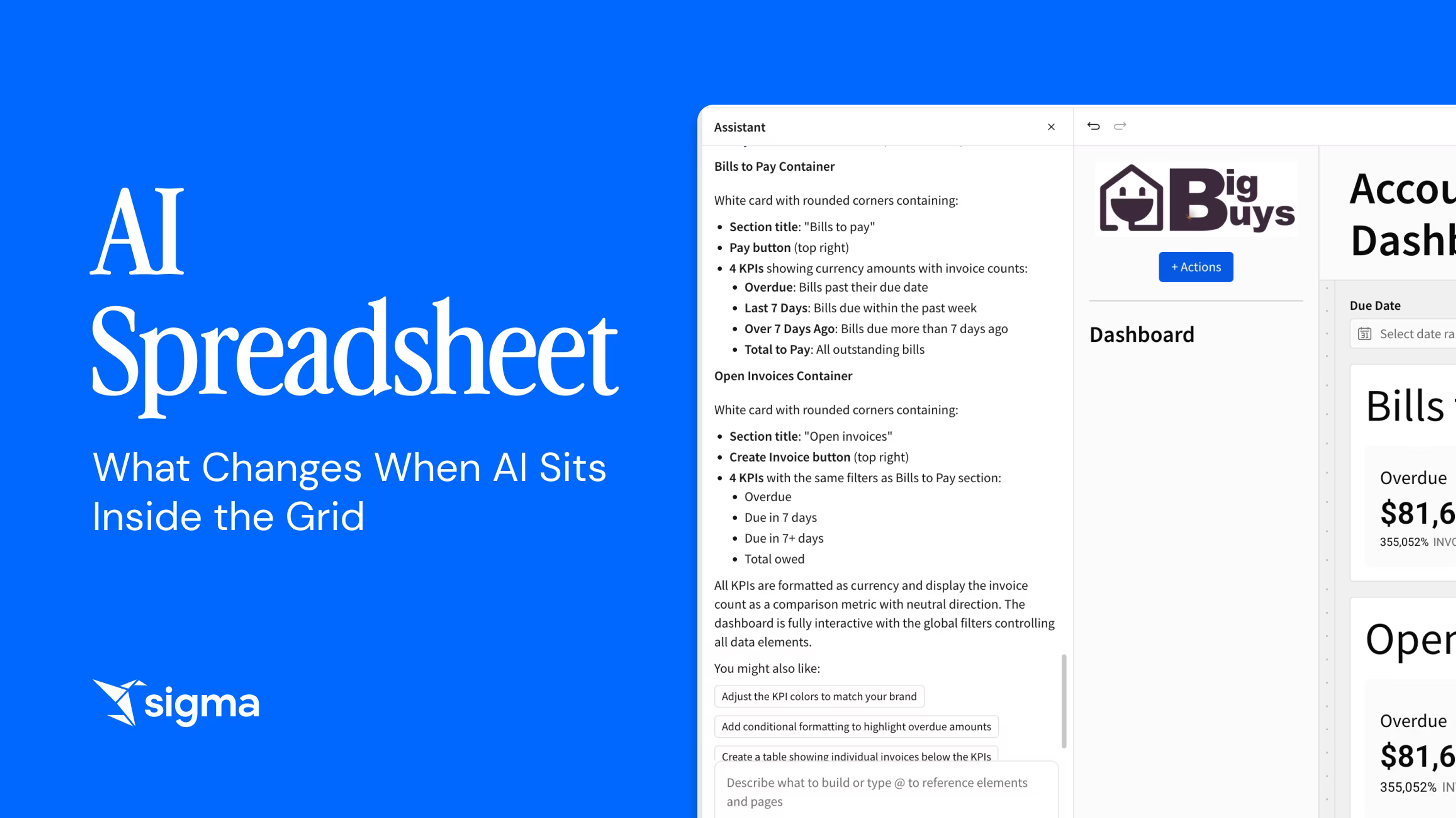
Sigma Assistant answers plain-language questions from that same live data, and users can trace any answer, inspect the query, and follow it to the underlying data. AI Columns run LLM prompts against each row of the grid on the customer's own warehouse compute, such as Snowflake Cortex or Databricks model serving, and warehouse row-level security applies when the call runs. This opens up tasks the grid could not handle before: classifying transcripts or support tickets by sentiment, matching vendor or customer names with minor typos, extracting fields from unstructured text, and generating row-level commentary that stays inside the governed data.
Writeback that turns AI output into an auditable record
Querying live data is one half of the loop. Writing changes back to the warehouse is the other. Input Tables carry the work past the chart. A regional manager adjusts a forecast figure in the grid, and the edit writes back to the warehouse with the original value, the new value, who made the change, and when.
Sigma Actions chain approvals, alerts, and writeback off a single trigger, so an event like a variance breaching a threshold can route to the right approver, notify a stakeholder, and record the outcome without anyone leaving the workbook. Sigma Agents can propose the adjustment, wait for human approval, and write the approved result back.
Permissions and row-level security inherited from the warehouse
Those queries, AI calls, and agent actions inherit row-level and column-level security from the warehouse at query time, and Sigma validates queries before they execute. When a regional manager asks the grid a question, they see only their region's rows, so IT retains visibility and control while business teams keep moving at their own speed.
Experience AI spreadsheets with Sigma
You now have one test for any AI spreadsheet claim. Find out whether the AI sits inside a governed, live connection to the source data, or on top of an exported copy. The copy carries the file's staleness and its sharing mistakes. Sigma's grid sits directly on your warehouse, so the AI explores, builds, automates, and acts on live, governed data from the first query.
See it running on your own data. Get a demo or try Sigma free.