AI for business analysts: How the role is changing

Business analysts spend most of their week on recurring work: rebuilding the same revenue report for a new stakeholder, re-running a query with one filter changed, and reconciling a forecast that was stale before it finished circulating.
AI for business analysts is now absorbing a meaningful share of the recurring work. The immediate effect is a shift in task mix that reallocates analyst weeks toward the questions that needed an analyst in the first place.
Key takeaways
- AI is absorbing recurring work — first-pass reports, routine data pulls, and dashboard scans. That frees analyst time for novel investigation, judgment calls, and stakeholder interpretation.
- Knowing where a model is reliable, and being able to trace its answers back to the underlying data, is now a core analyst skill. That's what protects the trust the analytics function is built on.
- Self-service shifts analyst time from producing reports on demand to curating the layer self-service depends on. When business users can answer their own routine questions in natural language, analysts spend more of their time on certified metrics, endorsed models, and governed data instead.
The business analyst's pre-AI workload
A business analyst is the person the business turns to when a decision needs a number behind it. In an enterprise, that means owning the translation layer between how the business talks about itself (revenue by segment, pipeline coverage, and cost per acquisition) and how the warehouse stores the data behind those concepts. Recurring responsibilities include:
- Translating vague business questions into data requests the warehouse can actually answer.
- Owning recurring reports (the weekly revenue snapshot, the monthly board pack, and the quarterly forecast) and keeping them running as schemas and metrics change.
- Metric governance: maintaining consistent definitions so two dashboards don't disagree on revenue.
- Ad hoc investigation for whichever team is currently on fire.
- Validation, catching bad numbers before they reach a decision-maker.
- Presentation, turning findings into language non-technical stakeholders can act on.
Most of this work compounds; every new dashboard needs maintenance, and every new metric definition needs policing. The workload tends to grow with the size and complexity of the business, and the queue grows faster than headcount can catch up.
The capacity ceiling on pre-AI analyst work
Analysts are expensive to hire, slow to onboard, and hard to clone, and demand for their work tends to grow faster than most teams can scale to meet.
Headcount doesn't scale with data request volume
Data request volume climbs every quarter as new hires, new teams, and new tools generate new metrics to explain. Analyst headcount doesn't keep pace. Budget, hiring markets, and how long it takes a new analyst to learn the business well enough to be useful to it.
The mismatch between demand and supply is structural, and hiring constraints intensify it: data science and analytics ranked as the third-hardest IT role to fill in 2026. When the queue is a month long, the business stops filing requests and starts guessing.
Repeat requests crowd out new analysis
A queue doesn't distinguish between a report rebuilt 15 times and a pricing analysis nobody has ever run. The recurring work almost always wins because it has a deadline and a named requester. Over time, the analyst function drifts toward maintenance and away from the analysis that would change how the business operates.
Doubling the team wouldn't fix it if the new capacity got absorbed by the next wave of recurring requests. The ceiling comes as much from how analysts allocate their time as from team size.
How AI is changing the business analyst's daily work
Current foundation models, together with the warehouse-native models that Databricks, Snowflake, and BigQuery now expose directly to analysts, can handle a meaningful share of the recurring work described above. Tasks analysts used to run end-to-end become tasks they review, correct, and hand off. Three shifts stand out.
1: AI can draft first-pass reports and summaries
The first draft of most analyst deliverables, whether a variance explanation, a weekly business review, or a client-ready summary, follows a predictable structure: state what changed, explain why, and note what to watch.
Structured writing like that is a task current models tend to handle well, especially when the underlying data is in front of them. An analyst who lets AI produce the first pass and focuses their time on review and revision can reclaim hours a week.
In a study of 758 knowledge workers, those who used AI for tasks within the model's capability completed 12.2% more tasks, finished 25.1% faster, and produced results rated 40% higher in quality than the control group.
2: AI can handle routine data questions before an analyst gets involved
Many of the requests analysts field are variations on questions someone else has already asked: revenue by region, headcount by department, and pipeline by stage. These don't need a human analyst to translate into SQL if a governed natural-language interface can do it directly against the warehouse.
When routine questions get answered without touching the analyst queue, analysts can spend the reclaimed time on questions that need judgment. In such cases, the answer depends on knowing that the sales team restructured last quarter or that the metric changed definitions in March.
3: AI can surface what to investigate first
The hardest part of proactive analysis has always been knowing where to look. Analysts scan dashboards each morning hoping something catches their eye, or wait for a stakeholder to flag a number that seems off. Anomaly detection inverts that. The analyst opens their week with a precomputed list of metrics and segments that moved outside their expected range, ranked by materiality. The judgment call shifts from "where should I look" to "which of these actually matters," which focuses analyst attention on materiality.
The competencies business analysts need to sharpen in the age of AI
When AI absorbs the mechanical parts of the job, what remains is what AI tends to do poorly: judging when the model is wrong, framing questions precisely enough for the model to answer them, and supplying the organizational context the model can't access.
Validating and correcting AI-generated analysis
A system that's right most of the time can conceal its errors because mostly correct output encourages trust. Analysts are the last line of defense between AI output and the stakeholder who acts on it. That means knowing which classes of questions the model handles cleanly, which ones prompt fabricated answers, and how to distinguish a confidently phrased answer from a correct one.
AI tends to degrade output quality where users are least equipped to spot errors. Analysts who can identify the boundary of a model's reliable range and can trace an answer back to the underlying data that produced it help protect the trust the analytics function is built on.
Framing sharper questions for AI to answer
Question quality now shapes analysis quality. The skill extends beyond narrow prompt tricks to what analysts have always done: framing precise problems, supplying relevant context, and iterating until the output is accurate and actionable. The system answering the question has changed, but the discipline of asking well-formed questions turns a vague ask into a useful answer, whether it comes from a SQL query or a model.
Applying business-specific context that AI misses
Organizational context remains with the analyst, including knowledge that the Northeast region restructured in March, that a metric definition changed two quarters ago, or that a stakeholder's real question differs from their stated one. That context is what lets an analyst push back on an output that "looks weird" and catch the error a non-expert would ship. Labor demand reflects the value of this expertise.
Self-service analytics can shrink the analyst's queue
If AI raises the ceiling on what an analyst can produce individually, self-service analytics changes the queue itself. Business users can answer a growing share of their own questions directly against governed warehouse data, with AI to help them explore it.
Basic requests get answered without reaching analysts
The requests that used to burn analyst hours (pulls of last quarter's numbers, filters on an existing report, and one more cut of a familiar dashboard) never enter the queue when a business user can ask the question in natural language against a governed data model. Every request resolved at the business user's own desk is one that doesn't push a novel investigation further down the line.
Analysts spend more time curating the layer self-service depends on
Self-service moves analyst work upstream rather than eliminating it. For business users to answer their own questions reliably, someone has to build and maintain the layer underneath: certified metrics, endorsed models, tested definitions, and documented lineage. Analysts increasingly spend time defining what "revenue" means, which tables are canonical, and which dashboards are trustworthy, because the accuracy of downstream self-service answers depends on it. The role shifts from producing analysis on demand to creating the conditions for anyone to produce good analysis.
The remaining queue holds complex, time-sensitive work
After routine work moves off the plate, the remaining queue holds the questions that needed a human in the first place: multi-source investigations, novel segmentation, and the "why did this happen" question that requires piecing together data no dashboard already shows. That queue also comes with compressed turnaround expectations. Stakeholders who have gotten used to answers arriving in seconds through self-service expect analyst turnaround to compress too.
How Sigma supports business analysts working with AI
Analysts and business users need access to live, governed company data, and analysts need a clear way to inspect and correct the AI output that reaches stakeholders.
Sigma is the AI Apps and analytics platform that lets users build agentic analyses and applications directly on live data in their cloud data warehouse, whether that warehouse is Databricks, Snowflake, BigQuery, Amazon Redshift, or others. Sigma applies the data team's existing governance to workbooks, apps, and agents. AI-assisted work stays open to inspection in a workbook rather than sealed inside a chat session no one else can review.
Analyze with Sigma Assistant for natural language querying
Analyze with Sigma Assistant answers plain-language questions using the organization's data models, certified metrics, and endorsed workbooks as context, with row-level and column-level security intact. An analyst can inspect the query, trace it to the underlying table, and audit the full analysis in a workbook, which turns validation from guesswork into a concrete review step.
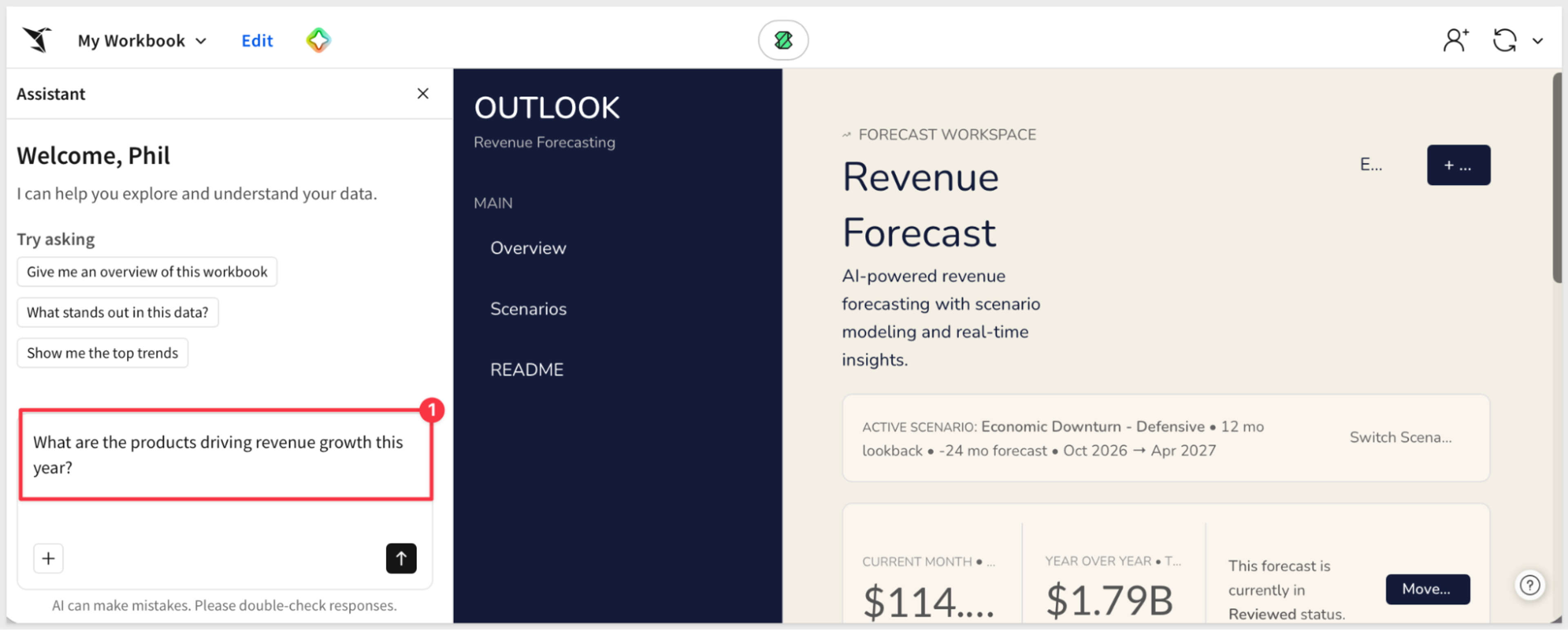
Caption: Ask Sigma Assistant a plain-language question, and it answers directly against your governed revenue forecast.
Embedded, AI-assisted self-service for business users
The same governed AI extends to the self-service and embedded experiences business users work in, so end users can ask questions in natural language and get answers scoped to their own data. Business users get direct access without leaving governance, and analysts get a queue that no longer fills up with routine pulls.
Embedding Sigma Assistant in your own application is easy and the steps are detailed in the QuickStart: Embedding 08: Embedding Sigma Assistant:
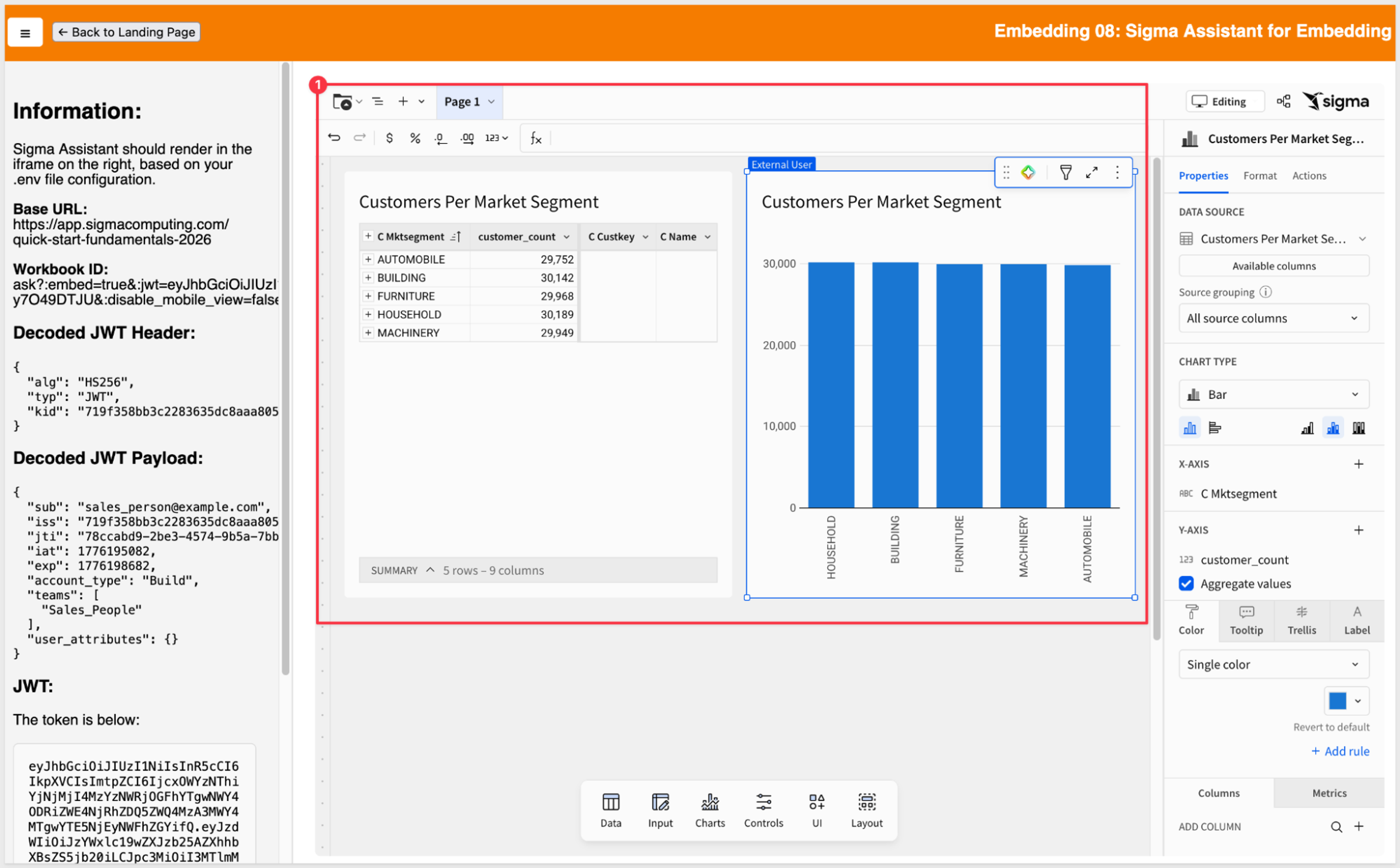
Caption: The same governed Sigma Assistant can run inside an external app, scoped to that user's JWT-based permissions
Sigma Agents for automating recurring analyst tasks
Sigma Agents are customized workflows a builder configures inside a workbook, with defined data access and specific actions the agent can run. A revenue team might schedule an agent to run before a weekly forecast review and summarize what changed, which deals moved, and where the risks sit, so the meeting starts from analysis instead of prep. The agent carries forward a goal the analyst set, and it inherits the permissions of whoever calls it.
Start building AI-augmented analyst workflows with Sigma
AI will enter analyst workflows whether it's sanctioned or not. Governed AI that analysts can inspect and correct beats a disconnected chat window with no equivalent path to check the work. Sigma connects governed access, analysis, validation, and configured actions on one canvas, so the question, the AI-generated answer, and the permitted next steps all inherit the governance the data team already built.
Pick one recurring report or one routine question your team answers every week, and see how much of it AI can already carry. To see how it works on your own warehouse, request a Sigma demo today. You can also learn more by:
- Starting a free trial
- Exploring Sigma Public
- Reviewing our QuickStarts: Sigma Fundamentals and AI Apps in Sigma