AI for Data Analysis: An Operational Guide

Data analysis has always been about turning raw data into decisions. AI now sits inside the data analysis workflow, changing who can do it, how fast, and at what scale. That reach runs end-to-end: from the question someone asks to the writeback that updates a record, sends a notification, or triggers a downstream workflow.
This guide covers what AI for data analysis is, what it adds to the workflow, how it works within the pipeline, where humans still stay in the loop, and how Sigma supports it end-to-end.
Key takeaways
- AI lets more people work with data, faster. A business user can ask a question in plain English and get an answer from live warehouse data in seconds, without waiting on an analyst to write SQL.
- An AI answer is only as reliable as the data behind it. When AI runs on the live warehouse with permissions and row-level security applied at query time, users see only the data they're allowed to see, and every answer can be traced back to the source.
- AI can generate a query, a chart, or a recommended next step, but a human must review the output before it becomes a decision or writes anything back to the warehouse.
What is AI for data analysis?
AI for data analysis is the application of artificial intelligence (machine learning, natural language processing, statistical models, and generative AI) to any step of the data analysis workflow. It covers the use of AI for data preparation, querying, exploration, pattern detection, forecasting, interpretation, and action.
Using AI for data analysis overlaps significantly with augmented analytics: the use of enabling technologies such as machine learning and AI to assist with data preparation, insight generation, and insight explanation. Both terms describe the same shift: AI is taking on parts of the analytical workflow that once required specialized skills.
The scope reaches every stage of the workflow and extends beyond generative AI. A production stack usually blends several implementations:
- Classical machine learning and statistical models power anomaly detection, clustering, classification, and regression.
- Predictive and time series models handle forecasting, risk scoring, and demand planning.
- Natural language processing turns plain-language questions into queries, and unstructured text into structured signals.
- Generative AI and large language models (LLMs) translate questions to SQL, summarize results, explain what changed, and draft narratives around the numbers.
- Agentic systems combine the above with tools and actions, enabling an agent to reason, analyze and take the next step.
Generative AI gets most of the attention because most people first encounter AI through chat interfaces, but high-performing systems match the job to be done to the right AI implementation.
What AI adds to data analysis
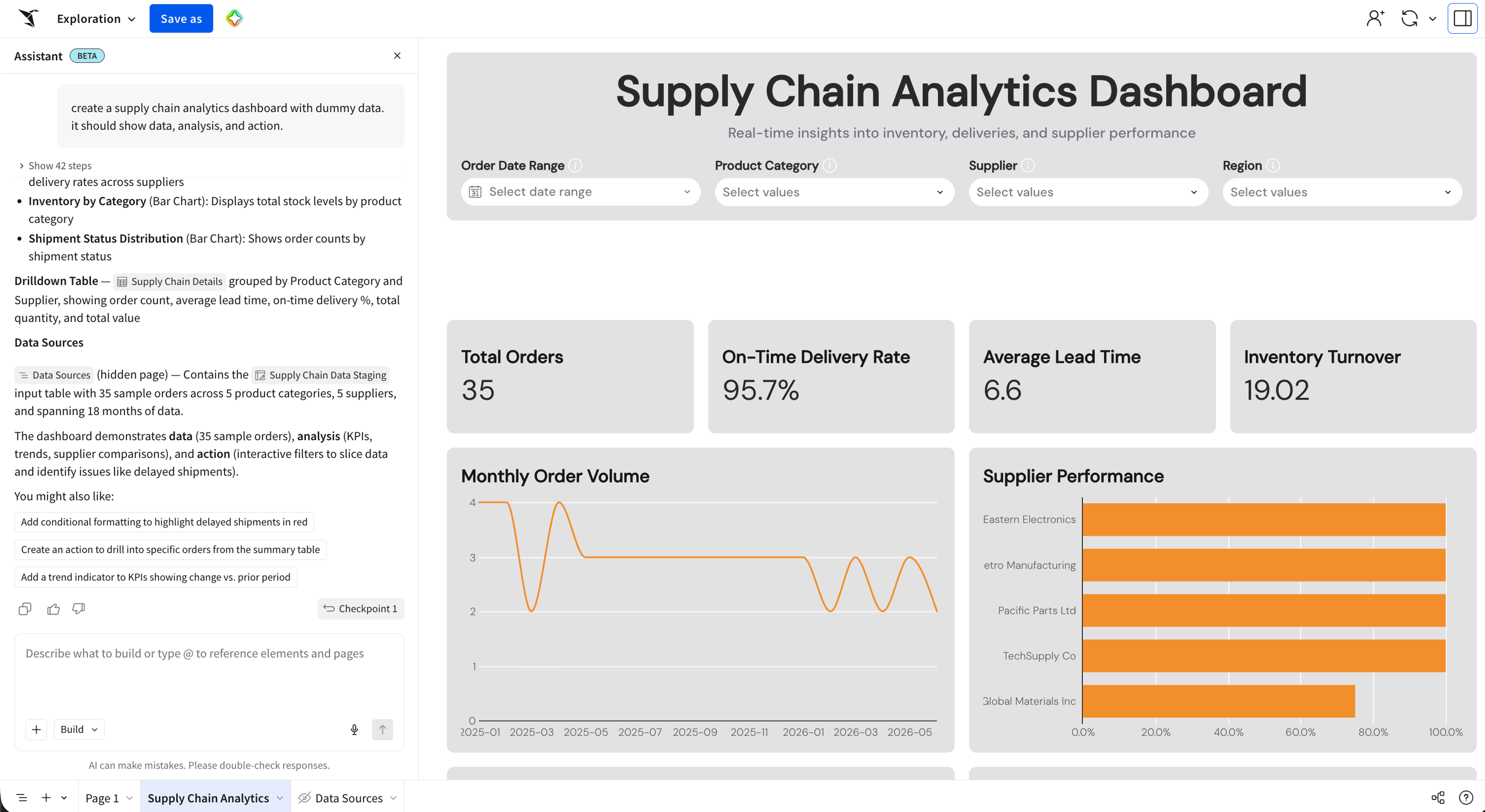
Traditional data analysis is bottlenecked by two constraints: the number of people who understand the data catalog, can write SQL or Python, and time they have in a day.
Natural-language access to warehouse data
Legacy BI routes almost every question through a small pool of analysts. The person with the question describes it in business language, an analyst translates it into SQL, validates the result, and sends back a chart. Each handoff adds delay, and the person waiting can't iterate.
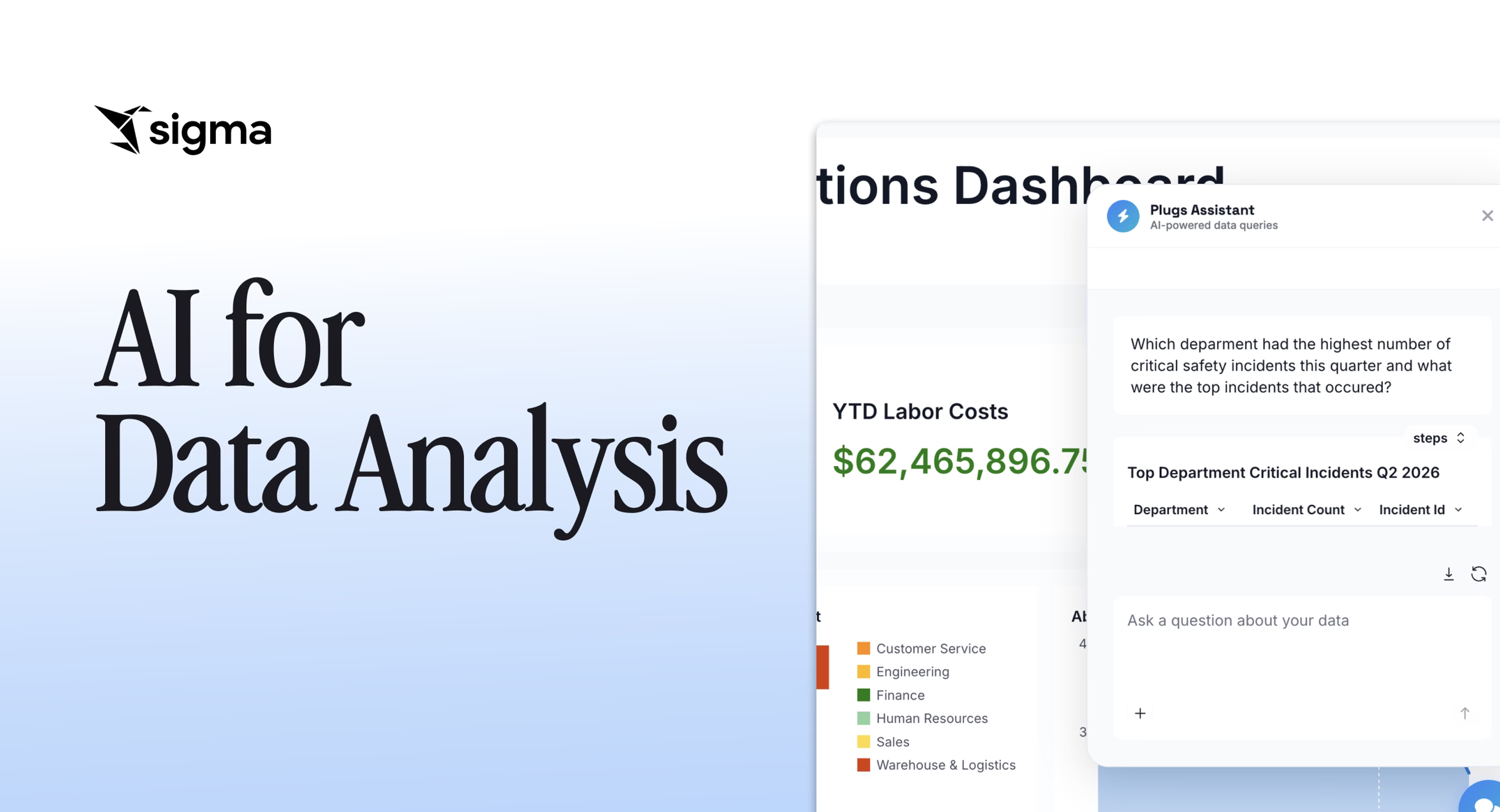
With AI, business users can access the warehouse data directly. They can ask a question in plain English, and AI translates it against a governed data model, so the person with the question gets the answer, without needing to learn SQL or go through an intermediary.
Relief for overstretched analyst teams
Analyst time is the other constraint most enterprises are trying to solve for, and hiring can't keep pace with demand. Employment for data scientists is projected to grow 34% from 2024 to 2034, faster than the average for all other occupations. That gap means demand for analytical work is outpacing the supply of people trained to do it. Every analyst ends up with a queue longer than they can work through, and requests that require judgment sit behind requests that don't.
AI relieves that pressure by shrinking the queue itself. When business users can self-serve routine questions (recurring pulls, standard summaries, first-pass exploration), fewer requests reach the analyst team, and the ones that do are the ones that actually need an analyst. Enterprises using generative AI at scale report daily time savings of 40 to 60 minutes per employee, with engineers and data scientists reporting up to 80 minutes.
Enterprise-scale pattern detection and forecasting
Some analytical work simply can't be done manually when operating at enterprise scale, and some can't be done fast enough to matter. AI addresses both and opens up categories of work that manual analysis can't reach:
- Anomaly and outlier detection. Hybrid machine-learning approaches identify multivariate outliers that simpler univariate methods miss. They surface irregular transactions or signals no analyst would catch by inspection.
- Automated forecasting and modeling. AutoML automates feature engineering, model selection, and hyperparameter tuning. Time-series foundation models, such as Amazon's Chronos and Google's TimesFM, support zero-shot or few-shot forecasting.
- Multimodal signal extraction. LLMs and vision models convert PDFs, images, and free-text fields into structured attributes for classical analysis.
None of these additions are guaranteed by adopting any one AI product. They show up when AI is wired into the same data, definitions, and permissions the rest of the business already trusts.
How AI works inside the data analysis pipeline
Whether AI adds speed a business can trust or introduces risk it can't see depends on what happens between the question and the answer. The pipeline below traces that path, step by step, and shows where governance either holds or leaks.
1. Grounding on the data
An AI system that answers questions about a company's data has to know what the data is. That grounding usually comes from three sources:
- The warehouse schema: the tables, columns, and data types the AI has to work with.
- A semantic layer or data model: definitions of business concepts such as revenue, customer, and active user.
- Reference examples: certified metrics, endorsed reports, and other curated artifacts the AI can learn the organization's conventions from.
Without that grounding, an LLM can generate syntactically plausible but semantically incorrect answers that reference non-existent tables, columns, or endpoints.
2. Schema linking and intent resolution
When a user asks a question, the system has to identify which tables and columns are relevant and what the user means. Current text-to-SQL methods increasingly use multi-stage agentic pipelines that filter schemas, explore columns, and refine candidate queries. Multi-stage matters because enterprise schemas have hundreds of tables, obscure column names, and semantic ambiguity a model can't resolve alone. Explicit business definitions and semantic layers reduce the ambiguity the model has to guess through.
3. Query generation and validation
Once the system knows what to ask, it generates a query, usually SQL for structured warehouse data. Query generation is followed by validation: syntax checks, sanity checks on result size, and permission checks so that the query respects row-level security and column masking. A validated query won't error out, won't exceed guardrails, and won't return data the caller isn't allowed to see.
4. Query execution against live data
The validated query runs against the source data, ideally the live cloud data warehouse rather than an extract. Executing on live data means the answer reflects the current state, and the execution is all in the warehouse.
5. Interpretation and response
The system takes the query result and turns it into an answer the user can act on: a chart, a summary, a narrative, or a follow-up prompt. Good systems keep the query, the underlying data, and the reasoning inspectable, so a user can verify the answer rather than trust it blind.
6. Action, writeback, and audit
For AI systems that do more than answer questions (agents, in particular), the workflow closes with an action: writing a recommendation back to a table, updating a status, sending a notification, or calling an external API. Every step in the chain (prompt, model, query, result, action) is logged, so the outcome is traceable end-to-end.
Where humans stay in the loop
AI does more of the mechanical work of analysis, but humans still own the decisions that shape it and the ones that follow from it.
Strategic direction and problem framing
AI can answer questions well. It can't always decide which questions are worth asking. Choosing what to analyze, why it matters, and how the answer will feed a decision remains a human job. A well-framed question routed to AI produces a useful answer. A poorly framed one produces a confident answer to the wrong question.
Judgment on causal and ambiguous questions
Humans must still provide causal reasoning and domain context because LLMs can still make spurious correlations, especially when they lack an internal causal model. Such causal reasoning errors can show up in answers in which AI flags an anomaly and misattributes its cause. Hallucination is another failure mode to watch for, as humans can miss plausible but incorrect output when it is presented with enough confidence.
Review and approval before decisions or writeback
In regulated domains, human-in-the-loop oversight and explainable reasoning are required controls.
How Sigma supports AI for data analysis
Sigma is the runtime layer to build and scale AI Apps, analytics, and agents on live cloud data warehouse data. It sits between the warehouse and the AI tools generating against it. The runtime turns their outputs into production-ready software that inherits the organization's existing governance for permissions, audit, lineage, and change management.
Sigma AI requests through the warehouse itself. Analytical actions, including spreadsheet formulas and natural-language questions, compile to SQL that executes inside the connected warehouse.
Sigma Assistant for governed natural-language analysis
Sigma Assistant supports governed natural-language analysis and app building. Analyze with Sigma Assistant is GA for live-data questions, and Build with Sigma Assistant supports app building in natural language.
Answers draw on the organization's data models, certified metrics, and endorsed workbooks as context. Every answer is verifiable: inspect the query, trace it to the underlying table, and audit the analysis in a workbook. Queries are validated before execution, so malformed or randomly generated SQL never reaches the warehouse, and row-level security remains intact throughout.
Sigma Agents for scoped, governed actions
Sigma Agents are customized agentic workflows that a builder configures, scoped to specific data and defined with instructions and actions. A single agent can analyze a question, propose a next step, and execute an approved action, including writeback through an Input Table, notifications, REST API calls, webhook triggers, and stored procedure execution.
Agents run on the customer's choice of models, including models from Anthropic, OpenAI, and Gemini, as well as warehouse-native models via BigQuery, Databricks, or Snowflake Cortex. Builders choose from three interaction modes depending on how much autonomy the workflow calls for:
- Conversational. A user and agent iterate turn by turn, with the agent responding to each prompt in context.
- Human-in-the-loop. The agent proposes an action, and a person reviews and approves before it lands.
- Autonomous. The agent executes against goals a human has configured in advance, without a per-action approval step.
Conversational and human-in-the-loop modes fit workflows where review adds value or is required, while autonomous mode fits repetitive, well-scoped tasks for which a builder has already defined guardrails.
Get started with AI for data analysis with Sigma
The platform you choose for implementing AI for data analysis determines whether AI operates within the governance, oversight, and audit trail the organization already requires.
Sigma keeps AI Apps and analytics on the live warehouse where governance already lives, so every answer inherits row-level security and every action is traceable from question to writeback. Business users get the speed of natural-language analysis, IT keeps the guardrails, and analysts get their time back for the work that actually needs them.
Try Sigma free or get a demo to see AI for data analysis running on your own governed warehouse data.