Introducing full stack apps in Sigma: IT-managed apps that anyone can build

I’ve always believed that the people who understand a business problem best should have the power to solve it. They shouldn’t have to wait months for engineering resources or settle for software that doesn’t fit their needs. On the other end, adoption of generic AI app builders is fueling a new wave of shadow IT and application sprawl.
Today, I’m excited to introduce a new way to build in Sigma that lets you create virtually any custom application simply by describing what you want. From there, AI builds working React applications with custom interfaces and business logic.
We’re combining the simplicity of vibe coding with the security, governance, and infrastructure that make Sigma a trusted platform for data and AI among leading banks, insurers, and healthcare institutions.
AI means anyone can build an app, and people already are. The harder question is where those apps get run and managed. Sigma gives businesses one place to run and manage the growing number of AI-built assets they’ll depend on, from analytics and agentic workflows to custom applications, without multiplying the complexity of their technology stack. Business teams can build, deploy, and scale apps directly in Sigma. All they need is a connection to their cloud data warehouse. That means business teams can move quickly, while IT retains the ability to manage what gets built at scale.
We’ve spent more than a decade building for enterprises. This is the next chapter in Sigma’s evolution from analytics into applications, workflows, and AI.
We’re making this new experience available today through a private beta, with plans to roll it out to all Sigma customers over the coming months.
Build anywhere, manage in one place
It goes without saying that AI is rapidly changing how software gets built. Employees are already using AI to create applications, often outside the systems IT manages.
While this unlocks tremendous innovation, it also creates real challenges. Apps built with standalone AI tools can introduce security risks, fragmented data access, technical debt, and a growing collection of infrastructure and vendors that IT must manage at scale. Building anywhere is fine. What businesses need is one place to manage what gets built, and that is where Sigma has a critical advantage.
We’ve spent years helping organizations move beyond analyzing data to building applications and operational workflows directly on their cloud data platforms. Our customers already use Sigma’s writeback capabilities to turn insights into action. Now, we’re bringing that experience to a new generation of AI-built applications.
Build with AI, scale with Sigma
In Sigma, business teams get the speed of AI-built apps tailored to their exact needs, while IT gets the infrastructure and controls to operate and scale them with confidence.
The new experience brings together:
- AI-powered app generation: A new interface in Sigma that generates React applications with fully customizable user interfaces and business logic.
- Governed enterprise data: Existing warehouse connections, data models, authentication, and per-user access controls.
- Enterprise runtime: Secure, scalable hosting and execution with built-in administration, security, and auditability built on the Sigma platform.
- A connected ecosystem: Access to Sigma’s broader analytics, applications, agents, and AI capabilities.
- Sigma Tables: Shared tables that custom apps can transact with, while enabling admins to control who edits what.
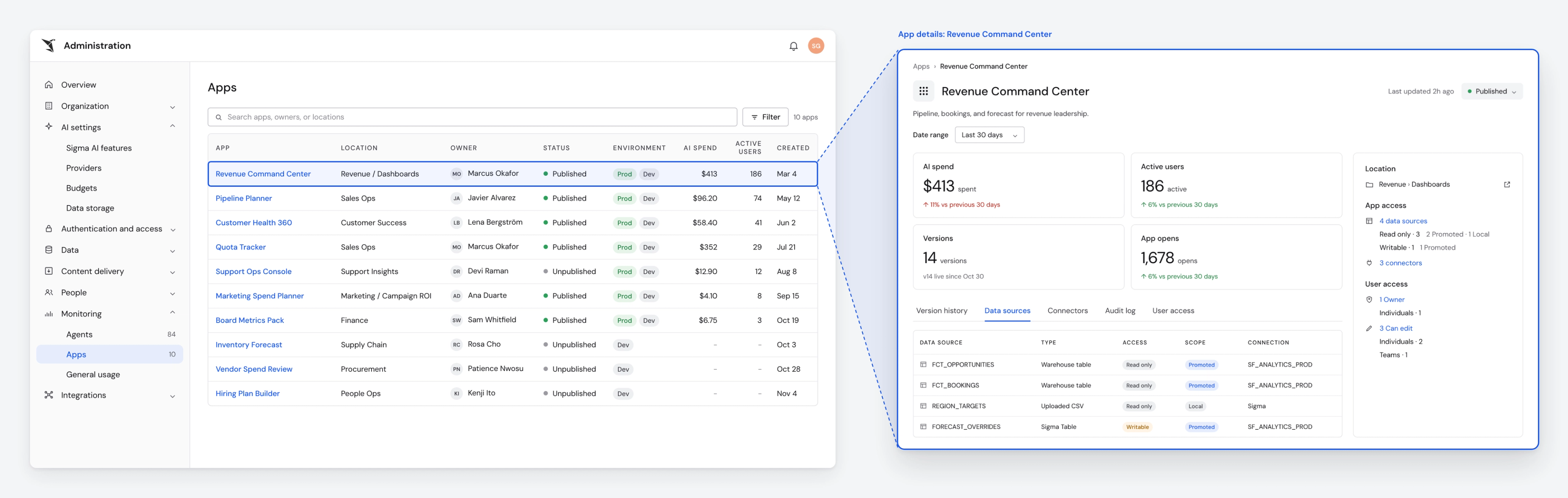
- Centralized app visibility: See every app, its owner, usage, access permissions, and AI costs in one place, giving IT complete visibility and control.
- Analytics on app usage: Analyze usage data directly in your own cloud data warehouse, and share insights across the business with permissions you control.
Businesses can build applications across the full spectrum—from simple departmental workflows like expense approvals, support ticketing, and team scheduling to complex, cross-functional systems of record for customer onboarding, inventory management, and service operations. Each can be tailored to how the business actually works, whether it supports a single team or coordinates critical processes across the enterprise.
Here is how that plays out in three apps.
Expense approvals. A finance team builds an approval flow tailored to its own policy. Because the app runs on Sigma, it uses each person’s existing warehouse permissions, and admins control who can edit the approvals table through Sigma Tables.
Support ticketing. A support lead replaces a standalone ticketing tool with an app built around the team’s actual queue. Tickets live in shared Sigma Tables, so IT adds no new vendor, no new infrastructure, and no separate access model to manage.
Team scheduling. An operations manager describes how shifts really work and gets a working scheduling app without filing an engineering request. It runs on Sigma’s built-in administration, security, and auditability, so IT sees it alongside every other asset instead of finding out about it later.
In each case the business team moves on its own, and IT keeps one place to see, secure, and manage what was built.
The next chapter for Sigma
This is part of a much larger shift in enterprise technology. For years, companies have relied on an ever-growing collection of SaaS applications to run their businesses. They’re paying more and more for software that doesn’t quite fit their needs, while critical data remains trapped in disconnected systems. As AI makes custom software dramatically easier to create, I believe we’ll see more organizations move toward building the applications they need on their own enterprise cloud platforms.
That shift has enormous potential to help businesses move faster, reduce costs, and get more value from existing investments in data and AI.
Our ambition is to make Sigma the platform where businesses don’t just understand their data, but build and operate the applications and intelligent workflows that run their business.
And we’re just getting started.
Help us build what’s next
We’re introducing our new app-building experience through a private beta. Interested in joining? Fill out the form below to request access. We’ll review submissions and reach out to selected participants with next steps.
You can also see 50+ examples of apps created by the Sigma team with this new functionality.
Join the private beta waitlist
Be first to know when the private beta opens.