How AI Is Replacing SaaS in Data Analytics

The finance manager needs a variance report before Monday. She pulls last quarter's actuals from a business intelligence (BI) dashboard, drops them into a separate planning tool to rerun the forecast, and exports the result to a spreadsheet so she can write commentary a stakeholder will actually read. Three tools, one workflow, a full afternoon gone. She'll do a version of it again next week, and the week after that.
That is the analytics stack many teams still run today. AI is starting to answer questions, build reports, and write results back to the warehouse directly, so querying, planning, forecasting, and data entry run as governed workflows on live data instead of getting stitched together by hand.
Key takeaways
- The analytics stack is bloated because people move data by hand between dashboards, planning apps, and workflow tools, and each of those tools bills separately for a seat on the workflow.
- AI closes the manual handoffs rather than the underlying capabilities, so querying, reporting, forecasting, and data entry all stay, while the standalone tools that only existed to bridge those handoffs become harder to justify as separate subscriptions.
- The bar for safely retiring a SaaS subscription is AI that can query and write back to governed warehouse data, with a full audit trail of what changed and who changed it.
Why the analytics SaaS stack got so bloated
The bloat comes from a simple constraint: each analytics capability shipped as its own standalone tool, and those tools rarely connected well enough to carry a workflow end to end.
Each tool ends where its own output ends
Dashboarding, forecasting, and workflow apps each stop at their own output: a chart, a scenario, or a submitted form. The dashboard shows a variance number but can't rerun the forecast against it. The planning tool can rerun the forecast but can't push the new assumption into the system the ops team actually uses. The workflow app can route an approval but has no idea where the number came from or whether it's still current. Every tool sits as a hub, good at its own function and blind to everything after it.
A person is the connection between the hubs
Because the hubs don't reach each other, someone has to. An analyst reads a number off one screen and types it into another. A finance lead pastes an export into a planning model. A team lead emails a screenshot to the person who owns the next system. The stack often works because people do the integration by hand across the workflows that touch data.
Every hub bills separately
Once each hub has a seat license, every new person on the workflow adds a line item to every hub they touch. Each hub bills by role: viewers in dashboards, modelers in planning tools, and editors in workflow apps. Enterprise SaaS portfolios can run to more than a hundred applications, and the analytics slice of that portfolio is dense on its own. The sprawl grew because the only way to connect two hubs was to pay a person to move data between them.
What "AI replacing SaaS" actually means for the analytics stack
Four capabilities are doing the real work of consolidation:
- Natural-language querying against governed warehouse data replaces the analyst-pulls-an-export step.
- Natural-language app building turns a described spec into a working dashboard or app, replacing the analyst ticket queue.
- Writeback lets a forecast assumption or commentary land directly in the warehouse, so it never has to travel through an emailed spreadsheet.
- Agentic workflows carry the sequence forward, acting on instructions a person configured, with approvals wherever they write data or trigger a downstream system.
With those four capabilities in place, tools that existed only to bridge two other tools lose their per-seat justification. Up to $234 billion of enterprise application spend, roughly 20% of the category by 2030, is set to shift as agents take on that work, and the spend moves toward the platforms where the workflows now run end to end.
AI needs governance to close the handoff safely
Retiring a SaaS subscription safely takes more than an AI that can answer a question. It takes warehouse-native AI that reads and writes against the same governed data, permissions, and lineage the rest of the stack already runs on, so nothing slips outside the controls IT and compliance already trust.
A chat window doesn't fully replace data sources
Point a language model at an exported spreadsheet, and it will happily answer questions. It will also happily invent columns, misread joins, and confidently return numbers that don't reconcile with anything the business already trusts.
On the BEAVER benchmark, built from real enterprise databases averaging 101.5 tables and 869.4 columns, state-of-the-art generic agentic methods reach only 10.8% accuracy, against 62.9% on the academic Spider 2.0 benchmark. The gap is context. A warehouse-native platform gives the model the semantics a raw schema doesn't: certified metrics, endorsed data models, row-level security, and lineage back to the source table.
Closing the handoff means writing to the system of record
Reading data out of the warehouse is only half the workflow. New values, forecast assumptions, and decisions have to write back to the warehouse where the rest of the business will read them. A forecast assumption sitting in a chat transcript still needs someone to move it into the planning system, which means the handoff never actually closed. Real replacement requires AI that writes back to the warehouse under the same governance, permissions, and lineage the read side already has, with agents carrying forward the goals a person configured and approvals gating every write or downstream trigger.
Governance has to survive the automation
Once AI writes data rather than just reading it, every change needs a trail: the original value, the new value, who or what changed it, and when. Without that trail, compliance teams block the deployment, and they're right to. So many AI pilots stall between demo and production because nobody can prove what the model did after the fact, even when the model itself is right.
How to use AI to replace SaaS in your data analytics stack
The playbook starts with one question: which handoff are you closing, and will the replacement reintroduce the same problem one layer down?
Map the handoffs first
List your analytics subscriptions in one column. In a second column, write down what happens between each subscription and the next: who exports, who pastes, who emails, who re-enters. That second column is the target. Start with subscriptions that exist because someone has to move data between two systems. Keep tools that do real work outside those handoffs.
Anchor AI on warehouse data
Every AI capability you introduce should query and write to the same governed data your BI layer already reads. A capability that needs an export to work creates a new handoff instead of closing the old one, and it asks you to reproduce your row-level security, certified metrics, and data models in a second place, which is exactly how the sprawl started the first time.
Require writeback with an audit trail before you retire anything
Don't retire the workflow app until whatever replaces it can log the change: what the row was, what it became, who changed it, and when. Without that, the compliance conversation ends the pilot, and you'll be running the old subscription for another year on top of the new one.
Retire one subscription at a time
Trying to swap the whole stack in a single quarter is how consolidation projects die. Pick one handoff, the one your team feels the most on a Monday morning. Close it, prove the audit trail holds, and cancel the subscription that existed to sit on either end of it. Then pick the next one. Each retirement gives the team proof for the next one.
How Sigma is enabling AI in data analytics
Sigma is an AI Apps and analytics platform for building and scaling analytics, apps, and agents on live warehouse data. It sits between your warehouse (Databricks lakehouses, Snowflake, BigQuery, Amazon Redshift, and others) and the AI tools generating against that data, turning what they produce into production-ready software governed by one control plane for permissions, audit, lineage, and change management.
Live queries mean there's no export to hand off
Sigma is warehouse-native. Formulas, filters, and pivots compile to SQL that executes in your warehouse, and governance is inherited at query time. The export step that started downstream handoffs in the old stack no longer has to happen, and the sync jobs that existed only to feed a separate analytics copy become candidates for retirement on day one.
Sigma Assistant means the question doesn't become a ticket
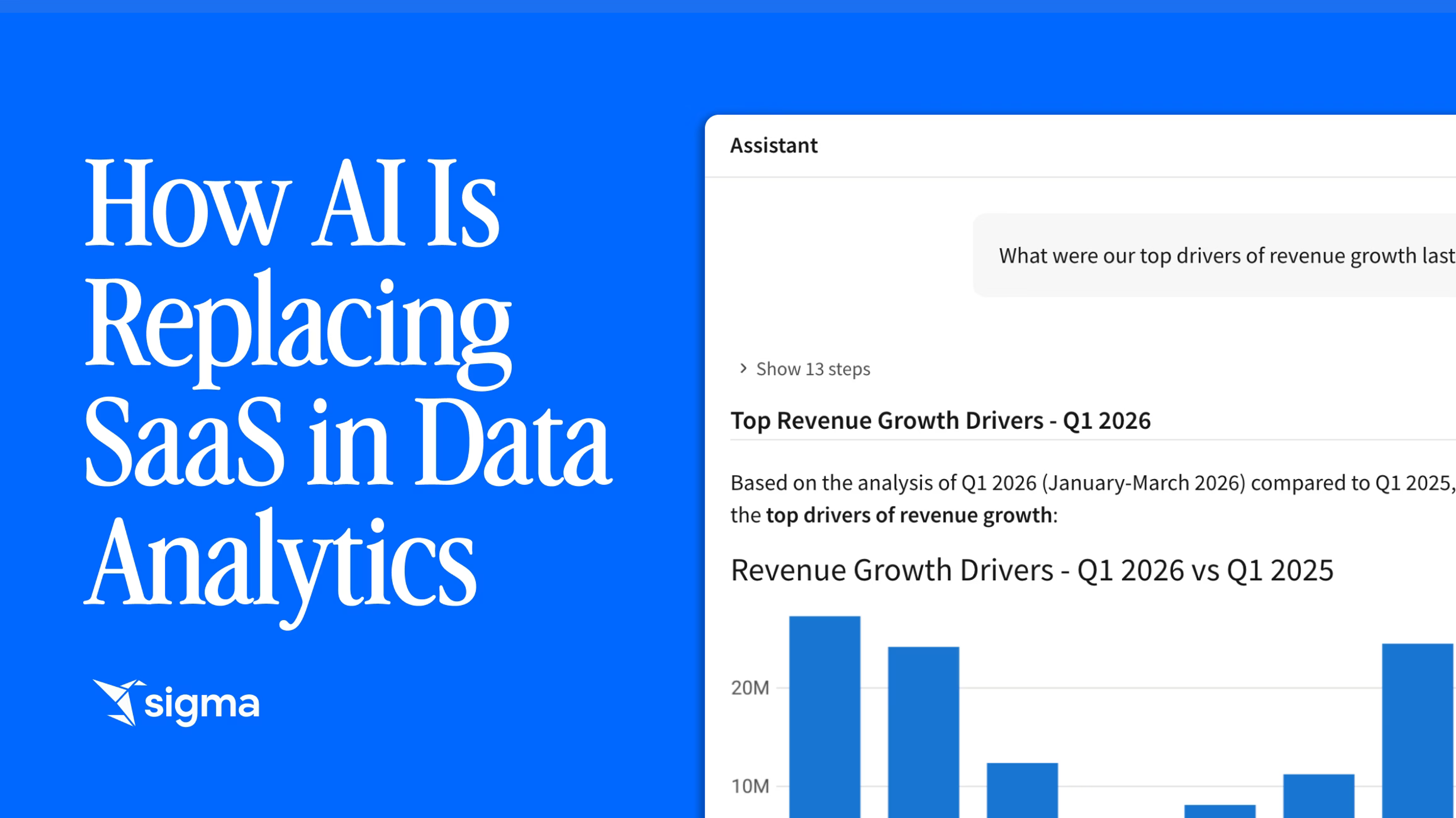
Analyze with Sigma Assistant answers plain-language questions against governed warehouse data. Answers draw from your data models and certified metrics, and query-backed responses can be inspected as SQL and traced back to the underlying tables. Build with Sigma Assistant, currently in beta, turns a described dashboard or application into real workbook elements you can edit on the canvas. The cycle that used to run "business asks, analyst files ticket, analyst rebuilds view, business waits a week" can shorten to a single step in a governed environment the data team already trusts.
Input Tables put the forecast into the warehouse directly
Input Tables bring data entry into the same workspace as analysis. A forecast assumption, a scenario input, or a piece of commentary writes back to the warehouse with a full audit trail. New writes land in a separate schema, which preserves the original warehouse data. The emailed spreadsheet, the separate planning tool, and the workflow app that only existed to catch the output no longer have to sit in the middle.
Get started with AI in your data analytics stack
You don't have to replace the whole stack at once. Pick the handoff your team feels most confident with and close that one first.
Swap a stale export for a live Sigma query against the warehouse. Use Build with Sigma Assistant, currently in beta, to draft the dashboard or application that takes a ticket and a week of waiting today. Replace the spreadsheet you email around with an Input Table that writes back to the warehouse with a full audit trail. Because Sigma runs on the warehouse you already govern, IT keeps visibility and control. At the same time, business teams gain speed, and each subscription you retire gives the team proof for the next retirement.