New in Sigma August 2026: the Sigma CLI, apps built by coding agents, and a secret manager integration

In August, we highlighted new ways to work with Sigma outside the browser. We featured the Sigma CLI, which exposes our REST API to your terminal. This means outside systems can call Sigma too, closing a loop that used to require a custom integration.
Most of what's below is in beta, and we note the status where each release appears. Here's August.
Sigma in your terminal
The Sigma CLI is generally available on macOS, Linux, and Windows. After you install it and run a single command, you can read or change anything Sigma’s public REST API exposes: workbooks and data models, connections and permissions.
Because it signs in as an API client over OAuth, it inherits the account types and permissions you already have, so you don't have a second access model to keep in sync.
Whether the command comes from your shell or from a coding agent, it takes the same governed path into Sigma.
Describe the workflow, get a governed app back
Workbooks as Code turns a workbook into a YAML spec you can read, version, and generate. It's still in private beta. On top of it is a set of Sigma Skills that teach a coding agent how to build in Sigma properly.
TJ Wells, a product advocate at Sigma, pulled the YAML from a few of Sigma's own production workbooks and handed the agent those files as the house standard. Then he wrote a skill that interviews you before it builds anything: does this workflow need approvals, does it need an agent, which fields should people be able to edit.
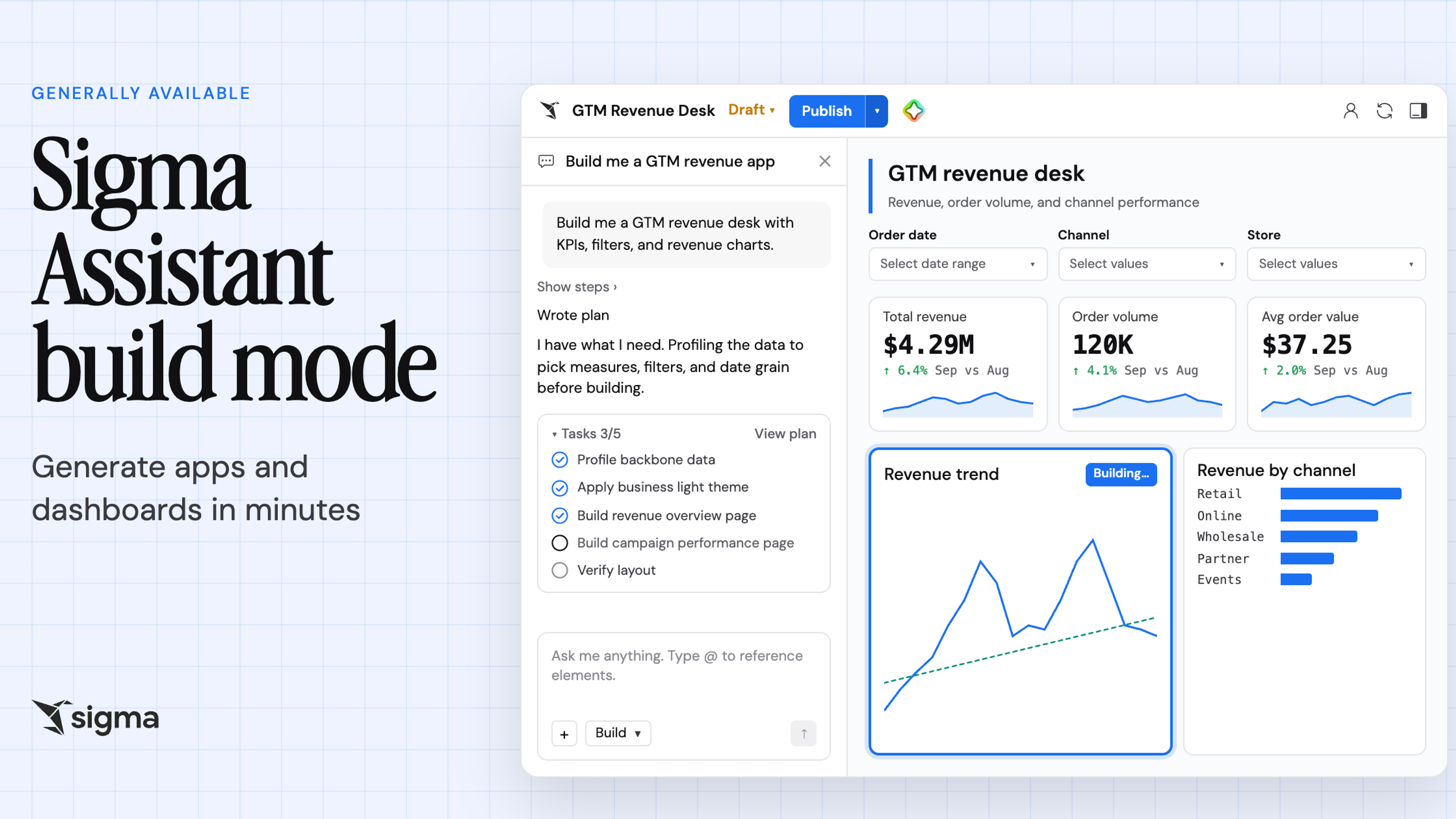
Eight minutes after describing a scenario-planning workflow, he had a working app with approval routing, an AI summary, and a Sigma Agent for planning, running on the same governed data model as everything else and writing back through Input Tables. Cursor tested the UI on its own before he opened it. That same build takes him a few hours by hand.
Somebody still has to say who can edit the plan, what needs approval before it counts, and what the agent is allowed to answer, which is why the skill asks first, and those decisions took exactly as long as they always did.
Migration Skills point the same technique at legacy content. The agent reads the source, meaning the data, the metadata, and how people use it, then proposes what could become an app. It recreates the dashboard, then offers to turn the spreadsheet somebody re-uploads every Monday into a forecasting app with writeback.
Sigma connects to the rest of your stack
Webhook triggers, in public beta, let an outside system POST to a Sigma endpoint and start a sequence of actions. That makes an AI App bidirectional: a deal moves in Salesforce and the change lands in Sigma, or a Slack approval comes back and opens a Jira ticket. If you already run a flow in n8n or Zapier that ends with data you want in Sigma, point it at the webhook URL, and the sequence takes it from there.
Sigma can use Claude models directly now, also in public beta. Add your Anthropic API key and Claude powers Sigma Assistant, Sigma Agents, Formula Assistant, and Explain this Chart, with the spend and the security sitting on your Anthropic contract, not ours.
Anthropic models aren't available for embedding configurations, and because Anthropic doesn't offer an embeddings model Sigma can use, semantic search still needs a separate provider.
The MCP server is also getting upgrades beyond answering questions. Design a workbook, drop the screenshot into Claude Code, and ask it to turn that design into a Sigma dashboard. That work is still in development, along with a Sigma plugin for Claude, Codex, and Cursor that pairs the MCP tools with skills for moving content out of Looker, Tableau, Power BI, or Excel.
Isolation you don't configure twice
Sigma Tenants is generally available. A tenant is a complete Sigma organization with its own users, data, and content, connected to a parent organization that keeps governance and visibility in one place. Isolation is architectural, so it holds no matter what anyone changes to permissions inside a tenant later.
Content now organizes into folders, with a dependency list you can read before you push, and a deployment carries Input Table data along with the user attributes behind row and column security, so a tenant receives complete content and nobody finishes assembling it by hand on the far side. Tenant organizations also support usage analytics and audit logging, and audit logging is enabled per tenant, so turning it on in the parent doesn’t turn it on everywhere. Embedded tenants now behave like any other Sigma workbook. Because any tenant can deploy to another, a real development, staging, and production pipeline works without routing every promotion through a central team.
Hundreds of customers are already running thousands of tenants today.
Your credentials stay in your vault
The secret manager integration is in public beta, with HashiCorp Vault and AWS Secrets Manager.
Sigma retrieves a credential from your vault when it needs to authenticate and keeps no copy of it. Link the store to your organization, add your secrets, then reference them per connection. It covers warehouse connector credentials (passwords, private keys, OAuth secrets), the API credentials an app uses to call an external service, and the MCP tool credentials an agent uses to reach outside systems.
Rotate on your own schedule; Sigma picks up the change, and if you revoke it, Sigma can no longer retrieve it. No separate request to Sigma, and nothing to update inside Sigma when the credential changes.
More that shipped
- Bulk insert (public beta). A single action adds many rows to an Input Table. with no cap on the count. Run it on click or on a schedule, and a scheduled run stacks a fresh dated snapshot each period.
- AI Apps people built. A manufacturing finance team traces a margin variance down to the SKUs missing yield targets, logs the corrective action, and lets agents write the fix back to the warehouse. New to Sigma? Request a demo or start a free trial to see it on your own warehouse. You can also build and share for free on Sigma Public, no license or warehouse required, and the QuickStarts walk through the secret manager setup for Vault and AWS step by step.