6 Embedded analytics use cases across industries

Embedded analytics use cases can't be treated as a one-size-fits-all category. The data that matters, the next action the user takes, and the compliance rules governing access all shift meaningfully from one industry to the next.
This article covers six industries (financial services, healthcare, retail, insurance, logistics, and manufacturing), how each one shapes an embedded analytics use case, and how one platform can serve them all.
Key takeaways
- The use cases for embedded analytics are industry-specific, not generic. Three things vary by vertical: the data that matters, the next action the user takes, and the compliance regime governing access.
- Value shows up when the embed sits inside the tool the user already uses and carries them from insight to a concrete action. It disappears the moment the embed just points them to a separate dashboard to interpret.
- Multitenant embeds serving regulated industries need controls enforced at the data layer, not just the application layer. That means row- and column-level security, audit logs, and tenant isolation applied where the query runs, not bolted on in the application.
Why embedded analytics use cases are industry-specific
The core embedding architecture (iFrames, scoped tokens, row-level security, writeback) is shared across industries. The product built on top of it is not. Three things vary from one industry to the next: the data that matters, the next action the user takes, and the compliance regime governing both. Miss any one of these three, and the embed becomes shelfware, regardless of how well the underlying architecture is built.
The relevant data is industry-specific
The value of embedded analytics lives in the data it surfaces, and no two industries surface the same thing. Get the data model wrong, and the embed answers the wrong question, no matter how polished the interface. Representative examples:
- Retail teams work with live inventory state, stock on hand by stock keeping unit (SKU), sell-through by location, and days of supply.
- Insurance teams review fraud scores, claim-to-premium ratios, historical claim patterns, and telematics events.
- Healthcare teams work with care gap status, risk scores, and screening completion, much of which can include protected health information (PHI).
- Logistics teams track shipment status, ETAs, dwell and detention times, and exception flags.
- Manufacturing teams monitor overall equipment effectiveness (OEE), scrap rates, cycle times, and corrective action status.
Each domain calls for its own data model, refresh cadence, and presentation.
The required action is industry-specific
An embed that only shows information is a report. An embed that carries the user through to the next step is a workflow. What that step looks like changes by industry:
- Retail: the planner triggers a replenishment order or applies a markdown from within the embed.
- Insurance: the adjuster logs a documented decision (clear, investigate, escalate, or deny) against a specific claim.
- Healthcare: the care team flags a patient for outreach, orders a screening, or routes a case to care management.
- Logistics: the operator dispatches an exception, reroutes a load, or notifies a customer.
- Manufacturing: the supervisor opens a corrective action, adjusts a schedule, or holds a batch.
Each action has to route back to the system of record.
The compliance regime is industry-specific
Every embed inherits the compliance posture of the industry it lives in. The controls that suffice in retail don't suffice in healthcare, and vice versa:
- Retail systems handling personal data may be subject to General Data Protection Regulation (GDPR) privacy requirements.
- Insurance workflows may need to account for state regulation, financial-reporting traceability, and documented approval workflows.
- Healthcare systems touching electronic PHI fall under the Health Insurance Portability and Accountability Act (HIPAA) Security Rule, which makes audit controls a required technical safeguard.
Multitenant products serving regulated industries should enforce isolation at the data layer, not just the application layer, so the tenant boundary matches the boundary an auditor would recognize.
Embedded analytics for financial services
Advisors and clients need portfolio changes visible in the same portal where they discuss strategy. Compliance officers need alert queues with risk context in the same workflow that produced them. Both use cases fail when analytics lives in a separate BI tool, and both benefit from the same embedded analytics features with different row-level cuts.
Portfolio and account dashboards inside client portals
Advisors and account holders shouldn't have to leave their portal to see what changed today. An embed collapses that trip and puts positions, performance, and next actions in the same window. A wealth-management platform might split its embed by audience:
- The advisor view surfaces client counts, new accounts, and firm key performance indicators (KPIs).
- The client view shows projected income, estate views, allocation, performance, and transactions.
The same architecture serves both audiences with different row-level cuts.
Transaction monitoring with embedded alerts
Compliance officers work through queues that are long, noisy, and time-sensitive. Embedding alert queues with risk context in the compliance workflow lets officers prioritize instead of triaging blind, and the cost of getting this wrong is concrete, not theoretical. United Overseas Bank works through more than 5,700 monthly alerts with AI-assisted prioritization.
Embedded analytics for healthcare
Healthcare carries the tightest compliance bar of any industry in this article, and it defines what an embed can do. The Health Information Technology for Economic and Clinical Health (HITECH) Act applies the HIPAA Security Rule to business associates the same way it applies it to covered entities. So, an analytics vendor handling electronic protected health information (ePHI) is directly liable for violations. That liability is why multitenant isolation matters here more than anywhere else.
Patient and population health dashboards
Care gap data does its work at the point of care, inside the electronic health record (EHR) the clinician already has open. Anywhere else, it arrives too late. An embed brings clinical monitoring into the care team's live workflow, so a medication affordability problem surfaces during the visit rather than in a follow-up chart review, and outreach can start before the patient leaves.
Operational and claims reporting for administrators
Administrators need a single patient view across payer claims, health information exchange (HIE) feeds, and lab results, without exposing more PHI than the role requires. Access must follow HIPAA's minimum necessary standard, which means role-based policies define which classes of workforce members can see which categories of PHI. In a multitenant product, that translates to three controls:
- The platform enforces row-level security at the data layer.
- Per-tenant audit logs give auditors a record they can inspect.
- Business Associate Agreements bind vendors that handle PHI.
The security team gets policies it can show an auditor, and the administrator gets an answer without filing a ticket.
Embedded analytics for retail and e-commerce
In retail, speed matters because the cost of getting it wrong is immediate. Inventory distortion costs global retail $1.7 trillion a year, equal to 6.2% of sales, with out-of-stocks making up 65.6% of the total. And when shelves sit empty, Amazon Prime members are 52% more likely than other consumers to buy online instead. Embedded retail analytics live or die by how quickly they turn signals into action.
Merchant-facing sales and inventory dashboards
Merchants need sell-through, days-of-supply, and inventory position in the same view where they place the reorder, not scattered across dashboards and spreadsheets. One effective layout:
- Sell-through by SKU with days-of-supply flags.
- Inventory by location, plus a consolidated view across locations.
- Reorder or markdown action logged from the same view.
At enterprise scale, generic reporting isn't enough. The embed has to reflect the merchant's actual assortment and location structure.
Customer behavior and campaign performance views
Behavior and campaign views belong next to the levers the merchant pulls. When search query, market basket, and repeat-purchase reports sit inside the same system where the merchant manages listings and campaigns, a weak search term or a strong repeat-purchase cohort leads straight to a pricing or advertising change, with no export and no handoff.
Embedded analytics for insurance
Brokers, adjusters, and policyholders already log into an insurance portal every day, and the industry can't afford to route them back out to a legacy BI tool. Incumbent carriers often support disparate lines of business through disjointed data silos, so the embed has to unify the experience inside the portals users already know.
Claims status and risk dashboards for brokers
An adjuster-facing embed has to surface enough context to trigger a decision in the same view. A representative fraud-investigation layout shows four things:
- Fraud score (for example, 0.82) with weight drivers.
- Claim value against policy premium (a $45,000 claim against a $2,400 annual premium, an 18.75× ratio).
- Days since policy start (for example, 28).
- The clear/investigate/escalate/deny decision logged from the same view, with escalations routed to the special investigation unit.
Broker and customer claims portals can apply the same logic with live status tracking.
Policyholder-facing usage and premium views
Policyholders want to see their own risk profile, and they change behavior when they can. More than 21 million U.S. policyholders shared telematics data with their insurer in 2024. A policyholder app can present live risk scores and tailored driver feedback in the same interface the policyholder uses to pay a premium or file a claim. A static bill becomes an interaction that shapes next month's risk.
Embedded analytics for logistics and supply chain
Shipment data loses value by the hour, and end-to-end visibility across a supply chain network is genuinely hard to maintain. The embed must surface exceptions and support response in one place, on live warehouse data, or the delay compounds.
Shipment tracking and exception dashboards
Live tracking pays for itself when the exception reaches the person who can act on it. C&S Wholesale Grocers embedded FourKites tracking into its C&S Delivery Alerts product and cut internal productivity loss by 65%. Manage-by-exception works because the dashboard surfaces the late load, and the user triggers the next step (reroute, notify, dispatch) inside the embed.
Partner-facing inventory and fulfillment views
Shared portals give shippers and third-party logistics (3PL) partners the same live view of inventory and fulfillment status, but each partner wants a slightly different cut, and teams quickly accumulate near-duplicate reports. One embedded experience with per-partner filtering solves that.
Embedded analytics for manufacturing
In manufacturing, timing is the constraint. A dashboard outside the plant workflow arrives after the waste is done, and an overnight extract leaves the team reviewing yesterday. The stakes are steep: automotive downtime reaches $2.3 million per hour, and the cross-sector average is $260,000 per hour. A warehouse-native embed surfaces issues while there's still time to act.
Production and quality dashboards for plant teams
Plant supervisors need a live read on whether jobs are running to plan, and where the bottlenecks are, before the shift ends. Managers need an at-a-glance read on job status and which machining operations created bottlenecks. An embedded design should tie quality signals directly to corrective actions rather than leaving them for end-of-day reporting.
Supplier-facing performance and compliance views
Supplier performance has to be visible to both sides. For automotive manufacturers working under International Automotive Task Force (IATF) 16949, digital corrective-action workflows provide live visibility into supplier non-conformance resolution timelines. A supplier scorecard tracks:
- Defect rate against contracted thresholds.
- On-time delivery performance across shipments.
- Corrective action response time against agreed SLAs.
A supplier portal then lets vendors review their evaluations and respond to quality tasks inside the same system that scores them, closing a loop that email and PDF scorecards leave open.
How Sigma supports embedded analytics across industries
Embedded analytics has to sit inside the product the user already works in, tie insight to the specific action, and inherit the compliance posture of the industry it serves. One platform has to meet all three requirements at once, across six industries.
Sigma is the runtime layer for building and scaling analytics, AI Apps, and agents using live data from cloud data warehouses. Its embedded, data isolation, and writeback layers are each configurable per customer, so a healthcare team and a retail team can build on the same underlying architecture with different requirements.
Granular embedding down to a single workbook, page, or element
Teams can embed an entire workbook, a single workbook page, or an individual element such as a table, chart, or KPI, with configurable iFrame dimensions. The developer surface covers what a host application actually needs:
- The JavaScript Embed API and React SDK handle the integration itself.
- Single sign-on (SSO) and JWT claims pass per-tenant context for embed security and row-level access policies.
- Inbound and outbound events connect embedded interactions with host application workflows.
- Per-customer theming lets one embed match each customer's application.
Sigma's license tiers (View, Act, Analyze, and Build) let a host match each embedded audience to the interaction level it needs.
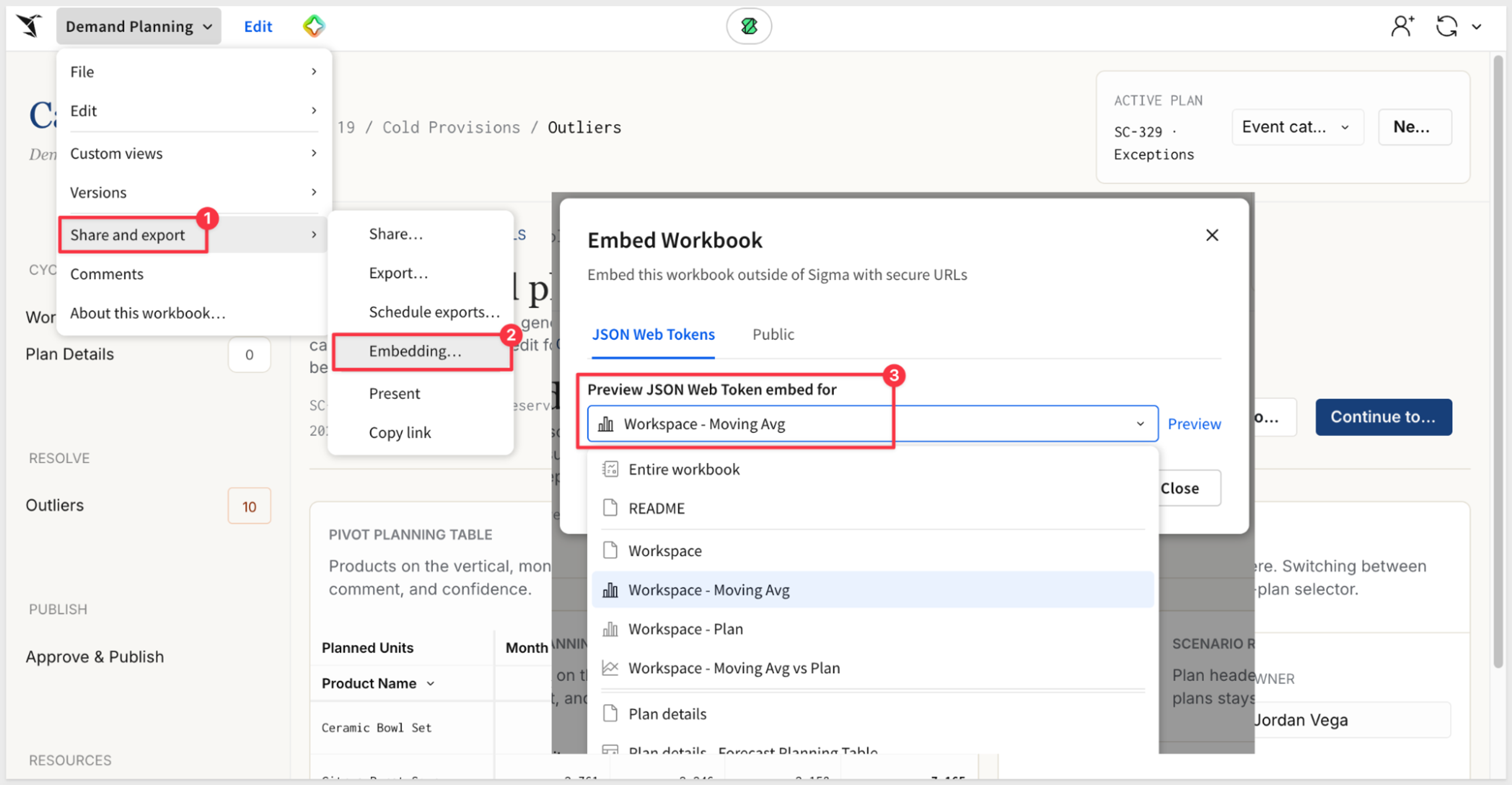
Caption: Sigma's Share > Embed panel: choose to embed a full workbook, a single page, or an individual table, chart, or KPI, with iFrame dimensions set per embed.
Sigma Tenants for multitenant data isolation
Sigma Tenants provides a multitenant environment with data isolation and cross-region provisioning. Row-level and column-level security are inherited from the warehouse at query time rather than rebuilt in a separate permissions model, so each tenant inherits the governance its industry requires. A healthcare deployment enforces the data-layer isolation HIPAA guidance calls for, while a retail deployment configures only the controls it needs, all under the customer's own governance model.
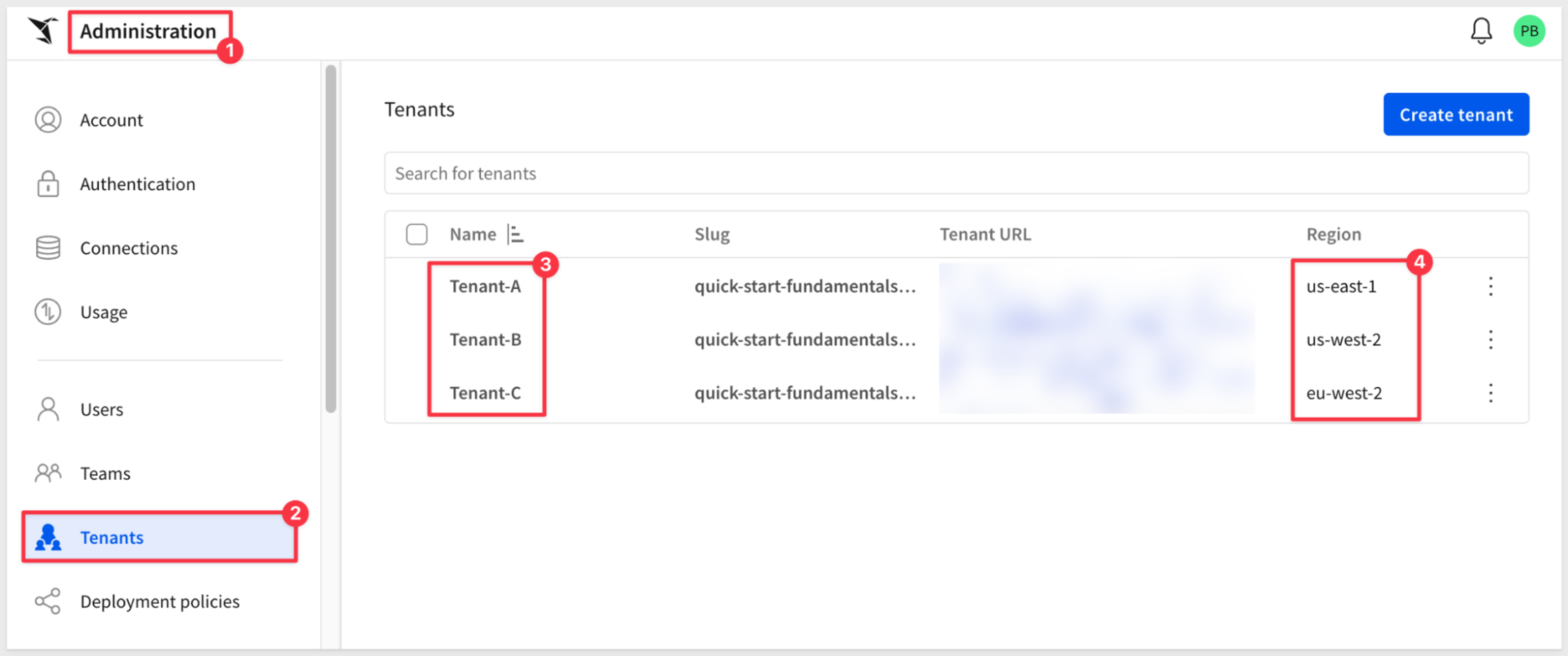
Caption: The Sigma Tenants admin console, showing the tenant list alongside each tenant's assigned region and data-isolation settings.
Writeback through Input Tables for embedded actions
Input Tables let embedded end users write to the warehouse from inside the product: a merchant logs a reorder, an adjuster records an investigation decision, a plant manager updates a schedule. New data writes to a separate writeback schema, so it doesn't overwrite original warehouse data. Sigma creates a separate edit log (a write-ahead log) for each Input Table to support durability, consistency, and recovery. However, workbook version history doesn't restore Input Table contents to prior points in time.
Next steps
A retail reorder screen and a clinical care-gap dashboard couldn't look more different, but they answer to the same test: does the analytics live where the user already works, and does it carry them to the action they need to take? Hold any embedded analytics use case to that standard before you build it. Sigma meets it with warehouse-native architecture: live governed data queried where it lives, and the user carried from insight to writeback in one embedded surface.
Pick one workflow — a merchant reorder, a claims decision, a care-gap follow-up — and see it live inside the product your users already open.
Try Sigma free or get a demo to see industry use cases built on your own warehouse data. You can also learn more with these resources:
- Sigma Public
- QuickStart: Learn the Fundamentals
- QuickStart: Build AI Apps in Sigma