6 Types of AI Agents and What Each One Does Best

"AI agent" has become a catch-all term, but the systems behind it aren't always interchangeable. Some AI agents follow fixed rules. Some plan toward a goal. Some weigh trade-offs across competing objectives, and others improve their own decisions over time.
This piece walks through the six types of AI agents based on how they make decisions, what each one does best, and where each one hits its limits.
Key takeaways
- Start from the decision the agent needs to make. A threshold check calls for a simple reflex agent, a multi-step deadline calls for a goal-based agent, competing alerts call for a utility-based agent, and drifting patterns call for a learning agent.
- Define agent autonomy explicitly before deployment. Specify the goal, the tables and columns it can read, the actions it can take, and the conditions for human approval.
- Configure permissions at the data layer in the warehouse, not at the application level. Inherit row-level security, column-level security, and user permissions at query time so the agent can never access data the calling user isn't entitled to see.
- When designing agent workflows, default to a single agent and only adopt multi-agent orchestration when the work is genuinely parallel.
What are AI agents?
An AI agent is software that perceives its environment, decides on an action, and executes that action toward a goal defined by a human. The key quality is bounded autonomy: a person sets the objective and the guardrails, and the agent chooses how to reach the objective inside those guardrails, and then executes the required actions.
How AI agents differ from other AI implementations
AI agents with chatbots, copilots, and rule-based automation are different AI implementations doing different jobs. The differences come down to who executes the actions and how much room the system has to act.
- Rule-based automation. Fixed if-then logic where engineers define both the outcome and the steps in advance. An ETL pipeline that fires on a schedule and follows a hardcoded sequence is an example of rule-based automation.
- Chatbots. Conversation-first systems that answer questions, guide users, and route requests. They respond to prompts but don't take action across systems. ChatGPT answering a SQL question is a chatbot interaction.
- AI copilots. In-workflow assistants embedded in the application the user is already using. They suggest, draft, and recommend, but assist rather than act autonomously.
- AI agents. Goal-driven systems that perceive, decide, and act with bounded autonomy. A data quality agent can be configured to flag anomalies, reason about severity at runtime, decide whether to fix the data, retain it as a genuine signal, or escalate it, and carry out the chosen action, then write a log.
Each AI implementation has its place, and the right choice is the one that best fits the task. Rule-based automation handles stable, well-defined sequences. Chatbots and copilots keep a human in the loop for assisted workflows. Agents extend that toolkit to decisions no one could fully script in advance, carrying work from signal to action under guardrails the team defines.
Types of AI agents
There's no single right way to group AI agents. Most categorization frameworks usually pick one of three lenses:
- By decision-making behavior. How the agent selects an action, whether through fixed rules, a world model, a goal description, a utility score, or learned experience.
- By system architecture. How agents are composed, whether as a single agent, a multi-agent, or a hierarchical orchestration.
- By application role. The job the agent performs in the business, such as a coding agent, customer agent, analytics agent, or fraud agent.
In a business intelligence and data analytics context, where the work is fundamentally about matching a decision to a signal in the data, grouping by decision-making behavior is the most practical lens.
The decision-making behavior also maps onto the questions data teams already ask: Is this a fixed-rule alert? A planning problem? A multi-objective triage? A pattern that shifts over time?
1. Simple reflex agents
Simple reflex agents act on the current input using fixed rules, with no memory and no model of the world. A condition matches a rule, and the corresponding action fires.
In practice, the logic is direct: if CPU exceeds a threshold, resize the warehouse. If a dbt model run exceeds a runtime threshold, fire a Slack alert. If a table's row count drops to zero on ingest, page on-call.
Simple reflex agents work best in fully observable environments where the current state contains all the context the agent needs. Warehouse auto-scaling rules and static data quality checks operate at this level. The trade-off is brittleness when patterns shift. A holiday traffic dip and a real outage look the same to an agent that only sees the current number against a fixed threshold.
2. Model-based reflex agents
Model-based reflex agents maintain an internal model of the world, update it over time, and evaluate the current state against that model. They still apply condition-action rules, but to an inferred state rather than a raw input.
An ETL orchestration agent can track which partitions loaded successfully, the last known schema, and the typical row count range for each table at each point in the weekly cycle. When a current run deviates from that model, the agent flags the anomaly.
The agent then determines whether the run's output deviates from what this table's normal appearance should be at this point in the week. That internal model helps in partially observable environments where a single input doesn't tell the whole story.
3. Goal-based agents
Goal-based agents plan multi-step action sequences toward an explicit goal. They maintain a world model plus a goal description, and reason about the future: what will happen if I take this action?
An analytics agent that needs to deliver a weekly revenue variance report by Monday morning works backward from the deadline. It identifies which source tables need refreshing, checks data freshness for each dependency, conditionally triggers upstream jobs if it detects staleness, executes the report model after dependencies have cleared, validates the output, and distributes the result.
Goal-based agents fit complex workflows where the sequence of actions depends on intermediate results, which is how many data teams already think about pipeline SLAs.
4. Utility-based agents
Utility-based agents assign a real-valued score to possible outcomes and select the action with the highest expected utility. Where a goal-based agent asks "Did I reach the goal?", a utility-based agent asks "How well did I reach it, and at what cost?"
A data platform receiving simultaneous quality alerts can't treat them identically. A utility-based agent scores each alert across multiple dimensions, including downstream consumer criticality, fix cost, data freshness window, and pipeline position.
If table lineage shows the affected table feeds a critical revenue report, the agent escalates immediately; the agent can deprioritize a table that feeds a rarely accessed internal report. Similar logic applies to storage lifecycle management, where the agent weighs query frequency, dashboard SLA requirements, storage cost per GB, and retrieval cost to choose among available tiers.
Utility-based reasoning is well-suited to multi-objective environments where competing goals can't be reduced to a single binary test. Alert triage and resource allocation are good fits.
5. Multi-agent systems
Multi-agent systems decompose complex tasks across specialized agents that operate in parallel, with an orchestration layer coordinating them. Each agent runs its own program, whether simple reflex, model-based reflex, goal-based, utility-based, or learning.
For example, if you have an agentic system for investigating pipeline failures, an investigation will spawn parallel subagents. One agent queries the warehouse for anomalous metric values, another checks pipeline execution logs, and a third queries the data catalog for recent schema changes. A lead agent synthesizes findings into a root cause hypothesis. Sequential investigation delays synthesis because each path waits for the previous one to finish.
Multi-agent systems work well for cross-functional work that requires parallelism, specialization, and decomposition. Multi-agent orchestration can also consume substantially more tokens than just chatting with an LLM. For well-defined sequential tasks, a single agent reduces the governance surface area and avoids orchestration token overhead.
6. Learning-augmented agents
Learning-augmented agents improve their decisions from feedback over time. They update their internal program based on experience. A learning-augmented agent has four components:
- a performance element that selects actions,
- a learning element that modifies the performance element
- a critic that evaluates results
- A problem generator that suggests exploratory actions.
A regular anomaly detector agent can flag a seasonal traffic spike as a volume anomaly because it can't distinguish a business spike from a data failure. A learning-augmented anomaly-detection agent will observe the same spike, receive feedback that the alert was a false positive, and update its internal model to suppress similar alerts in future cycles. Over time, the agent's baseline evolves without manual reconfiguration.
The learning capability can be layered on top of any base agent type, whether simple reflex, model-based reflex, goal-based, or utility-based, so teams choose the base type first and then choose the learning mechanism.
How Sigma brings AI agents to your analytics
Sigma is the runtime layer to build and scale analytics, AI Apps, and agents on live cloud data warehouse data. It sits between your warehouse (e.g., Databricks, Snowflake, BigQuery, Amazon Redshift) and the AI tools that use that data.
Permissions, audit, lineage, and change management run through a single control plane. Data never leaves the warehouse. Sigma inherits row-level security and column masking from the source at query time. The agent operates under the same rules as the human who called it.
Sigma Agents
Sigma Agents are customized agentic workflows that a builder configures within a workbook and surfaces to end users through a chat element.
The builder defines three elements:
- Plain-English instructions for the agent's role
- The specific tables and columns the agent can access (which the agent inherits from existing warehouse security)
- The actions the agent can take, including writeback to Input Tables, notifications, calls to external systems through configured API actions.
Agents inherit five layers of control, from warehouse governance down to in-agent scoping, so an agent can never see data the running user doesn't have access to.
A single Sigma workbook can host any type of AI agent on the spectrum. A simple reflex pattern fires a notification when a threshold is reached. A goal-based pattern runs forecast prep ahead of an executive review. A utility-based pattern scores incoming alerts and routes the high-impact ones to the on-call queue. A multi-agent pattern uses a lead Sigma Agent to coordinate warehouse agents as tools.
Sigma Assistant
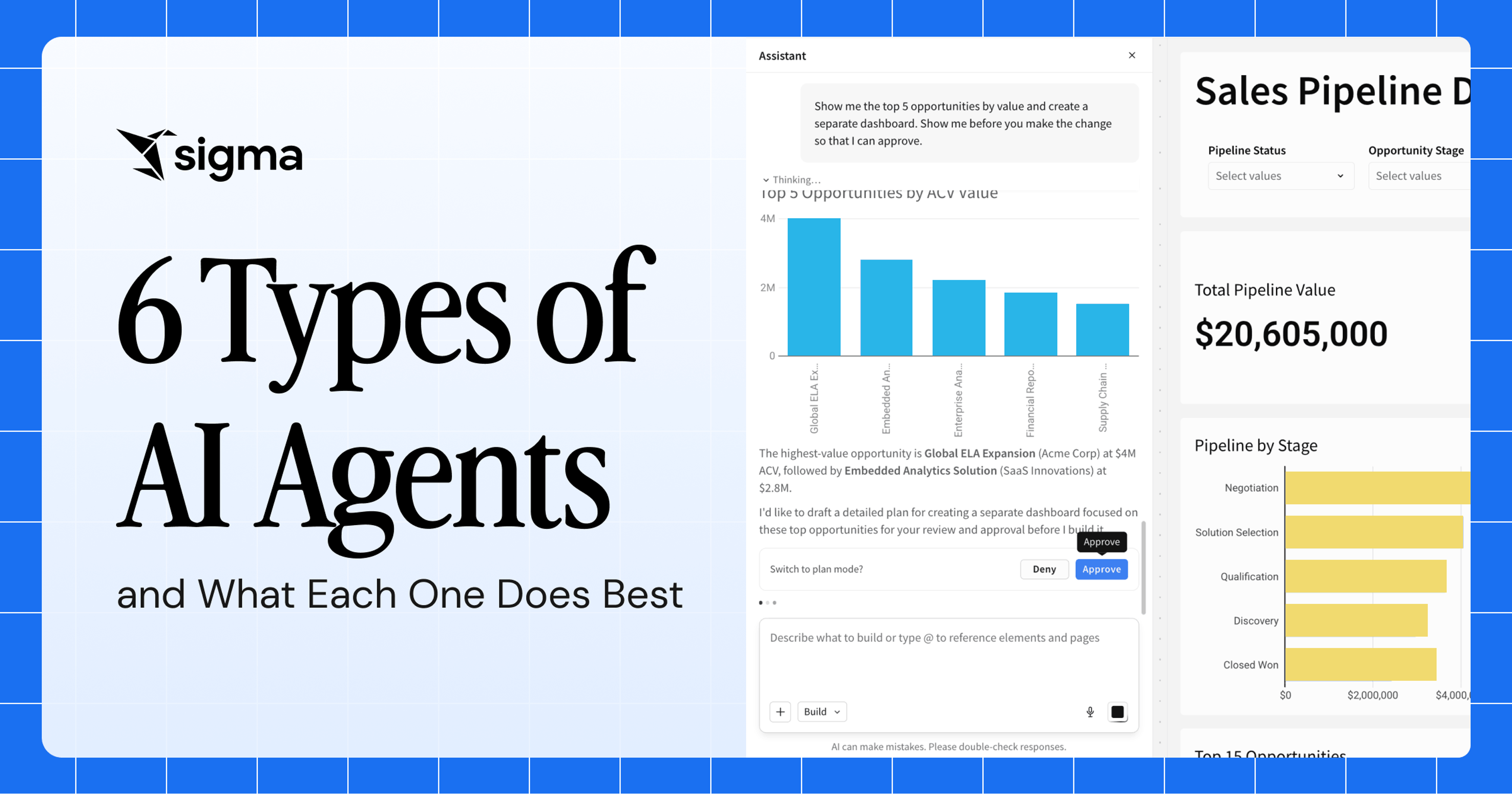
Sigma Assistant is the natural-language interface for analyzing data and building applications or dashboards on live warehouse data.
With Analyze with Sigma Assistant, users ask questions in plain language and get answers that draw on the organization's data models, certified metrics, and endorsed workbooks. Users can verify every answer: inspect the query, trace it to the underlying table, audit the analysis in a workbook. Sigma validates queries before they execute, so malformed SQL never reaches the warehouse.
With Build with Sigma Assistant, users can describe an AI App or dashboard, and the model selects the right data sources, prepares the data, builds the UI components, and wires them up. You can also switch between natural language and the drag-and-drop UI at any point.
Any agent type, one workbook
A single Sigma workbook can host any type of AI agent on the spectrum. The full loop runs in one workbook under one governance model: data comes in, the agent analyzes it, takes action, and sends a notification, all on warehouse data, all under the permissions the agent inherits.
A simple reflex pattern fires a notification when a threshold is reached. A goal-based pattern runs forecast prep ahead of an executive review. A utility-based pattern scores incoming alerts and routes the high-impact ones to the on-call queue. A multi-agent pattern uses a lead Sigma Agent to coordinate warehouse agents as tools.
Put AI agents to work with Sigma
Putting any of these six agent types to work means giving them a place to run where business users can actually engage with them. In Sigma, that place is the workbook: a simple reflex agent, a goal-based planner, a utility-based triager, or a multi-agent investigator all appear on the same governed surface, alongside the data they act on. How a person works with each one depends less on the agent type and more on the decision at hand.
Sigma supports three interaction patterns inside the same workbook:
- Conversational. A merchandising analyst asks a scenario-planning agent how a product line sold over the last two weeks, then asks for a comparison to the prior period and to a competing brand. The agent structures each comparison using live warehouse data.
- Human-in-the-loop. A review analysis agent reports on customer sentiment, surfaces top recommendations, and waits for the user to pick the ones worth pursuing before writing them back as to-dos in an Input Table.
- Autonomous. A scheduled agent runs in the background before a recurring forecast review, summarizes what changed at each level of the forecast hierarchy, identifies which deals moved into or out of the pipeline, and flags where the risks sit.
The full loop runs in one workbook under one governance model: data comes in, the agent analyzes it, takes action, and sends a notification, all on warehouse data, all under the permissions the agent inherits.
Sigma runs these types of AI agents on live warehouse data, with the warehouse governing every query, inside a spreadsheet interface every business user already knows. IT keeps visibility and control. Business teams get speed and flexibility. Both teams work on the same platform and the same data.
Get a demo or try Sigma free to put the right type of AI agent to work on your own data.