Accelerating the OODA Loop: How Sigma Delivers a Competitive Edge

Speed has always mattered in competitive environments, and there’s always been a thin line between reacting in time and reacting too late. In modern analytics, that line is rarely about effort. It’s almost always about how fast teams can understand what’s happening and turn that understanding into action.
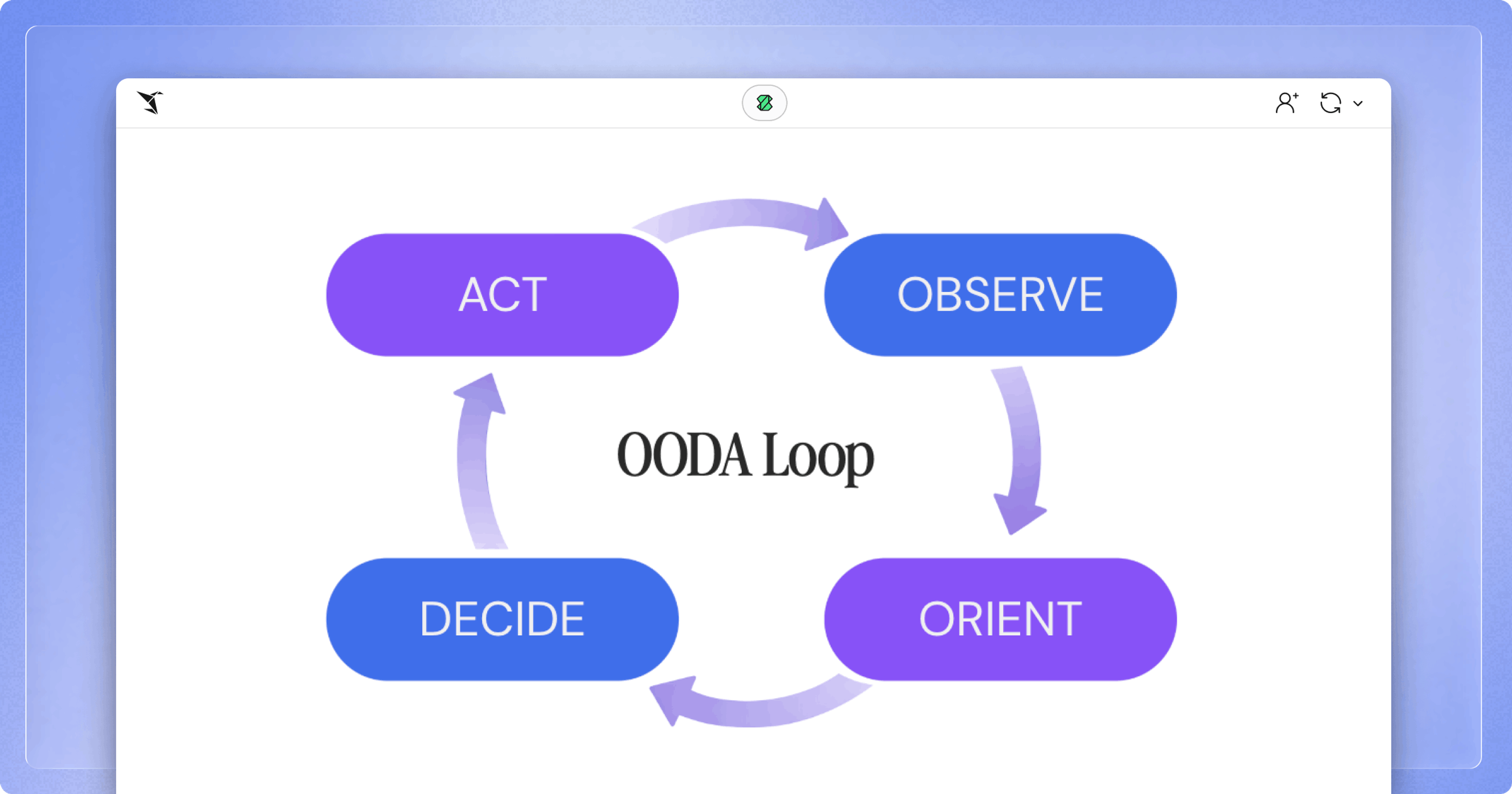
The OODA Loop—Observe, Orient, Decide, Act—offers a useful way to think about this. Originally developed by the U.S. military, the framework is now commonly used in business settings to describe how organizations transform information into action. The central insight is simple: advantage comes from completing that cycle faster than your environment changes.
But in today’s digital landscape, the real key to success takes it one step further. It comes from operating inside a competitor’s loop, and completing your cycle of action faster than they can. The problem, however, is that many companies do the opposite by relying on outdated data pipelines and analytical tools that add friction, introduce latency, and quietly slow every stage of the OODA Loop. That slowdown quickly becomes a hidden tax on speed and competitive agility.
Looking through that lens, it’s easy to see where the right tools can make a difference. That’s where Sigma comes in and removes friction, compressing the loop so teams can see their metrics faster, scenario model faster, decide faster, and act faster. Here’s how:
Observe: Eliminating latency for real-time awareness
The first phase, or observation phase, is about perceiving the world accurately and quickly. In business terms, that means accessing the freshest, most granular data without delay. Traditional business intelligence tools inherently slow this phase down by relying on a major bottleneck: extracts. But what Sigma gives business users is instant, unhindered visibility into your data warehouse.
With traditional Business Intelligence (BI), even data tagged as “real-time” is often minutes or hours old by the time anyone sees it. With Sigma, there is no such delay as it connects directly to the cloud data warehouse, so observations are based on what is happening now, not what happened earlier. This difference alone has a meaningful impact on the OODA Loop, as when data latency disappears, observation—and ultimately action—becomes faster.
Sigma’s core advantage here is its live connection model. By querying the cloud data warehouse directly, whether that’s Snowflake, BigQuery, Redshift, or Databricks, Sigma eliminates the need for extracts, data marts, and cubes. That removes both time and cost, and drastically shortens the Observe phase while preserving scale.
Sigma is also agnostic to where modeling happens. Teams can model data in the warehouse itself, using tools like dbt or Coalesce, or directly in Sigma. Wherever that logic lives, the live connection remains intact and semantics are retained. That flexibility reduces friction in data preparation and helps teams get to relevant observations faster.
Under the hood, Sigma’s modern Go-based connector is engineered for performance and optimized for each specific cloud warehouse. Even large, complex live queries return quickly by fully leveraging the power of modern cloud data warehouses. This technological edge guarantees that scale does not equate to slowness.
Orient: Transforming data into insight and understanding
Orientation may be the most crucial phase. This is where raw observations are contextualized, analyzed, and synthesized into a coherent understanding. Sigma’s goal is to make these complex processes intuitive, rapid, and scalable for all users, through a series of key features:
- Familiar spreadsheet UI: Sigma’s interface looks and feels like a spreadsheet, allowing business users to immediately interact with billions of rows of live data. This eliminates the steep learning curve associated with complex BI interfaces, drastically accelerating user orientation. All without the known volume and row limitations & security risks of offline spreadsheets.
- Pivot tables, grouped tables, and excel-like functions: Users can perform familiar operations—like pivoting, grouping, and applying complex formulas—directly on live data at an unprecedented scale. This allows for rapid slicing and dicing, helping users quickly find the signal in the noise without having to wait for a data team to build a new view or model.
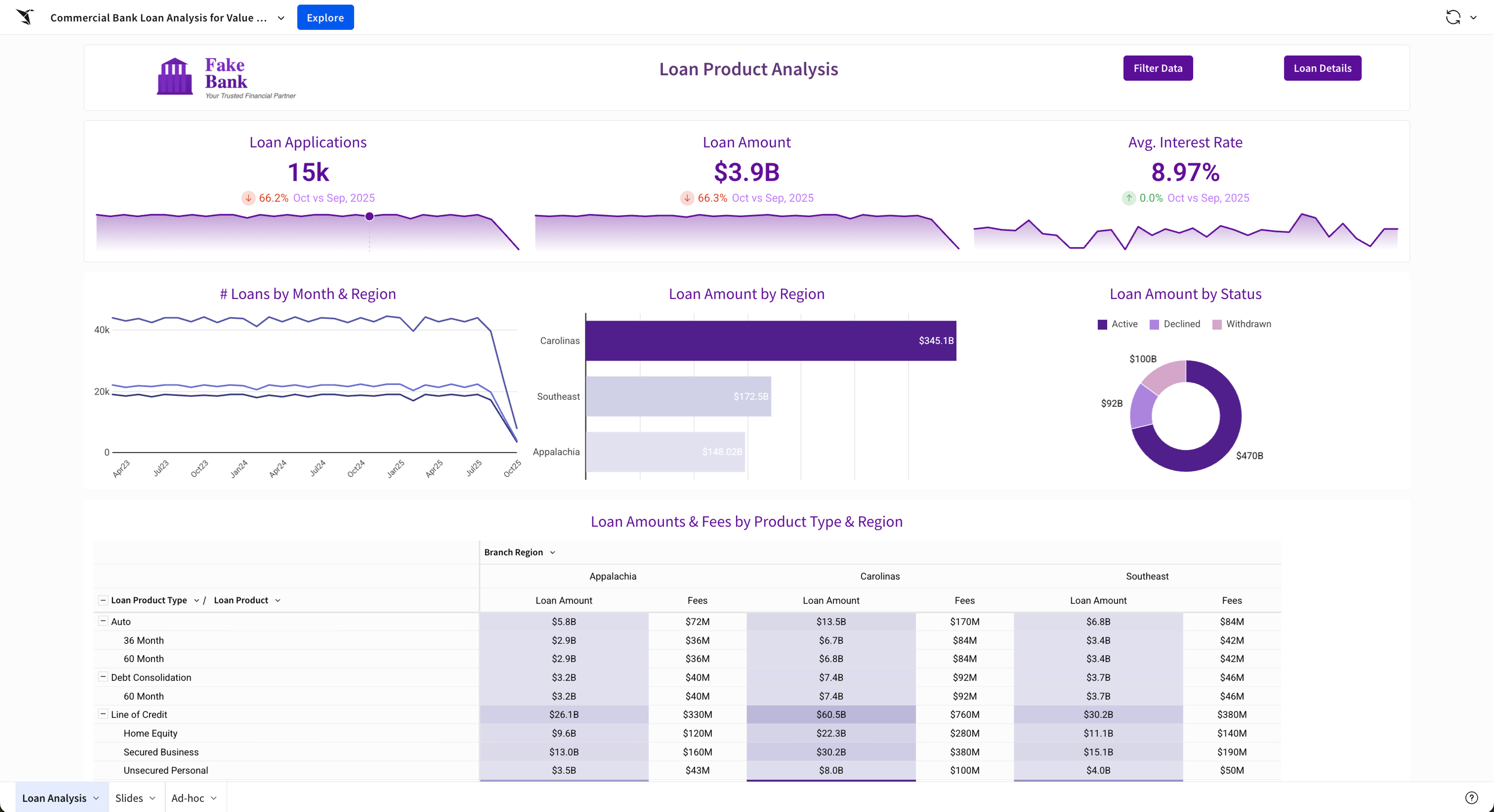
- AI:
- Leveraging generative AI, Sigma Agents and AI Assistant (composed of features like Ask Sigma, AI Builder, and AI Query) allows users to ask questions in natural language to guide analysis.
- Sigma’s native integration with warehouse LLMs (i.e. Cortex and AI Query) allows users to leverage all of the native AI capabilities supported by your cloud warehouse investments, including warehouse agents
Decide: Making informed, confident decisions
The decision phase involves forming hypotheses and selecting a course of action based on the outcomes of your orientation. This is where insight turns into commitment. Sigma accelerates this step by embedding decision support directly into the analytical workflow, instead of forcing users to leave their analysis to get answers.
Sigma Agents can be autonomous or conversational & iterative, allowing users to ask complex questions in plain English, making it easy to pass parameters into data science models that live in your cloud data warehouse. This enables users to get instant responses from those models as part of the decision process, which could easily take days if the business needs to tap a data science team on the shoulder for the “last mile” of their hard work. Autonomous agents drive even faster actions by automating mundane tasks and triggering actions as events occur.
Scenario modeling builds on that same foundation. Users can duplicate live worksheets and apply different hypothetical inputs or filters to explore “what if” scenarios. Because this happens on live data, without a need to switch to another application, decision-makers can immediately see the potential impact of different choices before committing. This shortens decision cycles and reduces risk at the moment it matters most.
Act: Closing the Loop with Immediate Execution
The true test of a fast OODA Loop is what happens in the Act phase, where decisions turn into real-world outcomes. Traditional BI tools tend to stop short here, as analysis becomes the endpoint, usually in the form of a static dashboard. Execution happens somewhere else, often much later.
Conversely, Sigma treats analysis as the starting point for action by allowing business users to translate insight directly into execution. Live writeback is the key. With Sigma, users can modify, annotate, and input data such as forecasts, budgets, or operational updates directly from a spreadsheet or form and write it directly to a dedicated space in your cloud data warehouse. The analysis environment becomes the execution environment, closing the loop without any handoffs or delays.
Sigma also enables action through workflows and conditional alerts. When data crosses a defined threshold, Sigma can trigger automated responses, sending a Slack message, updating a CRM record, or kicking off an ETL job. Insight turns into action programmatically, without waiting on someone to notice a dashboard or export a report.
For situations where execution depends on distribution, Sigma supports bursting and pixel-perfect reporting. Teams can deliver highly formatted outputs like invoices or regulatory filings to the right stakeholders at scale, ensuring that the information arrives in the format required for compliance and operational follow-through.
Finally, Sigma makes it possible to package execution into purpose-built workflows through AI Apps. These role-based applications give non-technical users curated environments where they can make decisions and take action in real time, replacing outdated workflows that existed in offline data copies shipped from email to email.
With Sigma, you’re more certain to win
Speed isn’t about moving faster for its own sake. It’s about removing the friction that slows seeing, understanding, deciding, and acting. The OODA Loop makes that abundantly clear. Small delays compound. Small advantages do too.
Sigma is built for teams that want to stay inside that loop, not once, but continuously. If you want to see what it feels like to operate with that kind of speed and clarity, schedule a demo to give Sigma a try. The market’s not going to wait for you to catch up.