What Is the Modern Data Stack? Layers, Benefits and Best Practices

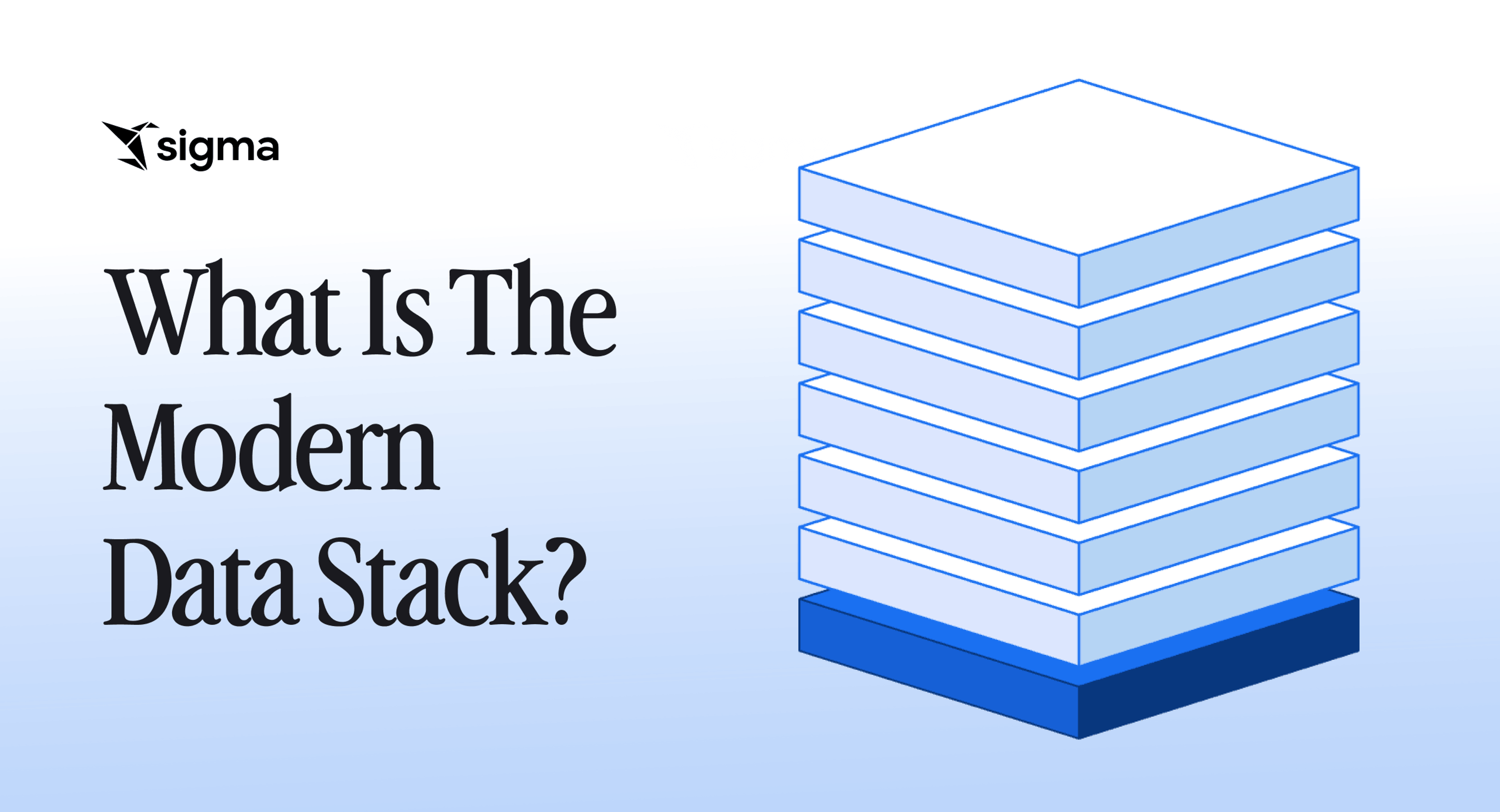
The modern data stack is the set of cloud-native, modular tools most companies now use to move data from source systems into a central warehouse, transform it into a trusted form, and make it available for analysis and action. It replaced the on-premise warehouses, monolithic ETL pipelines, and closed BI suites that came before it. This layer is increasingly where teams build on the warehouse rather than only read from it. Full data applications (interactive tools with their own inputs, writeback, and workflow logic) run directly against live warehouse data instead of being rebuilt on a separate application database. The consumption layer stops being a set of read-only dashboards and becomes the runtime where applications execute on top of the warehouse.
This article defines the modern data stack, compares it to the legacy stack it replaced, walks through its layers and benefits, and lays out how to modernize your own.
Key takeaways
- A modern stack is complete only when users can analyze, write back to, and run AI agents on live warehouse data without exporting it.
- When modernizing your data stack, shipping compute to where the data lives eliminates freshness lag, governance leaks from extract copies, and the scale ceilings that extract-based BI hits.
- When teams rebuild row-level security, masking, and audit separately in each BI tool or extract destination, a modern data stack can quietly slip back into legacy behavior.
What is a modern data stack?
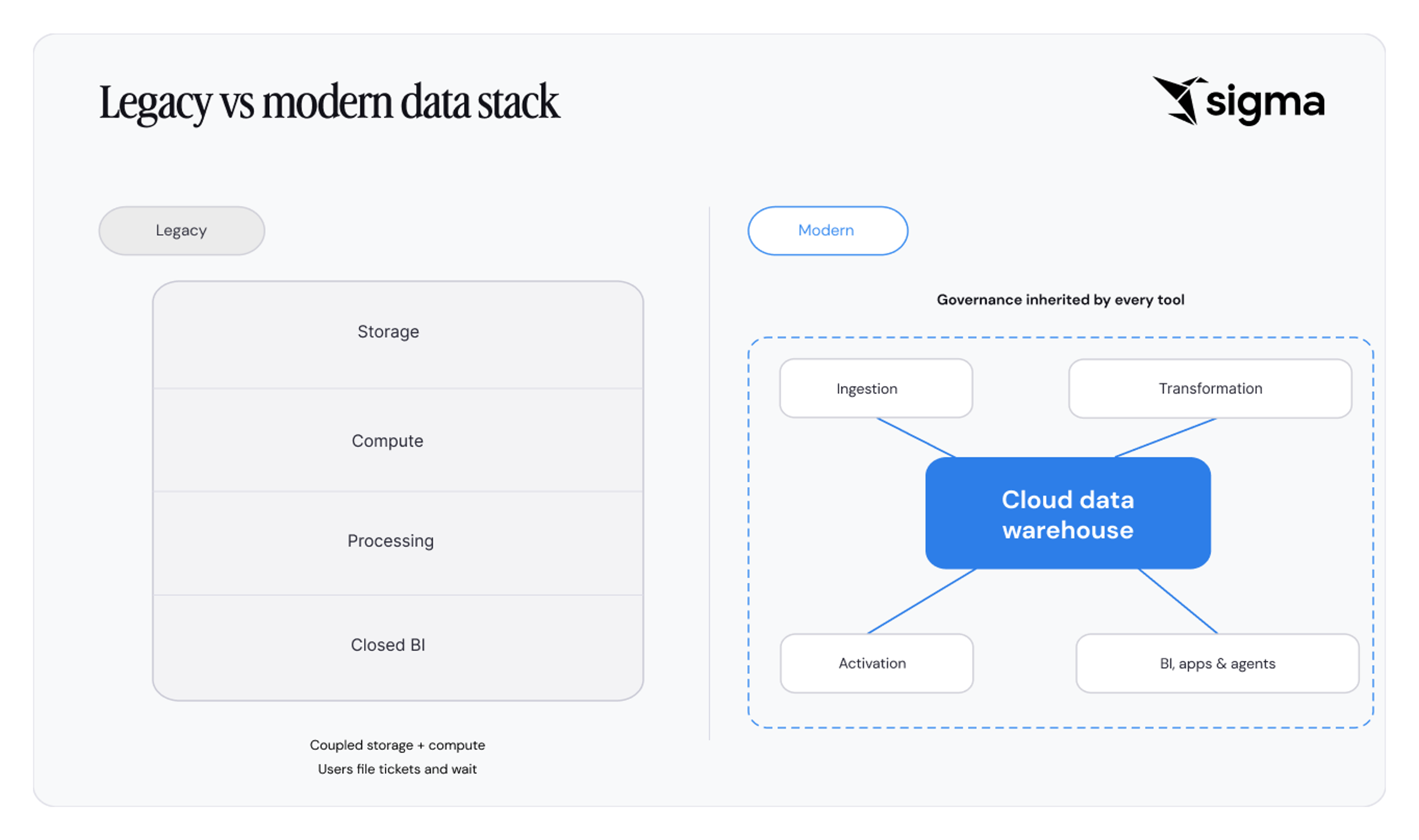
A modern data stack is a set of cloud-native, modular tools that move data from source systems into a central warehouse, transform it into a trusted, consistent form, and make it available for analysis and action. It replaced the on-premise warehouses and monolithic ETL pipelines that came before it.
A data stack is “modern” in three specific ways:
- Cloud-native. It runs on cloud infrastructure rather than internally managed hardware.
- Modular. Teams assemble it using specialized tools that connect via APIs rather than from a single closed suite.
- Warehouse-centric. It focuses on a cloud data warehouse or lakehouse that all other layers connect to.
Three technological shifts made these changes possible: storage became cheap, compute became elastic, and the move from ETL to ELT relocated transformation logic into the warehouse itself. The warehouse does not have to be a passive store anymore. It is now the engine that the rest of the stack reads from, writes back to, and increasingly builds on, running applications and AI agents directly against live data.
Legacy data stack vs. modern data stack
The clearest way to understand the modern data stack is to compare it against the legacy stack it replaced. The two differ across seven dimensions:
| Dimension | Legacy data stack | Modern data stack |
|---|---|---|
| Architecture | On-premise monolith bundling storage, compute, and processing into a single appliance | Cloud-native modular services that scale each layer independently |
| Data processing | ETL: transform records on a separate server before loading | ELT: load raw data into the warehouse first, then transform in place using warehouse compute |
| Tool integration | Closed vendor suite that required custom connectors for anything outside it | API-connected specialists; teams swap any one component without rebuilding the rest |
| User access | IT gatekeeping; business users file tickets and wait on the data team | Self-service through SQL, semantic layers, and spreadsheet-style interfaces |
| Scalability | Coupled storage and compute; scaling either disrupts the rest | Independent, elastic scaling of storage and compute |
| Governance | Every BI tool, reporting tool, and extract destination recreates the same controls | The warehouse enforces controls once, and every downstream tool inherits them |
| AI and Agents | AI and ML run outside the stack on exported copies, so models train on stale, ungoverned data and results rarely flow back | AI and agents run directly on live, governed warehouse data and can write results back to the source. |
Every modern dimension keeps work close to the warehouse. Wherever a layer drifts away from it, the stack starts behaving like the legacy one it replaced.
The 6 layers of the modern data stack
Most teams describe a modern data stack as five layers of data movement and processing, plus a sixth layer of governance and observability that runs across all of them. Each layer is its own market of specialist tools, but they share the warehouse as the connection point.
1. Data sources
The stack begins with the systems that produce the data: CRMs like Salesforce, ERPs like NetSuite, product databases, marketing tools, event streams, third-party APIs, and files. Other teams usually own these systems, and they set the terms for everything downstream: how often the data changes, how clean it is, and whether it arrives as structured rows, JSON events, or unstructured files. Even the field names originate here, and they are rarely as tidy as you would like.
2. Ingestion and integration
Ingestion and integration are the data movement layer. Ingestion tools pull structured and semi-structured data from source systems into the warehouse, and integration logic resolves schema drift, type mismatches, and naming conventions so the data lands in a usable shape.
In practice this step quietly renames things. A managed connector might load every Salesforce field in lowercase snake_case, so part of the work is keeping track of how a source field maps to its warehouse version.
Managed platforms ship broad connector catalogs with incremental syncs and log-based change data capture, and handle both batch and streaming loads. Most teams now use managed ingestion rather than hand-coded pipelines.
3. Storage and compute
Storage and compute is the layer where the data lives and the work runs. Cloud data warehouses and lakehouses store the data, and the same platform provides the SQL engine that queries and joins it, feeding it to downstream tools.
The core break from on-premise systems was separating storage from compute so each scales independently. A team can keep years of history at low cost and spin compute up only when a workload requires it. Platforms such as Databricks, Snowflake, BigQuery, and Amazon Redshift are all built around this principle.
4. Transformation
Transformation turns raw warehouse data into cleaned, tested, modeled production tables that the rest of the business can trust. In practice the work often starts in a live spreadsheet or SQL interface, because it is faster to see how the data actually looks and mess with it there, and only gets promoted into version-controlled data models once the logic is right. The exploration layer and the production layer are different, and moving cleanly between them is a lot of what makes the modern stack work.
Once the logic is settled, teams write it in SQL, version-control it in Git, and deploy through CI/CD, the same way software ships. Staging models become the practical source of truth for what each source field is actually called, which is what makes the messy source names from the ingestion layer manageable. Built-in tests check the data against expectations, like unique primary keys and no nulls in critical columns, so a change doesn't quietly break something downstream. A semantic layer on top stores metric definitions in one place, so every tool returns the same number for revenue, churn, or any other shared metric.
5. Analytics, BI, and activation
Analytics, BI, and activation are the consumption layer, where people and operational systems actually use the data. Analytics and BI cover dashboards, ad hoc exploration, spreadsheet interfaces, embedded analytics, and AI agents that query the warehouse and surface answers to humans.
Activation pushes data in the other direction, through reverse-ETL tools that send warehouse fields back into operational systems such as Salesforce or HubSpot. This layer is also where writeback lives: users and agents can act on warehouse data and persist the results rather than only reading them.
6. Governance and observability
Governance and observability span every other layer rather than sit in one. Governance covers row-level security, column masking, encryption, auditing, and role-based access.
The warehouse enforces them once, and downstream tools inherit them. Lineage traces a metric back through transformations to its source. Observability covers data quality monitoring, freshness tracking, and pipeline alerts that catch schema changes, broken syncs, and stale tables before they reach the consumption layer.
5 benefits of a modern data stack
The benefits of a modern data stack are structural. They follow from one decision: putting a cloud data warehouse at the center and letting every other tool inherit its compute, governance, and freshness.
- Scalability and elastic cost. Storage and compute scale independently on cloud infrastructure, so teams pay for what they use and adjust capacity without procurement cycles. A workload that would have required a hardware upgrade in the legacy world is now a configuration change.
- Faster time to insight. ELT, managed connectors, and SQL-based transformations reduce the time from a new data source landing to a usable model becoming available. Teams can answer new questions in days instead of quarters, and the cost of a wrong assumption drops with it.
- A single source of truth. Centralizing data in the warehouse and metric definitions in a semantic layer ensures that revenue, customer churn, and active users mean the same thing across reports, dashboards, and AI workflows. Fragmented metric definitions erode trust quickly, and the modern stack prevents that.
- Self-service for business users. Analysts and business users explore governed warehouse data directly via SQL, semantic layers, and spreadsheet-style interfaces, without having to file tickets. The data team's backlog shrinks, and decisions get made closer to the people making them.
- Stronger, centralized governance. Security, masking, audit, and access controls are enforced at the warehouse and propagated to every tool that queries it. Lineage traces back to a single source of truth, so governance lives closer to the data instead of being recreated in every downstream tool.
Many teams don't realize all these benefits at once in the earliest days of shifting to a modern data stack. Self-service in particular tends to lag because it depends on a consumption layer that can query the warehouse in real time without compromising governance, which is still the hardest layer of the stack to get right.
Best practices for modernizing your data stack
When modernizing your data stack, the project can stall if you make the warehouse decision too late or if every BI tool redefines the same metrics. The five practices below can help you get started on the right foundations.
- Anchor on the warehouse first. The warehouse is the foundational platform decision. Everything else reads from it, writes to it, and inherits its governance. Pick the warehouse, then build the rest of the stack around it.
- Choose ELT over ETL where possible. Loading raw data first and transforming it in the warehouse is faster to set up, easier to debug, and easier to change later. Reserve ETL for cases where regulatory or latency constraints actually require it.
- Centralize metric definitions in a semantic layer. Store metric logic in one place so every consumption tool returns the same answer. This matters more each quarter because the number of tools querying the warehouse continues to grow, and fragmented definitions silently erode trust.
- Push compute to the data, not data to the compute. Warehouse-native consumption tools query the warehouse directly instead of extracting data into their own engines. The mechanism is computation pushdown: ship compute to where the data lives.
- Keep analysis, writeback, and AI agents inside governance. The value of warehouse governance erodes the moment data leaves the warehouse. Every CSV export becomes shadow data outside the scope of retention schedules, access controls, and audit logs.
The most important thing is to keep the work close to the warehouse: you define metrics once, push compute down, and inherit governance rather than recreate it. The further any layer drifts from the warehouse, the more the stack begins to behave like the legacy stack it replaced.
How to modernize your data stack
Modernizing a data stack happens in stages over months, with each stage building on the previous one. The order below assumes a team starting from a legacy BI tool sitting on top of an on-premise warehouse or a tangle of extracts, and moving toward a cloud-native, warehouse-centric stack.
1. Audit the current state
Inventory the data sources feeding the business, the pipelines moving data, the storage systems holding it, the tools consuming it, and the metrics each team relies on. Note where you define the same metric differently in different places, where extracts have become shadow systems of record, and where business users have built spreadsheets to work around what the official tools could not do.
2. Pick the cloud data warehouse or lakehouse
The warehouse decision drives the rest of the stack. Evaluate platforms like Databricks, Snowflake, BigQuery, and Amazon Redshift against the team's existing cloud, workload profile, governance requirements, and AI roadmap. Pick one as the system of record before selecting any other tool.
3. Replace hand-coded pipelines with managed ingestion
Move source-to-warehouse data movement onto a managed ELT platform. Start with the highest-leverage sources, usually the CRM, the product database, and the finance system, and add the rest in waves. Keep hand-coded pipelines only where a managed connector does not exist or a regulatory constraint requires a custom approach.
4. Rebuild transformation as version-controlled code
Move transformation logic out of stored procedures, BI tools, and notebooks into a framework that lives in Git, runs tests, and deploys through CI/CD. Define metrics once in a semantic layer so every downstream tool reads from the same source. This step is where the data stack stops behaving like a reporting pipeline and starts behaving like software.
5. Choose a warehouse-native consumption layer
Replace extract-based BI with consumption tools that query the warehouse directly. The consumption layer is where most legacy stacks leak value, through stale extracts and read-only dashboards, so the tool here has to support live queries, writeback, AI agents, and inherited governance.
6. Make governance and observability cross-cutting from day one
Enforce row-level security, column masking, and audit at the warehouse so every downstream tool inherits them. Add data quality monitoring and lineage on top so schema changes, freshness lag, and broken pipelines surface before they reach the consumption layer. Treat governance and observability as ongoing properties of the stack from the start.
How Sigma fits into the modern data stack
Sigma is the runtime layer to build and scale analytics, apps, and agents on live cloud data warehouse data. It sits between the cloud data warehouse and the AI tools generating against that data. Sigma turns the artifacts they produce into production-ready software that inherits the warehouse's existing governance. Those artifacts include AI Apps, workbooks, dashboards, and agents.
In modern data stack terms, Sigma is a consumption-layer platform that connects directly to Databricks, Snowflake, BigQuery, Amazon Redshift, and other cloud warehouses, inheriting their governance rather than recreating it.
Live queries that run inside the warehouse
Formulas, filters, pivot tables, and sorting in Sigma compile into SQL and execute within the connected warehouse. There is no extract and no in-memory engine. The compute stays where the data already lives, following the same pushdown principle the rest of the modern stack is built on.
A spreadsheet interface on warehouse data
Excel hits a ceiling of about 1,048,576 rows and is a local, file-based tool, which forces analysts to sample, extract, or break their work across files the moment the dataset outgrows a laptop.
Sigma is a spreadsheet interface that runs live on billions of rows under an inherited governance model. Business users get the familiar formula bar, pivot tables, and cell-level logic they already know, but every operation runs against the warehouse instead of a downloaded copy.
Writeback that persists decisions to the source
Input Tables let users edit data in the workbook and write it back to the warehouse as new records, with record-level audit logging. Writeback lands in a separate schema, so the original warehouse data is never overwritten or lost. A finance analyst who used to rebuild numbers in a desktop spreadsheet can run scenarios on live data and persist the result to the source.
Agents that act on warehouse data under governed rules
Sigma Agents are workflows that a builder configures within a workbook, scoped to specific data with custom instructions and actions. They run on the customer's warehouse compute, and Sigma supports warehouse-agent integrations with Databricks and Snowflake, so agent actions route through the customer's own stack. Agents inherit five layers of governance, including warehouse-level permissions and the permissions of the running user.
Complete your modern data stack with Sigma
A modern data stack is complete when a team can analyze and act on warehouse data without leaving the governed system. Sigma closes the loop at the consumption layer, keeping analysis, writeback, and agents on live warehouse data under inherited governance. It moves insight to action without exporting a single CSV.
Get a demo or try Sigma free and see what your warehouse can do when the consumption layer finally catches up.