Automated Reporting: How AI Agents Automate Recurring Reports

Every business runs on a rhythm of recurring reports: the weekly revenue pull, the monthly close package, the daily operations digest that leaders open before the first meeting. Building and distributing them by hand consumes analyst hours that could go to analysis, delays answers to follow-up questions, and pushes stakeholders who can't wait into ungoverned spreadsheets.
This guide covers what automated reporting is, how it differs from conventional scheduled reports, and how AI agents now pick up the recurring work.
Key takeaways
- The traditional reporting cycle doesn't scale. Building, refreshing, and distributing recurring reports by hand absorbs analyst time that could go to analysis or other strategic work.
- Automated reporting uses an AI agent to construct queries at runtime, adapt the format to the audience, and take new requests as plain-language instructions.
- Trusting an agent with recurring reports takes three controls. Scoped access that inherits warehouse permissions, an audit trail that captures every query and source table, and accuracy checks that flag questionable outputs before they ship.
What is automated reporting?
Automated reporting is the use of agentic analytics workflows to produce and distribute recurring reports on a schedule, without requiring an analyst to rebuild the same query and export each cycle.
A person defines the metrics, the report structure, and the delivery targets once. The agent then pulls current warehouse data and delivers it in the right format on later cycles. The work begins with human instruction: the agent carries forward a goal someone set, and it runs on its own only because someone configured it to.
Agentic automated reporting vs. conventional scheduled reporting
Conventional scheduled reporting is itself a basic form of automation. A fixed query runs on a cadence and sends a fixed output without an analyst re-running it each time. Agentic automated reporting builds on that foundation. Instead of a hard-coded query and static output, a configured agent can adapt what it queries, how it formats the result, and how it responds when the underlying data or the request changes.
The specific differences:
| Dimension | Conventional scheduled reporting | Agentic automated reporting |
|---|---|---|
| Query construction | Runs a hard-coded query defined at setup. | Constructs the query at runtime based on the current request and available data. |
| Response to change | Can return outdated or incorrect results when a column is renamed, a table is restructured, or a new product line appears. | Can flag the change within its scope and, in some cases, adjust before the next run. |
| New variations | Needs an engineer to edit code for a new cut. | Accepts the new cut as a plain-language instruction. |
| Output format | Ships in the format defined at setup. | Adapts the format to the audience, producing a narrative summary for one recipient and a table for another from the same run. |
| Distribution logic | Sends the same file to the same list. | Routes conditionally based on what the data shows, so variances get escalated separately from routine results. |
A scheduled report covers one step, while an automated report covers the workflow around it. That difference compounds quickly. Building a recurring report from scratch can take hours, and each subsequent cycle brings small repairs: a renamed column, a new product line to add to a filter, a category value that shifted upstream. Small fixes across dozens of recurring reports absorb a growing share of every week, and follow-up questions route back to the analyst as new requests, slowing decisions on paper while pushing stakeholders who can't wait into ungoverned spreadsheets.
The numbers bear this out. Financial planning and analysis (FP&A) teams now spend 46% of their time on data collection and validation, the highest level in five years. When the recurring pull fills most of the week, the strategic work stakeholders actually want, such as variance explanations, scenario modeling, and root-cause analysis, doesn't get started. Agentic automated reporting shifts the recurring work back to the warehouse itself, so analysts get their time back for the analysis stakeholders came to them for in the first place.
How AI reporting agents automate the reporting cycle
An AI reporting agent is a configured workflow that queries live warehouse data, formats the results, and delivers them on a schedule or trigger without an analyst running each cycle. A builder defines the metrics, the data scope, and the delivery targets. The agent handles the recurring work from there. It reapplies the same instructions each time it runs.
The sections below explain how the agent handles recurring execution and accommodates follow-up variations.
Scheduled queries against live warehouse data
The agent can run on a schedule or an event trigger against the cloud data warehouse the company already operates, whether that's Databricks, Snowflake, BigQuery, or Amazon Redshift. Depending on the implementation, it interprets the request, plans the queries, and executes them.
Production implementations can be configured with checks that confirm the query executed and assess whether the results look reasonable before returning an answer. The query runs at delivery time, so the report carries the numbers the warehouse holds at that moment. Dynamic agent queries can increase warehouse compute consumption and may make query load less predictable. Scoping which tables an agent reads and how often it runs is as much about cost control as governance.
Automated formatting and distribution
From the same reporting environment, the agent can produce narrative explanations, tables, or charts formatted for the audience. Depending on the implementation, reports can land through email or Slack notifications, or through configured outbound actions to other systems, on the cadence the team set.
Results can be included in the notification body, so the recipient may see key information without opening an attached file. For example, a finance lead and an operations manager can subscribe to the same report, and each get it in the channel they already use.
Handling recurring report requests without manual rework
The data team defines the metrics and report structure once, and the agent can handle the recurring pull from then on. A new variation of the report can become a plain-language instruction instead of a ticket in the queue. Schema changes still need explicit validation before the next report ships.
Requirements for automating recurring reports with AI agents
An agent that ships wrong numbers on a schedule is worse than a manual process that ships right ones late. Three requirements separate a reporting agent teams can trust from one that just runs unattended: governed data access, an audit trail, and accuracy checks before delivery.
1. Governed access to the data behind every report
A production reporting agent should use scoped, authenticated data access rather than a broadly permissioned shared credential. Excessive permissions and autonomy can turn an over-permissioned credential into an over-permissioned agent operating at machine speed. Where row-level security is configured, the warehouse can enforce it at query time.
Even when an agent generates a broader query than the task requires, those warehouse controls can limit what the execution returns. These controls give data leads an access model that holds up in review and give CTOs an agent that can't read past it.
2. An audit trail for every automated report
Every automated report needs usage logging that captures the query, the timestamp, and the source datasets the agent read. Without that record, a wrong number in a shipped report has no traceable origin. Reviewers can't verify the result, compliance teams can't reconstruct the run, and the team can't tell whether the same problem exists in other reports.
The EU AI Act, for example, classifies a narrow category of AI systems as high risk, including those tied to specific uses such as critical infrastructure, credit scoring, or fundamental-rights impact. For those systems, automatic event logging is a legal requirement. Most automated reporting agents will not fall inside that scope, but the same logging discipline is good practice regardless of classification.
3. Accuracy checks before a report ships
Generative AI systems can produce confidently stated but erroneous claims. Open-ended text-to-SQL against raw warehouse tables therefore needs accuracy checks before unattended reporting. A query can calculate the requested metric while missing a filter condition. The result is a plausible number that means something different from what was asked. A governed semantic layer can constrain query generation to approved definitions. The remaining control is procedural: validation rules that flag outputs instead of publishing them, and a confidence threshold that escalates to a human rather than failing silently.
How Sigma powers automated reporting
Sigma is an AI Apps and analytics platform for building and scaling analytics workflows, AI Apps, and agents on live warehouse data. It sits between the cloud data warehouse and the AI tools generating against that data. That makes the artifacts they produce (workbooks, dashboards, AI Apps, and agents) safe to operate: governed, auditable, permissioned, and traceable.
For automated reporting, that architecture matters. Extracted-copy reporting separates execution from warehouse permissions and obscures source lineage. Sigma runs the agent inside a governed workbook context on the same warehouse the data already sits in, so the report inherits the workbook's permissions model, its data lineage, and its audit trail rather than layering a separate one on top.
AI agents that query live warehouse data directly
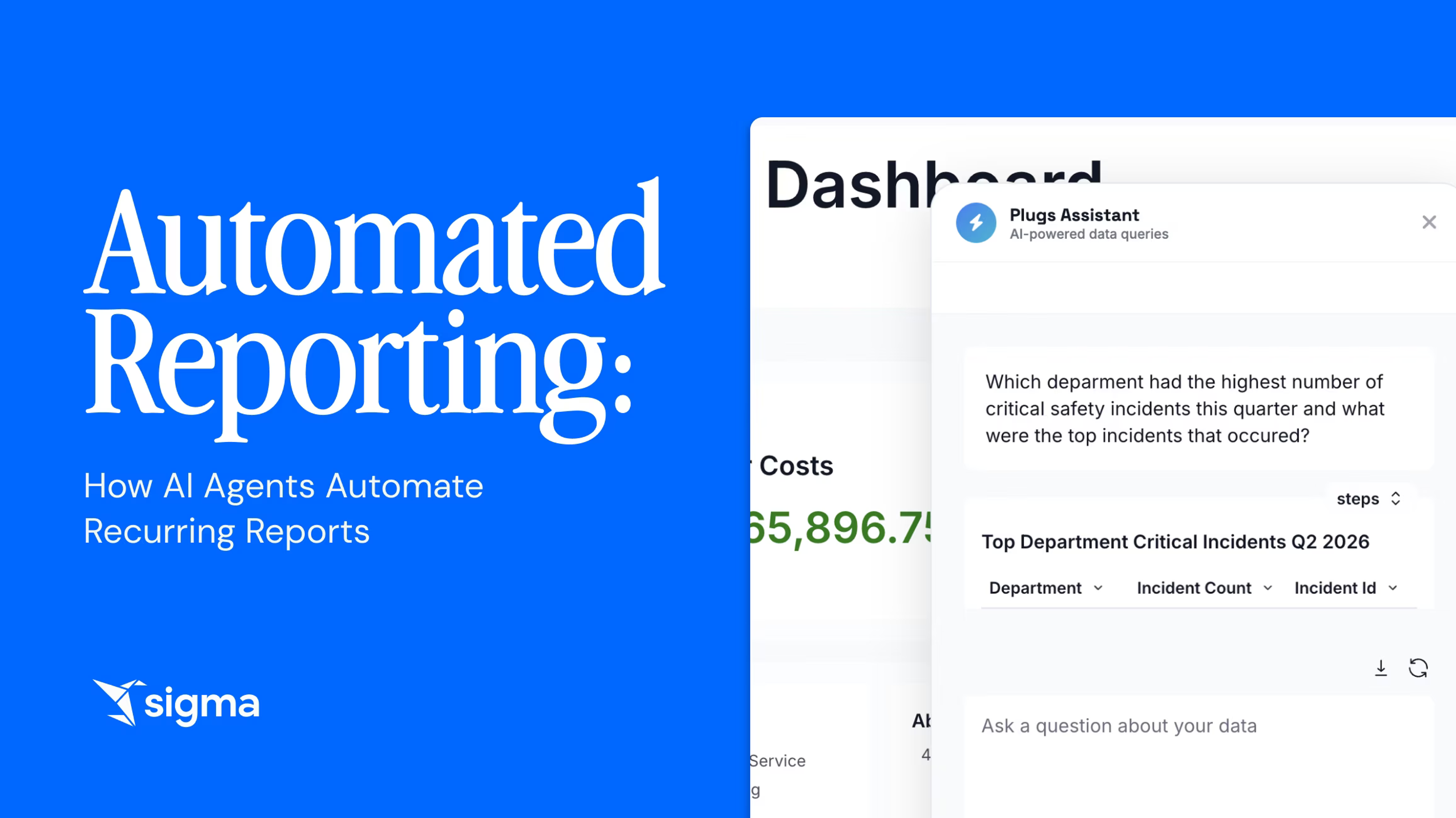
A builder scopes a Sigma Agent inside a workbook. The instructions are plain English. The builder names exactly which tables the agent can read, sets the actions it can run, and defines the interaction mode: conversational, human-in-the-loop, or autonomous on a schedule. If you can build a pivot table, you can scope an agent.
A revenue team can schedule an agent to run before the weekly forecast review. It summarizes what changed, which deals moved, and where the risks sit, so the meeting starts with the discussion instead of the status pull. Because the agent runs on live warehouse data, stakeholders can come back with follow-up questions in the same chat interface. They get answers grounded in the same governed dataset the scheduled report used. Queries compile to SQL and execute in the connected cloud data warehouse.
Pixel-perfect reporting for formal outputs
Some reports need to match exactly how finance, compliance, or the board expects them to look. Sigma's pixel-perfect reporting delivers paginated, WYSIWYG reports (board decks, regulatory filings, audited statements) on a schedule or on demand, with export bursting, PDF and image exports, and custom SMTP. The underlying data stays live in the warehouse, so the format is fixed while the numbers are current. Recurring formal outputs that used to require a manual layout pass each cycle can run unattended and land in the right inboxes in the right template.
Governed access inherited from the warehouse
A Sigma Agent inherits several layers of control: warehouse governance, Sigma's data model governance, roles and permissions defined in Sigma, workbook-level grants, and in-agent scoping the builder defines. Row-level and column-level security come from the warehouse at query time, and the agent runs with the permissions of the user who invoked it. A viewer without access to a table does not get data from that table through the agent, regardless of when the agent runs. Business teams move quickly within the guardrails IT maintains for scheduled reports.
An audit trail built into every automated report
Sigma logs Sigma Agent runs for traceability. Reviewers can inspect the query the agent generated, trace it to the underlying warehouse table, and audit the analysis inside a workbook. When a report writes back through Input Tables, the audit trail captures the original record, the new record, who changed it, and when. That gives compliance review and internal controls the record they need to reconstruct a run after the fact.
Automate reporting with Sigma
Moving recurring reports to governed AI agents returns hours spent on manual rebuild-and-redistribute work to analysis, gives stakeholders numbers based on live warehouse data on a cadence, and keeps each run on the governed data IT already secured. Teams explore, build, automate, and act in the same platform. Get a demo or try Sigma free to see Sigma Agents run your first recurring report.