What Is Agentic Analytics? How It Works and What It Takes to Run It in Production

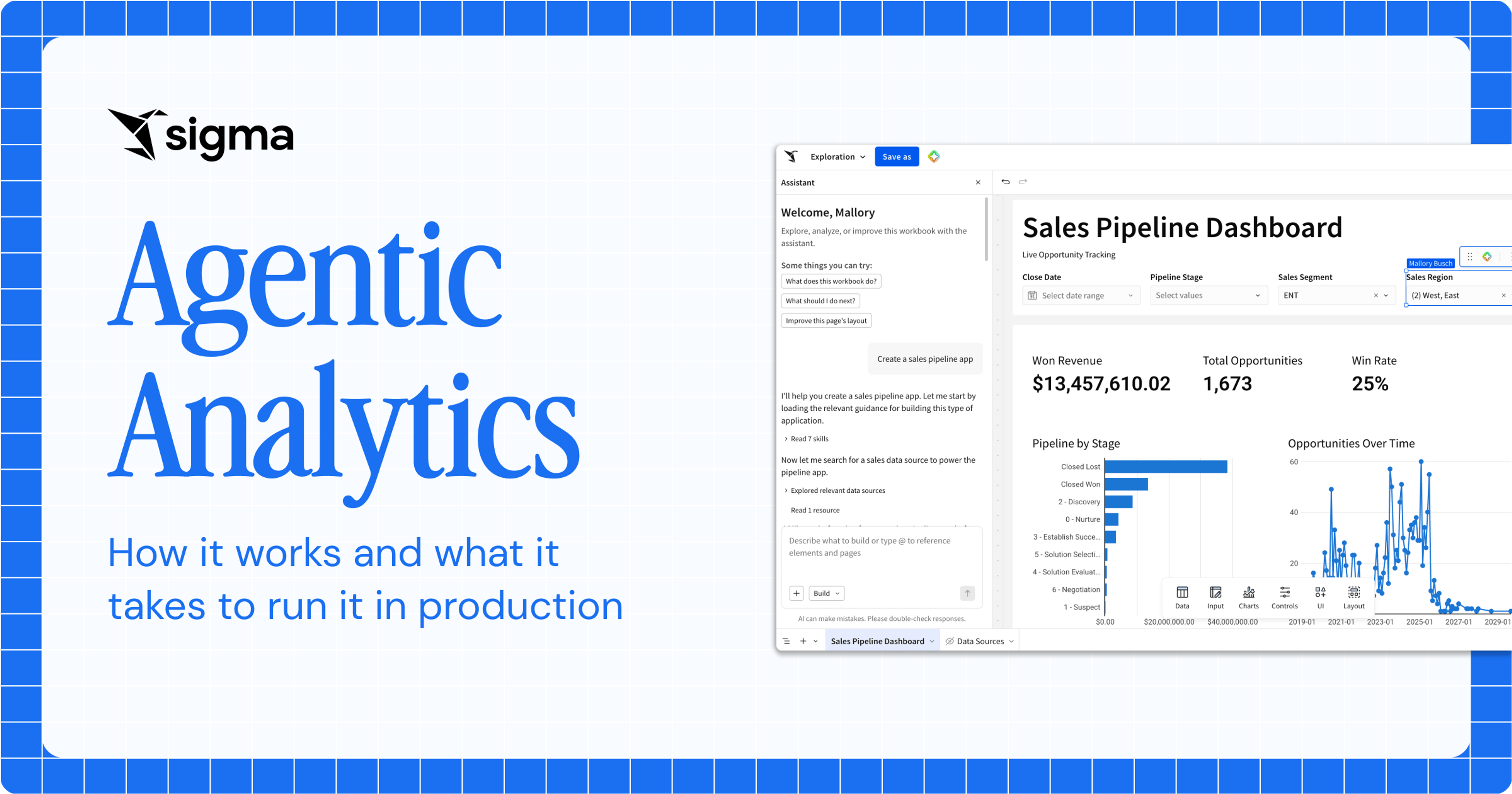
Agentic analytics is a new way of working with data, where AI agents take an objective, plan the steps to reach it, and act on instructions inside your governed data environment. Instead of asking an AI to write a single query or summarize a single chart, you hand it a goal, such as explaining a churn spike or comparing cohort behavior, and the agent carries that goal through every step of the investigation.
An agentic system carries an analytical objective forward across many steps, acts on the instructions it's given, pulls the right data, applies your organization's logic, and delivers a result you can inspect, redirect, or act on.
Key takeaways
- Single-shot AI assistants stall because text-to-SQL can quietly produce wrong answers, and business logic lives outside the model.
- You need four prerequisites for production-ready agentic analytics: modeled data, end-to-end lineage, a semantic layer, and usage signals.
- Sigma delivers agentic analytics natively on live cloud data warehouse data, with warehouse governance and workbook context applied to every agent action.
What is agentic analytics?
Agentic analytics refers to analytics systems in which autonomous AI agents perform data analysis tasks by reasoning through a business problem, deciding what to investigate, and taking action on findings. The core distinction from traditional analytics is agency: once a human sets the objective and configures the instructions, an agentic system pursues that goal on its own and can act autonomously in the background when commanded to, so the user doesn't have to re-prompt it at each step.
Agentic analytics systems take two forms. A single-agent system runs the entire loop within one agent. A multi-agent system splits that work across specialized agents coordinated by a planner.
Whether single or multi-agent, what defines the category as agentic is autonomous, multi-step behavior, regardless of how many agents are involved. Agentic analytics systems share a specific set of behaviors that one-shot chat assistants do not:
- Multi-step reasoning. The agent plans a sequence of actions, executes them, evaluates the intermediate results, and adjusts course before producing a final answer.
- Tool and data-source use. The agent calls external data sources, semantic layers, BI assets, and enterprise systems as part of the workflow, beyond what sits in its prompt window.
- Goal persistence. The agent keeps the original objective, such as "explain the EMEA retention drop," anchored across every step, so later actions remain tied to the question that started the workflow.
- Adaptation to intermediate results. If a first query returns nothing useful, the agent reformulates, broadens, or narrows its approach and tries again.
- Context-aware governance. The agent operates inside the same permissions, semantic definitions, and business rules the rest of the organization uses, so its answers remain consistent with everyone else's.
Together, those behaviors take a user from a question to a defensible answer within a single continuous workflow, rather than across a dozen back-and-forth prompts.
Why single-shot AI assistants stall on real analytical work
Single-shot AI assistants fail during the multi-step investigations analysts run every day due to two architectural weaknesses.
1. Generative SQL still needs governed table selection
Many BI copilots rely on text-to-SQL, which can hallucinate schema details and produce queries that are syntactically valid but semantically incorrect.
Text-to-SQL benchmark accuracy alone isn't enough in enterprise settings, because trust breaks down on the first wrong answer. A single wrong join condition produces a number that looks authoritative but isn't, and a one-shot system with no multi-turn correction loop passes that error directly to the decision-maker.
The risk grows when an assistant can't distinguish between a certified, tested data mart and a raw staging table. Enterprise data spans systems that were never designed for the same analytical workflow, and a stateless assistant has to guess its way through that ambiguity with every prompt.
2. Business logic lives outside the model by default
Generic LLMs have no built-in knowledge of an organization's metric definitions, transformation logic, or data quality rules.
When a generic copilot generates SQL to answer "What is our monthly active user count?" it may not know that your organization defines "active" as "a user who completed a specific event type within a 28-day rolling window" or by some other metric. Enterprise AI systems can close that gap when teams feed business metrics and logic directly into the model or connect it to a semantic layer, but without that context in place, the query returns a plausible-looking, wrong number that is harder to catch precisely because it looks right.
Closing that gap at the metric level isn't enough on its own. A single-shot assistant can pull the right definition for one question and still lose the plot on the next, because nothing carries the investigation forward. Overcoming both limits, governed business logic and continuity across steps, requires systems built to reason across a workflow rather than respond to a prompt.
4 requirements for agentic analytics in production
Four prerequisites must be in place for an agentic analytics system to run reliably in production: modeled data, lineage, a semantic layer, and usage signals.
1. Modeled data that gives agents something coherent to query
Your data team must model, test, and contextualize their data into analytics-ready structures before agents can reason over it. Clear definitions, governed metrics, documented transformations, and tested models give the agent something coherent to query, so it doesn't have to interpret raw tables on the fly.
2. End-to-end lineage that makes every answer traceable
Lineage lets an agent provide auditable reasoning traceable back to source systems and supports impact analysis when upstream data changes. Column-level lineage matters most — specifically when that metadata is defined in the semantic layer for each field. When that metadata is present, the agent can reference it directly to explain exactly which fields and transformations contributed to a number, and data teams can see the downstream blast radius before they ship a change.
3. A semantic layer that enforces one definition per metric
Organizations work with many data sources, and the same concept, such as "revenue," "churn," or "active customer," often appears in multiple ways. A semantic layer translates those business concepts into precise, reusable definitions that the agent can call on, so every analysis uses the same version of every metric.
4. Usage signals that surface the assets teams already trust
Usage signals can help surface which tables, queries, and dashboards the organization relies on. Column lineage, SQL query history, and BI semantic definitions are context that compounds over time, and an agent that can read those signals is more likely to gravitate toward the assets the business already trusts.
How agentic analytics workflows run
Once the prerequisites are in place, an agent moves through four stages: planning the steps, selecting data, applying business logic, executing, and handing the result to the user.
1. The agent interprets intent and plans the steps
A question like "Why did retention drop in EMEA last quarter?" is a multi-step investigation. The agent decomposes it into a sequence of sub-questions, such as what retention means here, which cohorts are in scope, what changed in the period, and what segments to compare, then lays out the steps needed to answer each one.
2. The agent selects data using the semantic and usage context
The agent decides which data to retrieve, drawing on the semantic layer to resolve metric definitions and on usage signals to prefer trusted assets. If the first pull is insufficient or surprising, the agent reformulates its query and expands or narrows the search until it has what it needs.
3. The agent applies business logic and executes
Before running any query, the agent applies the organization's domain rules, metric definitions, and analytical methodology. Each step's output feeds the next step's input, which is why the data foundation matters: errors compound across long workflows, and a small misalignment at step one can warp the conclusion at step five.
4. The user inspects, redirects, or accepts the result
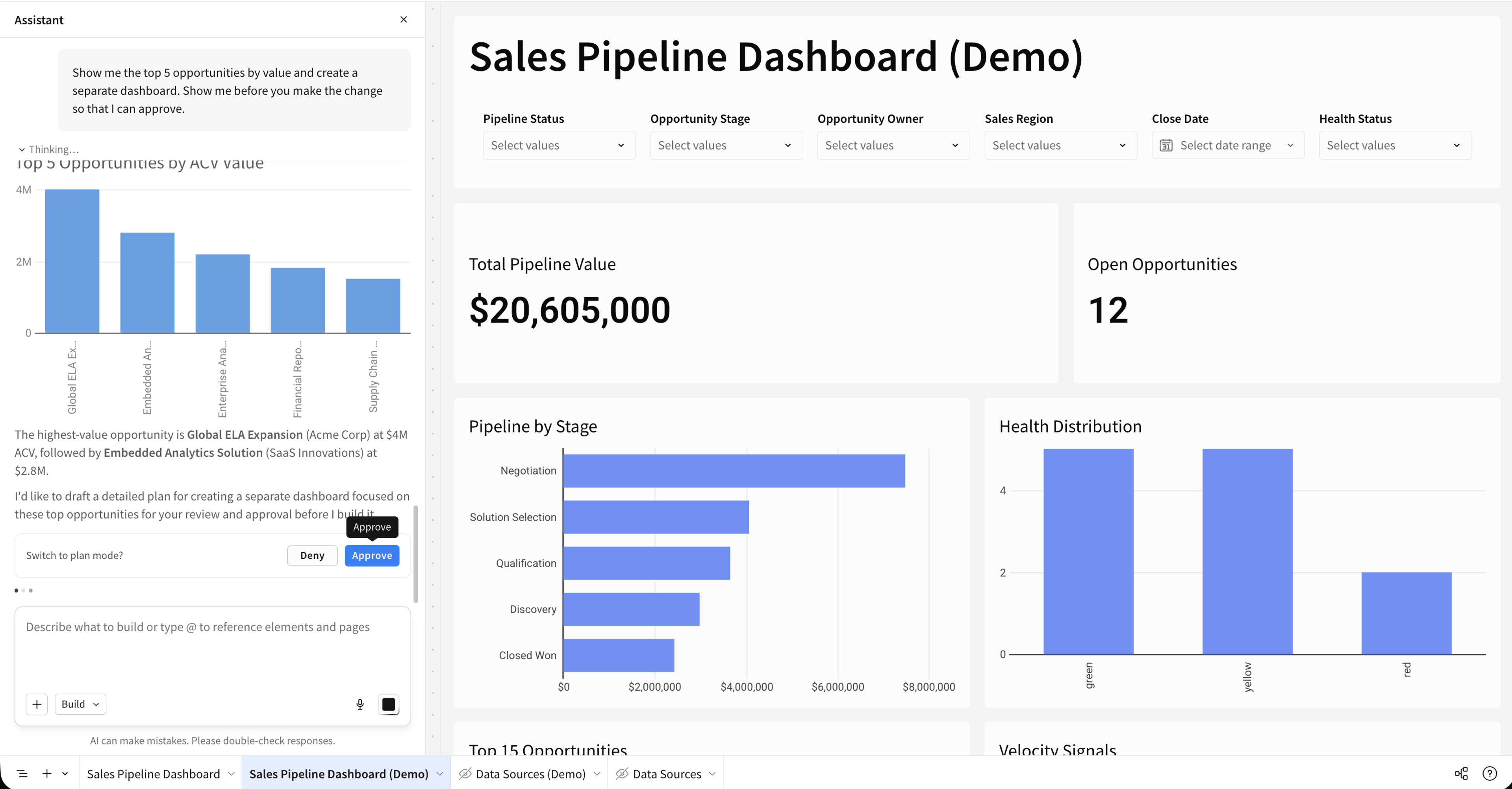
The agent presents its reasoning, its sources, and its answer in an inspectable form. As users gain experience with the workflow, they tend to shift from approving every individual action to monitoring the overall result and intervening when something looks off. The oversight model scales with the stakes of the question.
The benefits of agentic analytics
When an agentic system runs end-to-end on a governed foundation, the value compounds across the analytical workflow. Five benefits stand out:
- Teams reach a defensible answer faster. The agent scopes, queries, and validates the request itself, then returns a result with its reasoning and sources attached. Decision-makers see the answer and the work behind it in the same view, so they can act on it without a second round of verification.
- Workflows no longer require a ticket to the data team. Agentic analytics guides users through the analytical workflow rather than dropping them into an empty query interface, and well-scoped deployments reduce routine reporting handoffs to technical teams.
- Analysts spend time on judgment work, not request fulfillment. When agents handle multi-step retrieval and assembly, analysts spend less time fulfilling repetitive requests and more time on interpretation, modeling, and decision support, the work that requires their expertise.
- Every analysis applies the same business logic. Every query an agent executes draws from the same semantic definitions and business rules, so two people asking the same question get the same answer.
- One surface handles questions, inspection, and action. Agentic analytics keeps the original question, the investigation, and the follow-up action, such as writing back a value, triggering a notification, or updating a forecast, inside one workspace.
Taken together, these benefits move analytics from a series of disconnected handoffs to a single, governed workflow, where speed, trust, and consistency reinforce one another at every step.
The limitations of agentic analytics
The same capabilities that make agentic analytics powerful also expose where it can fail. Current limitations cluster in three areas: the quality of the underlying data foundation, the unevenness of codified business logic inside most organizations, and the difficulty of calibrating how much autonomy to give the agent in the first place.
1. Agents inherit the quality of the data foundation
Agents need clear signals about the trustworthiness of the data they query. Without those signals, they treat whatever they retrieve as ground truth. If no one refreshes context after a metric definition changes in the warehouse, the agent may still serve the old value, and an answer that was accurate last week can quietly become out of date today.
2. Codified business logic is still uneven inside organizations
What counts as an "active customer"? How does finance recognize revenue in edge cases? A lot of this knowledge lives in Slack threads, undocumented conventions, or the heads of long-tenured employees. Agents have no access to that tribal knowledge, so an agent asked to analyze revenue trends may quietly choose one interpretation and produce the wrong answer for the specific audience.
3. Autonomy is a dial most teams are still calibrating
Too little autonomy means constant human intervention and limited value. Too much autonomy lets errors propagate across downstream steps before anyone notices. Calibrating that dial is hard enough that more than 40% of agentic AI projects are projected to be canceled by 2027, with escalating costs, unclear business value, and inadequate risk controls as the primary causes.
How Sigma delivers agentic analytics
Sigma is the runtime layer for building and scaling analytics, apps, and agents on live cloud data warehouse data. Every artifact generated inside Sigma, from a workbook to an AI App, inherits the company's existing warehouse governance and stays auditable, permissioned, and traceable by default.
That foundation shapes how Sigma delivers agentic analytics across three layers: the product surface, the data foundation on which agents run, and the governance model that holds it all together.
Sigma has agentic analytics built into the core product
Sigma Agents are customized agentic workflows configured within a workbook context. Admins configure each one with plain-English instructions, defined data access, and specified actions including writeback, notifications, REST API calls to external systems, webhook triggers, and stored procedure execution.
Sigma Agents support three interaction patterns: conversational (the user asks, the agent answers and explores), human in the loop (the agent proposes, the user approves before anything is written or sent), and autonomous (the agent runs work on the user's behalf).
Sigma Agents run on the same foundation that users already query
Sigma's warehouse-native architecture keeps queries on live data in the warehouse (e.g., Databricks, Snowflake, BigQuery, Amazon Redshift), with no copying and no separate model store. Agents operate with the workbook context, defined data access, and configured actions that the rest of the team already uses.
Warehouse governance applies to agents by default
Agents inherit warehouse permissions, and row-level security, column-level security, and audit trails carry through from the warehouse to every action the agent takes. IT keeps visibility and control. Business teams get speed and flexibility. The same governance posture that protects a dashboard protects an agent's reasoning, retrieval, and writeback.
Experience agentic analytics with Sigma
Sigma puts agentic analytics in the hands of every team that already works with spreadsheets, dashboards, and workbooks. Agents plan multi-step investigations, query live cloud data warehouse data, use configured instructions, workbook context, and governed data access, and hand back inspectable answers your team can redirect, write back, or act on. Warehouse permissions, row-level security, column-level security, and audit trails carry through to every step, so IT keeps control while business teams move at the speed of the question.
The fastest way to see what agentic analytics delivers for your team is to run it against your own data. Try Sigma free or get a demo to see it in action. Check out our April 2026 product launch to learn more about Sigma Agents, and tune into the next quarterly product launch to catch the latest agent updates.