Back-to-Back: Sigma Named Databricks' 2026 Business Intelligence Partner of the Year


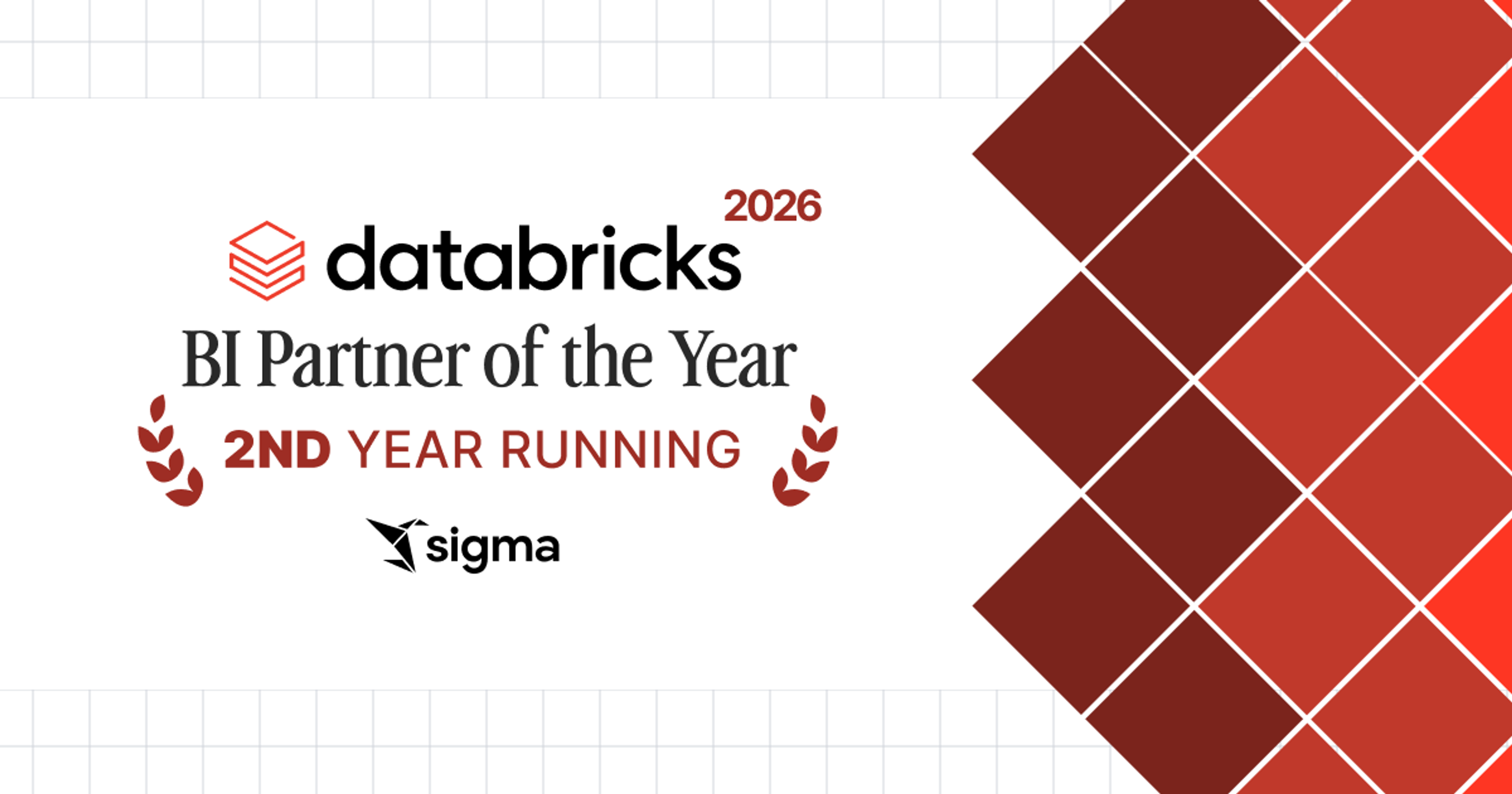
At Data + AI Summit in San Francisco, Databricks named Sigma its 2026 ISV Business Intelligence Partner of the Year for the second consecutive year.
Awards like this are measured in customer outcomes. The criteria is straightforward: which partner drove the most meaningful value for Databricks customers over the past year? For the second year running, that answer was Sigma.
The recognition comes alongside Databricks Ventures' participation in Sigma's recently closed $80 million Series E, which doubled the company's valuation to $3 billion. That investment reflects the same conviction the award does.
“We're honored to receive this recognition from Databricks for the second year in a row,” said Mike Palmer, CEO of Sigma. “Sigma now connects directly to Lakehouse//RT, Agent Bricks, Genie Agents, and Lakebase, so joint customers can get sub-second query performance at scale, explore billions of rows through a familiar spreadsheet interface, build agents that act on that data, and manage the full agent workflow without ever leaving the governed environment they already trust.”
Why Sigma and Databricks, Together
Databricks is where enterprise data lives, gets governed, and scales. Sigma is where that data becomes AI apps, analytics, and automated workflows that business teams can use.
Sigma is not a traditional BI layer sitting passively on top of the lakehouse. It is the execution environment where Databricks' AI capabilities (Genie, Agent Bricks, Unity Catalog governance and more) reach the people and processes that need to act on them. A team can query live data in natural language through Genie Agents inside Sigma, then build those results into an app, trigger an automated action, or write data back to Databricks, all within the same governed workspace, all without breaking permissions.
The insight becomes the application. The application becomes the workflow.
Stephen Orban, SVP of Product Ecosystem and Partnerships at Databricks, put it directly: “As the race to productionize AI accelerates, customers consistently ask us how they can better manage their data in order to build AI apps and agents that make a real impact on their business. As a key Databricks partner, Sigma helps our joint customers do exactly that. We're proud to recognize them as the 2026 Databricks ISV Business Intelligence Partner of the Year.”
What Sigma Shipped at Databricks Data + AI Summit 2026
Alongside the award, Sigma is announcing four new capabilities for joint customers:
Lakehouse//RT launch partner
Sigma joins as a launch partner for Lakehouse//RT, Databricks's new sub-second serving engine. Lakehouse//RT delivers sub-second query latency on existing Delta tables at massive concurrency, with no data movement and full Unity Catalog governance. Customers get real-time user-facing apps, operational dashboards, and AI agent-serving natively on Databricks, without standing up external infrastructure.
This feature is currently in development but is targeted for release by early fall.
Databricks Genie and Agent Bricks
Business teams can query live Databricks data in natural language and trigger automated actions directly from Sigma. Unity Catalog permissions are enforced end to end over what users can reach and what they can trigger. Where Genie answers a question, Sigma turns that answer into an app, a workflow, or a decision.
Lakebase connectivity
Sigma connects natively to Databricks Lakebase, Databricks' managed PostgreSQL engine embedded in the platform. Real-time transactional data sits alongside analytical datasets in one governed workspace, with no data movement and no separate pipeline for operational reporting.
Unity Catalog Semantics
Metric definitions managed in Unity Catalog now surface natively in Sigma workbooks. Data teams define business logic once; every report, dashboard, and AI app output draws from the same source. Metric drift between the warehouse and the analytics layer is eliminated.
This feature is currently in Private Beta but will be available for Public Beta early this summer.
What Databricks + Sigma Customers Are Building
At Data + AI Summit this week, Sigma is featuring sessions with four joint customers building on our integration in production.
- Hospital for Special Surgery is bringing clinical and operational data together in one governed environment, giving care teams live access to the information they need without introducing compliance exposure.
- Unilever is turning warehouse data into business-facing applications that reach the teams who need them, without data silos or analyst bottlenecks.
- Dotmatics is connecting scientific data with business workflows on a platform that handles both the governance precision and the live data access those use cases require.
- DraftKings built a streaming-first financial intelligence system on Databricks and Sigma, blending real-time, historical, and forecast data to deliver second-level visibility into transactions, active users, revenue, and real-time liability tracking.
The pattern across all four: Databricks handles the data platform. Sigma is where that data becomes applications, agents, and action.
The Road Ahead
The hardest part of enterprise AI is not finding the capabilities. It is deploying them on real business data, under real permissions, at production scale. Getting agents to reason over live data, enforce row-level security, write back results, and operate at scale across a large organization: that is where most AI initiatives stall.
That is the joint problem Sigma and Databricks are solving together, with deeper agent workflow support, broader Lakehouse//RT adoption, and continued Unity Catalog alignment across every surface of the Sigma platform. The goal is a governed workspace where teams build, deploy, and scale AI apps, analytics, and agents without architectural compromise.
Two years of BI Partner of the Year reflects what has already been built. What comes next is raising the ceiling on what joint customers can do with AI on the lakehouse.
Visit Sigma at Booth #106 at Data + AI Summit to see these integrations live, or request a demo to explore what Sigma on Databricks can do for your team.