7 Best Power BI Alternatives in 2026

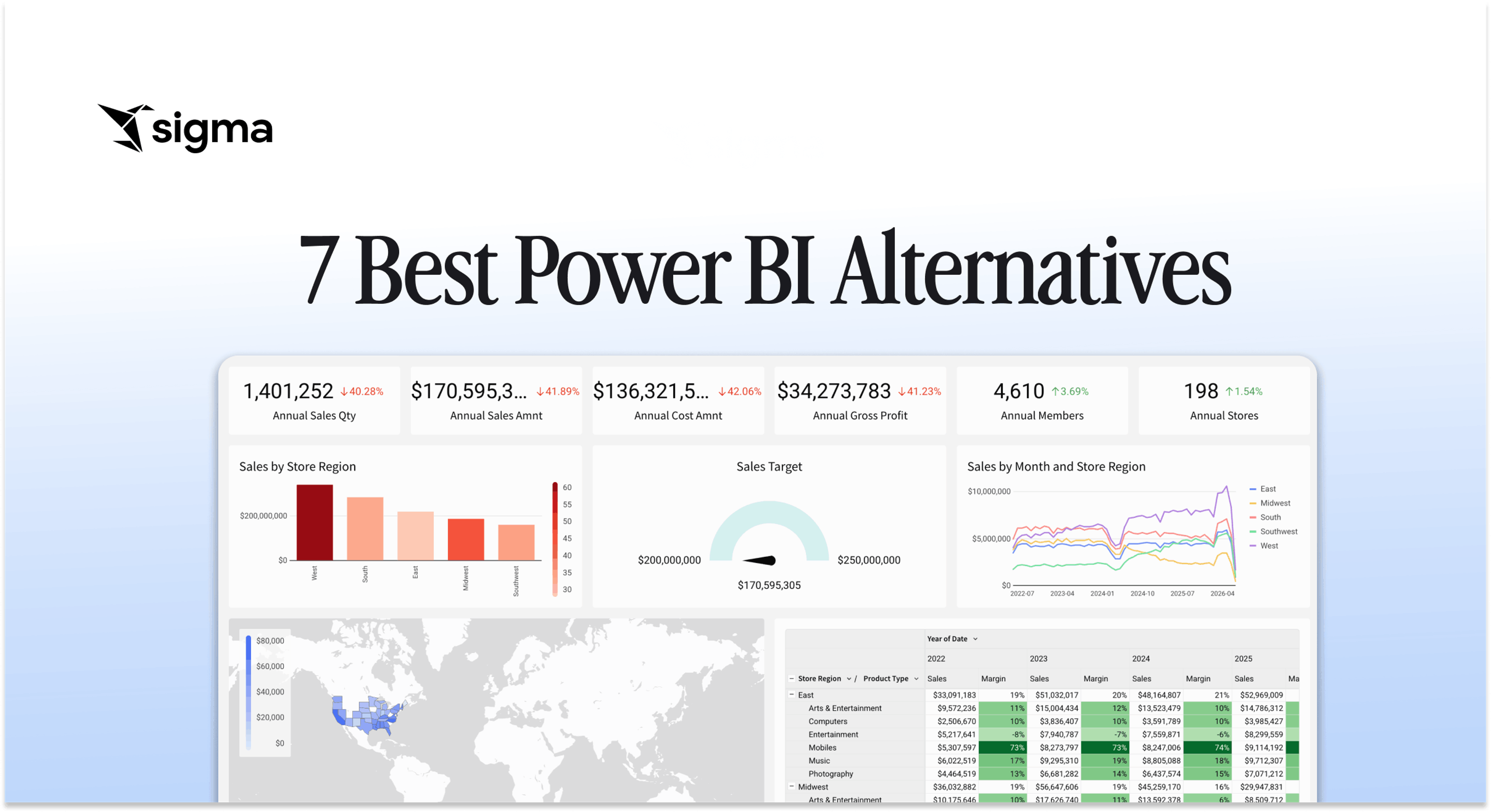
Microsoft Power BI is often the default choice for teams already in the Microsoft ecosystem, and for many of those teams, it does the job.
The search for a Power BI alternative is usually driven by something specific: an import model that caps dataset size, a per-user license that punishes viewer scale, or a DAX learning curve that keeps business users dependent on a central BI team.
This listicle is for teams facing any of those challenges and want to know what else is out there. It compares the 7 Power BI alternatives across architecture, self-service depth, AI capabilities, writeback, and pricing, so you can match the right platform to your data stack and team.
What should you look for in a Power BI alternative?
Most teams trace Power BI's persistent pain points to its default import-based architecture and cite its dependency on the Microsoft ecosystem as a secondary limitation. The right Power BI alternative resolves those structural issues rather than trading them for a different set of constraints. Evaluate each platform against these criteria:
- Query architecture: Whether the platform queries live or imports into a separate engine determines whether you inherit or duplicate governance.
- Self-service model: The interface determines who can build analyses without SQL or a proprietary language such as DAX.
- AI governance: AI features should run under the same row-level security as the rest of the platform.
- Native writeback: Platforms with writeback let users enter data and run scenarios without exporting to Excel.
- Warehouse connectivity: Multi-warehouse support matters for organizations that are not locked into a single cloud provider.
- Legacy BI tradeoffs: The right replacement should remove the extract, refresh, and licensing constraints that define legacy BI, not recreate them in a different form.
| Platform | Architecture | Self-service model | AI capabilities | Native writeback | Multi-warehouse support |
|---|---|---|---|---|---|
| Sigma | Warehouse-native (live queries) | Spreadsheet interface, no SQL required | Sigma Assistant, Sigma Agents, AI Columns | Yes (Input Tables, cell-level editing on the same canvas) | BigQuery, Databricks, Redshift, Snowflake |
| Tableau | Extracts or live connections | Extracts or live connections | Tableau Agent, Pulse | Limited (via third-party extensions such as WriteBackExtreme and SuperTables that enable typing directly into a table within Tableau) | Multi-database via connectors |
| Qlik Sense | In-memory associative engine | Associative exploration | Insight Advisor, Qlik Answers | Available (Write Table chart and Qlik Application Automation for write-back workflows) | Multi-source via connectors |
| Looker | Pushes queries to warehouse | LookML-dependent modeling | Gemini Conversational Analytics | Limited (via the Action API to write back to any data warehouse or destination, typically through Cloud Run functions or custom webhooks) | BigQuery, Snowflake, Redshift, Databricks |
| ThoughtSpot | Live queries to warehouse | Search-driven NLQ | Spotter, ThoughtSpot's analytics agent | Limited (via custom URL or callback actions that push data payloads to a third-party application or initiate a callback to the parent app) | Snowflake, Databricks, BigQuery, Redshift |
| Domo | Cloud-native with Cloud Amplifier | Drag-and-drop ETL | AI-driven analytics and data visualization | Limited (via Writeback Connectors that push Domo DataSets to third-party systems) | Multi-source via 1,000+ connectors |
| Sisense | In-memory (Elasticube) | elf-service analytics environment | AI-driven analytics for embedded analytics and data exploration | Limited (via BloX widgets or marketplace plugins that send input-field data to a REST API, which writes to the source database) | Multi-source via connectors |
1. Sigma
Sigma is the runtime layer for building and scaling analytics, apps, and agents on live cloud data warehouse data. It sits between the warehouse and AI, turning AI-generated artifacts into production-ready software that inherits the company's existing governance. Sigma is a strong Power BI alternative because it replaces Power BI's import-based architecture with live queries to BigQuery, Databricks, Redshift, and Snowflake, with no dataset ceiling, no refresh schedule, and no DAX.
Pros
- Native writeback through Input Tables. Users can enter data, run scenarios, and trigger workflows directly in the workbook. Every change carries a full audit trail.
- Sigma's spreadsheet interface compiles filters, group-bys, pivots, and formulas into warehouse SQL, while Input Tables and AI Apps close the loop between analysis and action on the same canvas.
- Spreadsheet interface on warehouse-scale data with no import limits. Sigma provides a CSV upload/import layer for bringing external files into the platform.
- AI that inherits warehouse governance. Sigma Agents and Sigma Assistant run on warehouse data with row-level security intact.
Cons
- The platform runs cloud-only, with no on-premises deployment option.
- Organizations without an existing cloud data warehouse need to establish one before adopting Sigma.
Pricing
Sigma offers four license tiers (View, Act, Analyze, Build). Sigma does not publish per-tier pricing; contact sales for a quote. A free trial period is available. Or, if you’re interested in seeing the apps, dashboards, and workbooks that people have built with Sigma, you can sign up for Sigma Public.
Who is Sigma best for?
Data teams that need governed, warehouse-scale analytics and business users who need to work with live data without learning SQL or managing refresh schedules.
Tableau
Tableau is a business intelligence platform built around drag-and-drop visual analytics with a deep visualization grammar and a broad connector library. Tableau ships in two deployment options: Tableau Cloud (SaaS) and Tableau Server (on-premises).
Pros
- High bar for visualization depth and interactivity.
- Tableau Cloud AI features run through the Einstein Trust Layer with zero data retention by third-party LLMs and PII masking.
- A broad connector library spans Excel, SQL databases, Snowflake, Salesforce, and dozens of other sources.
- Users consider Tableau a strong fit for organizations consolidating analytics across mixed data environments.
Cons
- Some users have raised concerns about Tableau's licensing costs as they scale to more users, with small teams and individual users describing these costs as a barrier.
- Some users have reported that performance slows with very large datasets or complex dashboards, and cite extracting and optimizing as the practical workaround.
- The extract-based architecture requires scheduled refresh management and extract sizing, reproducing a constraint similar to Power BI's import model.
Pricing
Tableau Cloud Standard: Viewer $15, Explorer $42, and Creator $75 per user/month, billed annually. Tableau Cloud Enterprise: Viewer $35, Explorer $70, and Creator $115 per user/month, billed annually. Cloud+ Edition and the Tableau+ Bundle (which adds Tableau Next and agentic analytics) require a sales conversation for pricing. Tableau offers a 14-day free trial for Tableau Desktop and Creator.
Who is Tableau best for?
Teams that prioritize visualization depth and already operate within the Salesforce ecosystem, with dedicated developers to manage extract schedules.
Qlik
Qlik is a business intelligence platform built around a proprietary associative engine that indexes every field-to-field relationship across the entire data model. In Qlik's current portfolio, Qlik Cloud Analytics is the SaaS offering, while Qlik Sense is the client-managed and on-premises offering.
Pros
- The associative engine lets users click any data value and see how it relates to every other dimension, with non-associated values visually grayed out. This enables free-form exploration without predefined drill-down hierarchies.
- Genuine hybrid deployment: SaaS, on-premises (Windows), containerized (Kubernetes), or hybrid combinations.
- Qlik Talend Cloud integration provides data integration and quality capabilities alongside analytics, reducing the need for separate ETL tools.
Cons
- The in-memory engine requires RAM provisioning and QVD file management, adding infrastructure overhead for organizations on a cloud data warehouse.
- Some users have raised concerns about the suitability for non-IT users and the minimal support from the Qlik team.
- Qlik uses a proprietary expression syntax, creating a steep learning curve for teams accustomed to standard SQL or spreadsheet formulas.
Pricing
Qlik Cloud Analytics uses capacity-based pricing for new subscriptions. The Starter tier remains user-based with a fixed 10 GB data capacity. The Premium tier costs $2,750/month (billed annually) with 50 GB capacity. Qlik does not publish pricing for the Standard and Enterprise tiers; contact sales.
Who is Qlik Sense best for?
Organizations in regulated industries that need hybrid or on-premises deployment alongside associative data exploration across complex, multi-source data environments.
Looker
Looker is a Google Cloud business intelligence platform built around the LookML semantic modeling language. Deep integration with Google Cloud's AI stack (Gemini, Vertex AI, Agentspace) gives teams on BigQuery a native path to conversational and agentic analytics.
Pros
- LookML creates a single source of truth for metric definitions. Every dashboard, report, and AI agent query draws from the same governed definitions.
- Looker pushes queries to the underlying database rather than importing data, avoiding the extract-and-refresh cycle.
- Deep integration with Google Cloud's AI stack gives teams on BigQuery a native path to agentic analytics.
Cons
- Only Developer User licenses can access LookML Development Mode, creating a dependency on technical resources for any model changes.
- The deepest AI and governance features (Gemini, VPC Service Controls, IAM integration) require a Google Cloud commitment, limiting flexibility for organizations on AWS or Azure.
- Looker does not publish pricing for any tier, which makes early-stage budget modeling difficult without a sales conversation.
Pricing
Looker offers Standard, Enterprise, and Embed editions. Pricing is not publicly available; contact Google Cloud sales for a quote.
Who is Looker best for?
Data teams at Google Cloud-native organizations that want a governed semantic layer with dedicated LookML developers to maintain the data model.
ThoughtSpot
ThoughtSpot is a business intelligence platform built around search-driven analytics and natural language querying. Spotter AI agents provide agentic analytics, including change analysis and anomaly detection.
Pros
- The search-driven interface lets business users type questions in natural language and receive chart-based answers, with drilldowns that don't require pre-defined drill paths.
- Live connections to Snowflake, Databricks, BigQuery, and Redshift avoid the import and refresh constraints of Power BI's default mode.
- Embedded analytics can provide product teams with a low-risk entry point into embedded use cases.
Cons
- ThoughtSpot caps Spotter AI usage at 25 queries per user per month on the Pro tier and excludes it from the Essentials tier, which constrains AI-driven workflows for teams that haven't upgraded to the Enterprise tier.
- Some users note limited customization options compared to platforms built primarily for visual analytics.
- The Essentials tier caps at 25 million rows and 10 users, which limits scalability for growing teams without upgrading to Pro or Enterprise.
Pricing
Essentials: $25/user/month for 5 to 50 users, 25 million rows, no Spotter AI. Pro: $50/user/month for 25 to 1,000 users, 250 million rows, 25 Spotter queries/month/user. Enterprise is custom. The Embedded Developer tier is free for up to 10 users. ThoughtSpot bills annually.
Who is ThoughtSpot best for?
Organizations where business users need to ask ad hoc questions of warehouse data without waiting on analysts, and where AI query volume stays within tier limits.
Domo
Domo is a cloud-native analytics platform that extends beyond traditional BI into workflow automation and AI agent deployment. It includes 1,000+ pre-built connectors and a drag-and-drop ETL interface (Magic ETL).
Pros
- The drag-and-drop ETL interface makes data preparation accessible to non-technical users, reducing dependency on data engineering teams.
- Cloud Amplifier can query data directly in certain source systems, such as Snowflake and some cloud data platforms, without replication.
- A native mobile application provides full dashboard access, a genuine differentiator for field teams and executives.
Cons
- Some users have raised concerns that the credit consumption model is confusing and limits their freedom to experiment with the platform.
- The AI Pro tier uses a separate consumption-based billing model on top of the base subscription, which can make total spend harder to forecast.
- Magic ETL can be limiting for complex transformations. Users who need code-based pipeline logic may find the visual interface insufficient.
Pricing
Domo offers Standard (full platform), Enterprise (volume discounts), and Business Critical (AWS Private Link, HIPAA) tiers. Pricing is not publicly available; contact sales for a quote. AI Pro carries separate consumption-based pricing.
Who is Domo best for?
Mid-market teams that need a single cloud platform for data integration, visualization, and workflow automation with mobile-first access.
Sisense
Sisense is an embedded analytics platform built around the Elasticube in-memory engine. It targets developers embedding analytics in SaaS applications through Sisense Fusion, the Compose SDK, and an API-first architecture. Sisense supports SaaS deployment on the Launch and Grow tiers, with dedicated cloud and on-premises options available on the Scale tier.
Pros
- The embedded-first positioning makes Sisense a direct fit for product teams building customer-facing analytics into SaaS applications, with white-labeling and SSO on Grow and Scale tiers.
- Sisense publishes self-serve pricing on its entry tiers, which is rare among embedded analytics platforms.
- On-premises and dedicated cloud deployment options on Scale matter for organizations with strict data residency requirements.
Cons
- Some users report that the performance of dashboards can be slow when handling large datasets.
- The Elasticube engine measures storage in Elasticube capacity (20 GB on Launch, 80 GB on Grow), with custom storage only on Scale.
- Sisense positions the platform primarily for embedded, customer-facing analytics. Internal self-service BI use cases have less depth compared to dedicated BI platforms.
Pricing
Launch costs $399/month and Grow costs $1,299/month (five designers, 100 viewers, 80 GB storage). Scale pricing is not publicly available; contact sales. A 7-day free trial is available.
Who is Sisense best for?
Product teams at SaaS companies that are building embedded, white-labeled analytics into their own applications for customer-facing dashboards.
Our verdict: Sigma is the best Power BI alternative
Power BI's friction is architectural: an import model that creates dataset ceilings, refresh schedules that lag operational tempo, DAX as a barrier to non-technical users, and a per-user license model that punishes viewer scale.
Most platforms in this comparison answer those constraints by adding a layer, whether that's an extract engine, a semantic modeling language, a consumption credit system, or a third-party writeback extension. Sigma removes those layers rather than replacing them with new ones.
If your organization runs on a cloud data warehouse, Sigma sits directly on top of it. Filters, pivots, group-bys, and formulas compile to live SQL against BigQuery, Databricks, Redshift, or Snowflake. There is no dataset ceiling, no refresh schedule, no proprietary formula language to learn, and no governance layer to duplicate. Row-level security defined in your warehouse carries through every query, every dashboard, and every Sigma Agent interaction.
Sigma is further differentiated by native, cell-level writeback on the same canvas as analysis. Input Tables let business users enter data, run scenarios, trigger workflows, and entirely replace the Excel export loop, with a full audit trail for every change. AI Apps and Sigma Agents close the loop between asking a question and acting on the answer, all in one workbook.
For teams whose users know spreadsheets but not SQL, who need governed live data without extract management, and who want AI features that respect existing data permissions rather than working around them, Sigma is a direct replacement for Power BI's architectural limits.
Try Sigma free or get a demo to see how well it functions as a Power BI alternative.