When One Report Becomes Hundreds: Building Bursting At Sigma

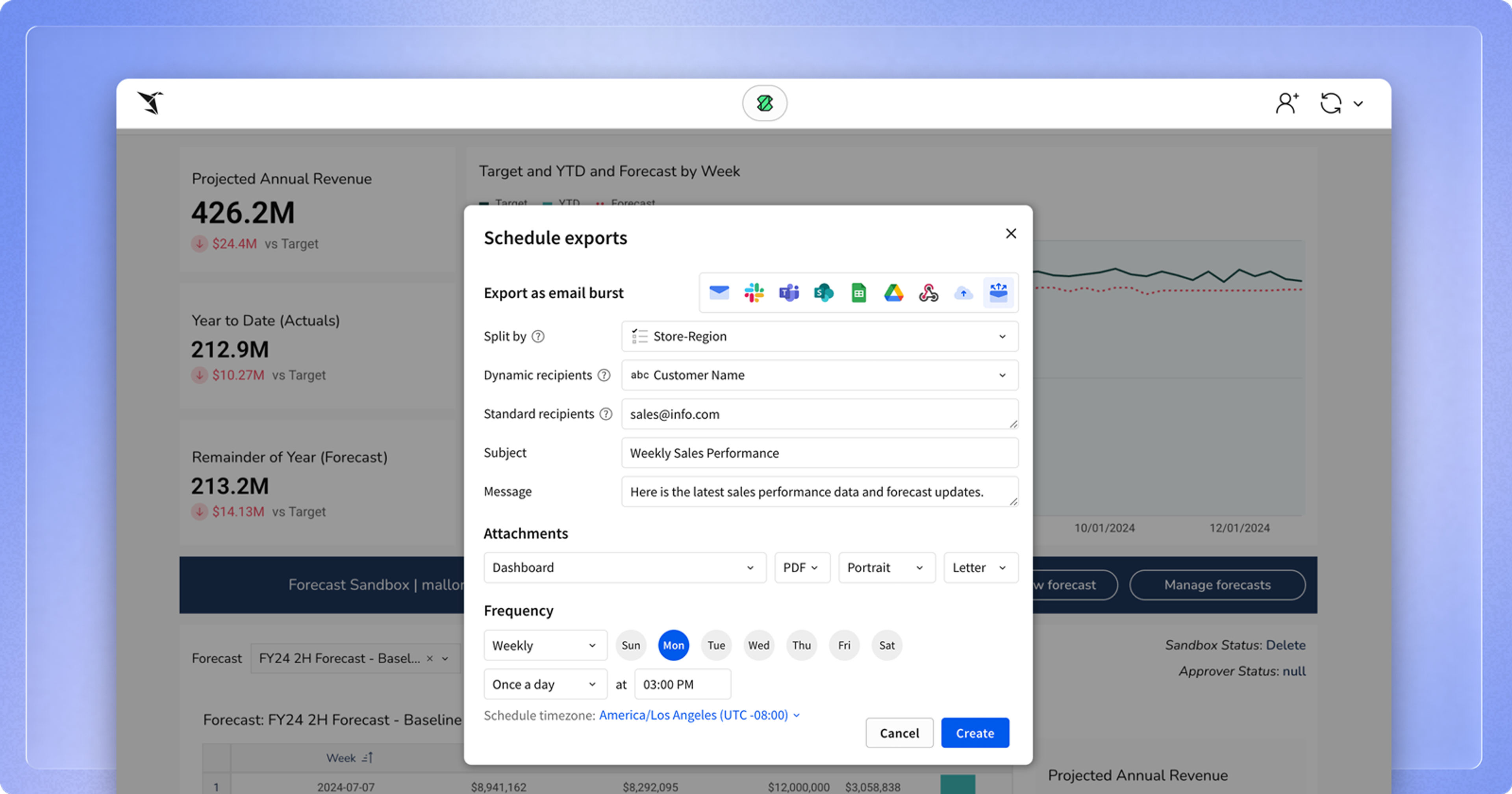
There’s always something exciting on the horizon at Sigma. In the Exports team, we help users create and deliver reports in many formats—CSV, Excel, PDF, JSON, and more—to destinations like email, Slack, and Google Drive. Recently, I worked on a powerful and unique feature: export as email burst, or “report bursting.”
What “report bursting” really does is that it distributes personalized reports to multiple recipients based on predefined mapping. Put simply, companies in many industries need to generate multiple versions of a single report—each tailored to specific criteria—and distribute them to different people. Users could do something similar before in Sigma, using a combination of separate schedules, Row-Level Security (RLS), and “Run as Recipient.” But it was harder to use than we would have liked. That’s when we saw the opportunity, and the idea for a dedicated “Export as a Burst” feature was born.
Bringing the burst to life
The Design and Export teams worked closely to bring “Export as a Burst” to life. There was real customer interest from the start, so we kicked off by interviewing potential users and solution architects to understand their needs. Our goal was clear: make bursting intuitive while and support the flexible workflows Sigma is known for.
We explored several concepts, and some ideas that initially looked solid were scrapped entirely as we gained new insights. But eventually, we arrived at a design that struck the right balance between ease of use and power.
Building the foundation
With the design in place, we turned to the harder part: building it. The core functionality required generating multiple reports based on a unique value defined in the UI—for example, a customer name, region, or product. Each value had to be mapped to one or more recipients, who would then receive a personalized version of the report.
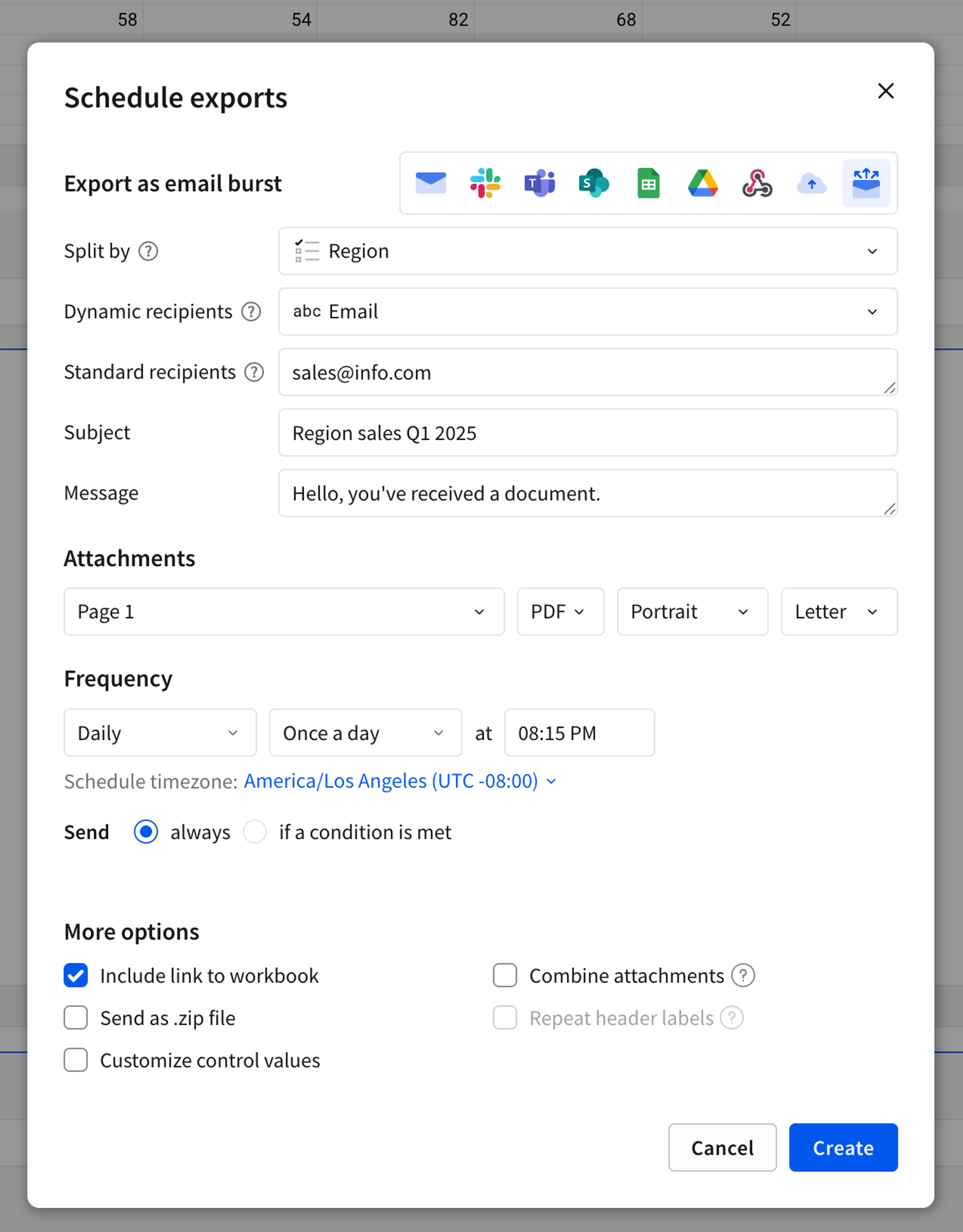
The final design helps users understand how they can send reports to dynamic or standard recipients, split by unique values.
This raised important questions. Should bursting support only Sigma users, or external recipients as well? Each choice had implications for RLS and access control.
Data retrieval was another technical hurdle. Our system didn’t have a built-in mechanism to fetch these unique values on the backend, where all report generation happens. We had to rethink the evaluation flow and create a way to execute these queries from there. That meant building entirely new types of evaluation queries that would work with any warehouse Sigma supports.
This pushed us outside our usual scope. Luckily, close collaboration with the Compiler team—experts at translating Sigma logic into warehouse-specific SQL—made it possible.
The best signal: customers wanted more
Once we rolled out the feature, we were thrilled to see that users were excited, and it was clear we were solving a real pain point. Even better, feedback didn’t stop at validation—customers wanted more. Bursting began with email destinations, but users quickly asked for Slack support, multiple destinations, and additional controls over how reports were split. For us engineers, that was the best sign: the feature wasn’t just being used, it was being wanted.
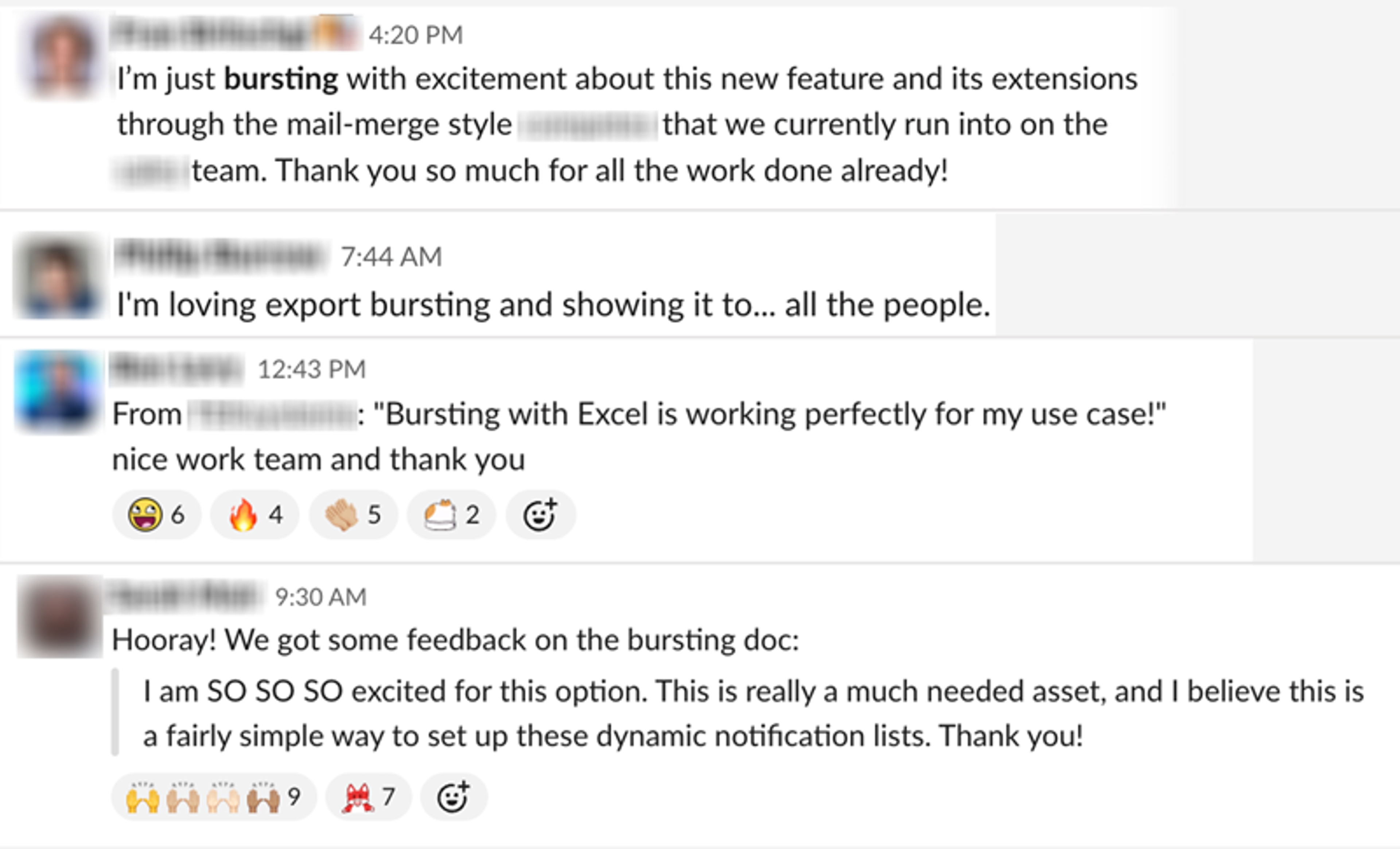
The best product signal: instant adoption among customers.
Bursting for scheduled email exports went Generally Available in February 2024. We're now focused on making it even better by expanding scalability and delivering major performance and reliability upgrades. This will provide users with an even more powerful and flexible bursting experience.
What we learned along the way
Looking back, a few lessons stand out from this build. The first is to start with the user. Some of the most impactful decisions came directly from conversations with customers, and keeping their workflows in mind helped us shape a more intuitive product.
The second is that collaboration is key. Many parts of this project would not have been possible without tight collaboration between teams. Breaking down silos allowed us to move faster and go further. We also learned not to fear rework—and even threw away several early designs and engineering prototypes as we went. While frustrating at times, it ultimately led us to a much better product. Launching the first version allowed us to validate the core concept quickly and move forward with the next phase of development.
And finally: when customers immediately ask for more, it’s a great sign. Their excitement doesn’t just prove the value of what we built—it fuels the roadmap for what comes next.
Building bursting reminded us why we do this work: the best features start with real needs, grow through collaboration, and continue to evolve with our customers.
Enjoyed this post? Check out our quarterly product launches and careers at Sigma.