It’s time to migrate from Power BI to Sigma
Stuck behind 1-million-row limits and DAX just to keep a report from breaking? Sigma runs live on billions of rows with a spreadsheet your team already knows, no extracts or capacity upgrades required.


Teams of every size are moving from Power BI to Sigma






Where your data goes to work
Most BI tools stop at the dashboard. Sigma keeps going, turning the same governed data into interactive apps and agents that act.
AI Ecosystem
Sigma is your OS for live data and AI. Unify external agents via MCP with warehouse LLMs and Sigma Agents for natural-language discovery, without vendor lock-in.
Closed-loop Execution
Collapse the insight-to-action loop. Safely write governed decisions back to the warehouse via input tables and trigger enterprise workflows from one environment.
Secure Governance
AI security must be architectural. Sigma Agents and AI Apps automatically inherit your cloud data warehouse row-level and column-level security.
Enterprise SDLC
Get production-grade controls without the engineering overhead. Sigma isolates draft and live states using connection-aware deployment and version tagging.
AI Applications
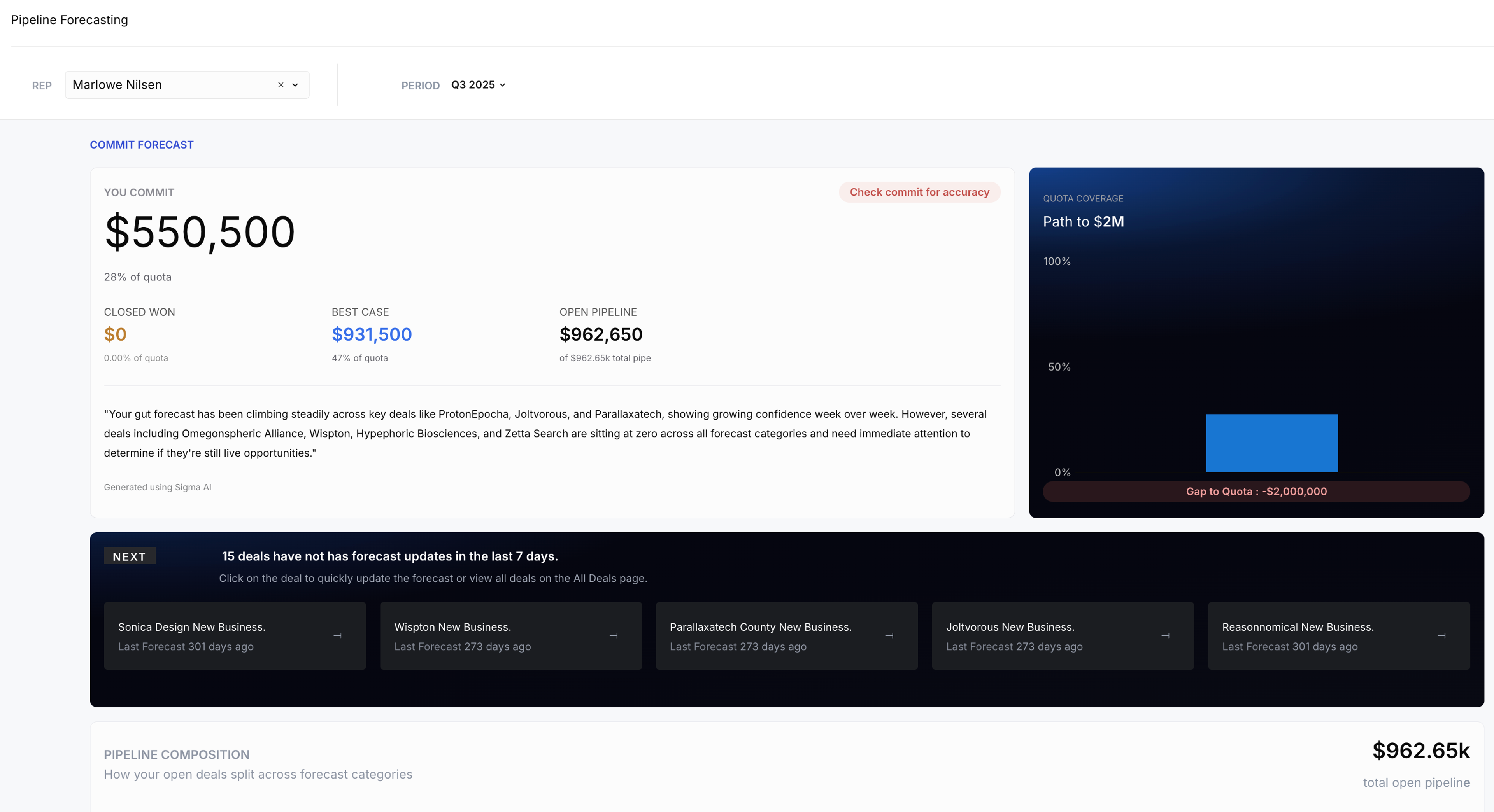
Move beyond read-only dashboards. Anyone can build interactive, no-code AI Apps that take action and write decisions directly back to your warehouse.
Sigma Agents
Turn insights into automated work. Sigma Agents read, write, and trigger external workflows while inheriting warehouse security, so every action stays auditable.
Three steps from Power BI to Sigma
Point Sigma at your warehouse and it rebuilds your workbooks as live, governed analytics your team already knows how to use.
- 1
Connect your warehouse
Sigma queries Snowflake, Databricks, BigQuery, or Redshift live, so nothing gets extracted and no data leaves your warehouse.
- 2
Auto-convert your Power BI dashboards
Sigma’s migration tooling rebuilds your Power BI content as live workbooks, carrying over the calculations, layouts, and filters.
- 3
Explore and extend
Anyone who knows a spreadsheet can explore, write back, and build AI Apps on top, with row- and column-level security inherited from your warehouse.
Sigma is the enterprise leader in self-service analytics and business intelligence
As of June 30, 2026 · Trusted by 2,000+ leading enterprises around the world
Capability

Power BI
Spreadsheet Interface
Familiar spreadsheet UI for accessible analysis and no-code AI App building, without added licenses or waiting on IT.
Confines spreadsheet functionality to a technical Analyst Studio and restricts users to a rigid search paradigm, bottlenecking self-service.
Multi-Modal Development
Unifies technical and non-technical users across spreadsheets, SQL, Python, and AI in one workspace. No context-switching, no duplicate data, no broken governance.
Forces developers into separate Notebook silos for SQL and Python, disconnecting technical teams from end users.
AI Applications
Move beyond read-only dashboards with AI Apps and Sigma Agents. All users build no-code interactive apps that answer questions, trigger workflows, and write governed decisions.
Cannot support interactive applications or autonomous agents without heavy external engineering. Traps users in an answer-only dead end.
AI Model Flexibility
LLM-agnostic architecture connects to OpenAI, Azure OpenAI, Google Gemini, Snowflake Cortex, or Databricks LLMs including Claude. Switch models with spreadsheet functions, no code required.
Restricts AI model selection to system-wide, admin-level configs behind a proprietary interface, replicating legacy IT bottlenecks.
Governed Collaboration
Synchronous, multi-user editing with human-in-the-loop approval chains, so teams review and approve Sigma Agent actions before execution.
Architected on serialized, single-user sessions; concurrent editing risks overwritten work. Users are restricted to async comments.
Write-back
Capture inputs and trigger workflows safely via Input Tables. Every writeback and Agent action inherits your warehouse’s native permissions.
Lacks direct warehouse writeback; users must egress sensitive data to external SaaS apps, breaking lineage and governance.
Unstructured Data
Natively extract insights from PDFs, images, and unstructured text using AI functions in the spreadsheet interface, alongside tabular data.
Analyzing contracts, images, or text requires extensive pre-processing and complex data engineering pipelines.
Lineage
Visual lineage traces data origin and transformations at data-element level.
Basic lineage via governed data models; lacks element-level detail.
Power BI
Familiar spreadsheet UI for accessible analysis and no-code AI App building, without added licenses or waiting on IT.
Confines spreadsheet functionality to a technical Analyst Studio and restricts users to a rigid search paradigm, bottlenecking self-service.
Unifies technical and non-technical users across spreadsheets, SQL, Python, and AI in one workspace. No context-switching, no duplicate data, no broken governance.
Forces developers into separate Notebook silos for SQL and Python, disconnecting technical teams from end users.
Move beyond read-only dashboards with AI Apps and Sigma Agents. All users build no-code interactive apps that answer questions, trigger workflows, and write governed decisions.
Cannot support interactive applications or autonomous agents without heavy external engineering. Traps users in an answer-only dead end.
LLM-agnostic architecture connects to OpenAI, Azure OpenAI, Google Gemini, Snowflake Cortex, or Databricks LLMs including Claude. Switch models with spreadsheet functions, no code required.
Restricts AI model selection to system-wide, admin-level configs behind a proprietary interface, replicating legacy IT bottlenecks.
Synchronous, multi-user editing with human-in-the-loop approval chains, so teams review and approve Sigma Agent actions before execution.
Architected on serialized, single-user sessions; concurrent editing risks overwritten work. Users are restricted to async comments.
Capture inputs and trigger workflows safely via Input Tables. Every writeback and Agent action inherits your warehouse’s native permissions.
Lacks direct warehouse writeback; users must egress sensitive data to external SaaS apps, breaking lineage and governance.
Natively extract insights from PDFs, images, and unstructured text using AI functions in the spreadsheet interface, alongside tabular data.
Analyzing contracts, images, or text requires extensive pre-processing and complex data engineering pipelines.
Visual lineage traces data origin and transformations at data-element level.
Basic lineage via governed data models; lacks element-level detail.
Comparison based on publicly available product capabilities as of June 30, 2026.
“Sigma is a Game Changer — Ease of Use, Great Analytics Tool”
Darlina J.
Business Intelligence Manager, Enterprise
 Verified review on G2
Schedule a live 30-minute demo
See your own Power BI dashboards rebuilt as live, governed Sigma workbooks in a 30-minute walkthrough on your data.