It’s time to migrate from Qlik to Sigma
Stuck with RAM-bound apps and scheduled reloads on a proprietary model nobody enjoys learning? Sigma runs live on your cloud data warehouse with a spreadsheet anyone can pick up.


Teams of every size are moving from Qlik to Sigma






Where your data goes to work
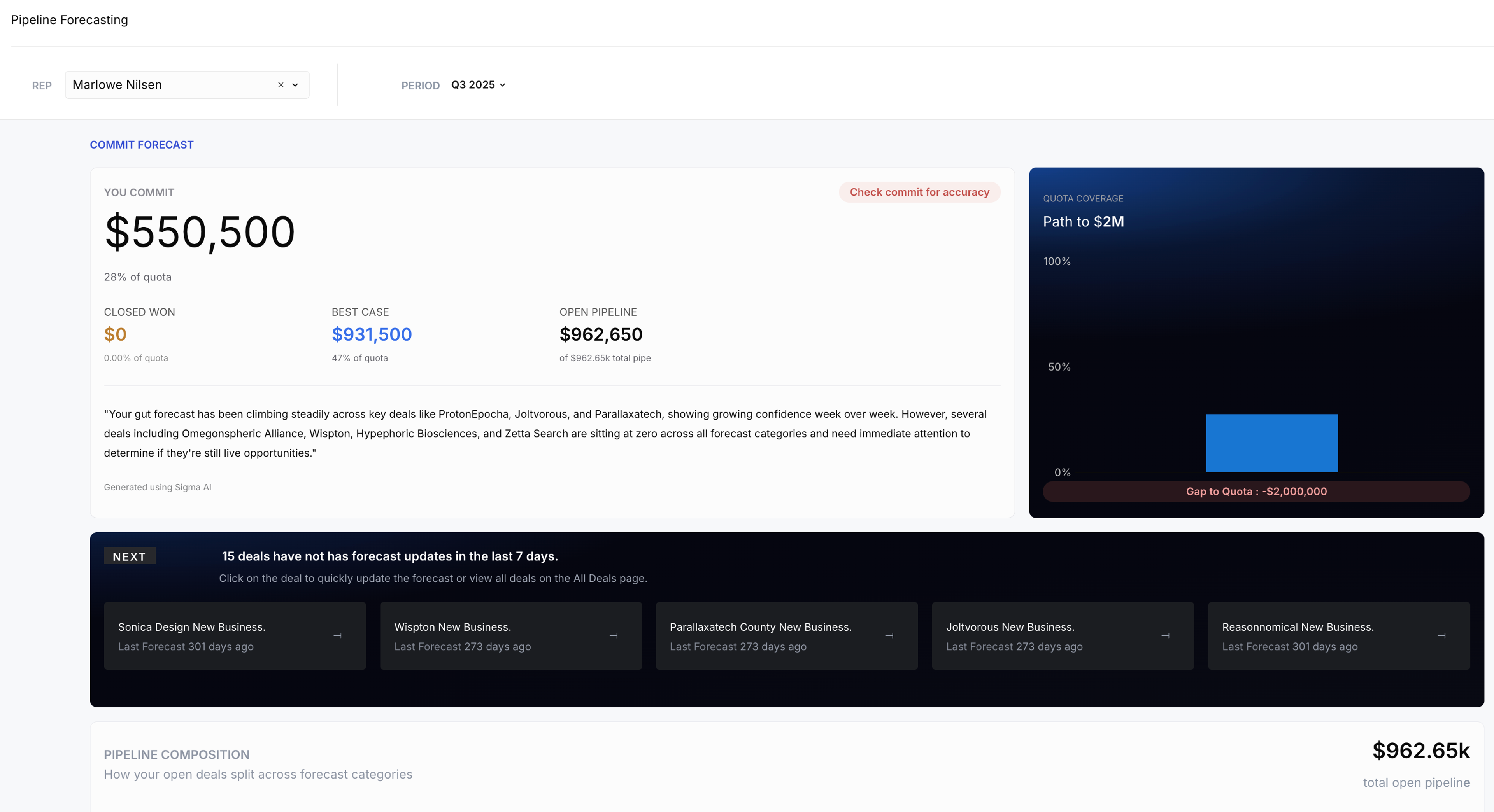
Most BI tools stop at the dashboard. Sigma keeps going, turning the same governed data into interactive apps and agents that act.
Secure Governance
AI security must be architectural. Sigma Agents and AI Apps automatically inherit your cloud data warehouse row-level and column-level security.
Closed-loop Execution
Collapse the insight-to-action loop. Safely write governed decisions back to the warehouse via input tables and trigger enterprise workflows from one environment.
Semantic Portability
Protect existing investments. Sigma natively integrates with dbt, Snowflake Semantic Views, and Databricks Unity Catalog metric views, so externally built metrics flow in without re-definition.
AI Applications
Move beyond read-only dashboards. Anyone can build interactive, no-code AI Apps that take action and write decisions directly back to your warehouse.
Sigma Agents
Turn insights into automated work. Sigma Agents read, write, and trigger external workflows while inheriting warehouse security, so every action stays auditable.
AI Ecosystem
Sigma is your OS for live data and AI. Unify external agents via MCP with warehouse LLMs and Sigma Agents for natural-language discovery, without vendor lock-in.
Three steps from Qlik to Sigma
Point Sigma at your warehouse and it rebuilds your workbooks as live, governed analytics your team already knows how to use.
- 1
Connect your warehouse
Sigma queries Snowflake, Databricks, BigQuery, or Redshift live, so nothing gets extracted and no data leaves your warehouse.
- 2
Auto-convert your Qlik dashboards
Sigma’s migration tooling rebuilds your Qlik content as live workbooks, carrying over the calculations, layouts, and filters.
- 3
Explore and extend
Anyone who knows a spreadsheet can explore, write back, and build AI Apps on top, with row- and column-level security inherited from your warehouse.
Sigma is the enterprise leader in self-service analytics and business intelligence
As of June 30, 2026 · Trusted by 2,000+ leading enterprises around the world
Capability

Qlik
Spreadsheet Interface
Spreadsheet UI uses familiar formulas, so adoption is fast with minimal training.
No spreadsheet interface; steep learning curve.
Cloud-Native Performance
Built for the cloud; runs live queries on trillions of rows with no extracts.
Qlik Cloud scales at low data volumes, but larger datasets require more RAM per app, leading to higher costs and hard technical limits.
Live Data Sources
Direct, real-time queries from cloud data warehouses.
Supports live connections with heavy limitations; most deployments rely on extracts and scheduled reloads.
Write-back
Write data back to the warehouse directly from the UI.
No native support; requires third-party extensions or custom development.
Data Models
GUI-based semantic layer for governed access.
Proprietary associative data model requires significant time and technical effort to learn.
Embedded Analytics
Full white-label, live-query embeds with interactive dashboards, write-back, and APIs. Native embed sandbox and quickstarts enable rapid deployment.
Basic iframe embedding; limited customization, no native live querying or write-back.
Python Editing
Integrates Python for scripting and advanced data analysis.
No native Python editing; integrations require external servers and complex setup.
Version Control
Built-in versioning tracks changes to everything, offering full history and granular reversion.
Lacks native version control in Qlik Cloud; admins must rely on 3rd-party systems, APIs, or Qlik Automate.
Qlik
Spreadsheet UI uses familiar formulas, so adoption is fast with minimal training.
No spreadsheet interface; steep learning curve.
Built for the cloud; runs live queries on trillions of rows with no extracts.
Qlik Cloud scales at low data volumes, but larger datasets require more RAM per app, leading to higher costs and hard technical limits.
Direct, real-time queries from cloud data warehouses.
Supports live connections with heavy limitations; most deployments rely on extracts and scheduled reloads.
Write data back to the warehouse directly from the UI.
No native support; requires third-party extensions or custom development.
GUI-based semantic layer for governed access.
Proprietary associative data model requires significant time and technical effort to learn.
Full white-label, live-query embeds with interactive dashboards, write-back, and APIs. Native embed sandbox and quickstarts enable rapid deployment.
Basic iframe embedding; limited customization, no native live querying or write-back.
Integrates Python for scripting and advanced data analysis.
No native Python editing; integrations require external servers and complex setup.
Built-in versioning tracks changes to everything, offering full history and granular reversion.
Lacks native version control in Qlik Cloud; admins must rely on 3rd-party systems, APIs, or Qlik Automate.
Comparison based on publicly available product capabilities as of June 30, 2026.
“The best and possibly last BI tool you will ever need”
Director of Data and Analytics
500M–1B USD Company, Banking Industry
 Verified review on G2
Schedule a live 30-minute demo
See your own Qlik dashboards rebuilt as live, governed Sigma workbooks in a 30-minute walkthrough on your data.